
The Cozy Cottagecore Mug Ritual (and Why It Matters More Than the Mug)
A cozy cottagecore mug is not, in the end, about the mug. It is about the five minutes you give yourself before the day starts asking things of you: the kettle, the window light, the small sound of a spoon against ceramic. You can buy the prettiest mushroom-glazed mug on the internet and still skip the ritual entirely, and you can drink from a chipped mug you have owned for a decade and have the ritual down perfectly. This piece is about the ritual first and the mug second, because that order is the whole secret. Get the order right, and almost any soft, well-shaped mug will do the rest of the work for you.
A cozy cottagecore mug is never really about the mug
Search for a cottagecore mug online and you mostly find the same thing: a product photo on a white background, a price, and a shipping estimate. Nothing about why anyone wants one in the first place. That gap says something true about how the aesthetic gets sold back to people. It gets treated as a look to collect rather than a feeling to build, so the mug becomes one more small object competing for shelf space instead of the thing that actually starts your day well.
What the aesthetic is really pointing at is slower than a purchase. Cottagecore, at its center, is a rebellion against the rushed version of life: the commute-coffee-in-a-lid version where a drink is fuel, not a moment. A mug is simply the object best suited to carry that rebellion into an ordinary Tuesday, because unlike a cottage, a garden, or a whole slower way of living, a mug is something almost anyone can actually have.
That is why the mug matters less than people think, and the five minutes around it matter more. The nicest mug in the world sitting in a cabinet does nothing. A plain one, used the same deliberate way every morning, becomes the thing you look forward to. The rest of this guide is about building that five minutes properly, and only then about the mug itself, its shape, its glaze, its motif, because a cozy cottagecore mug earns the name through use, not through how it photographs on a shelf.
Building a five-minute morning ritual around it
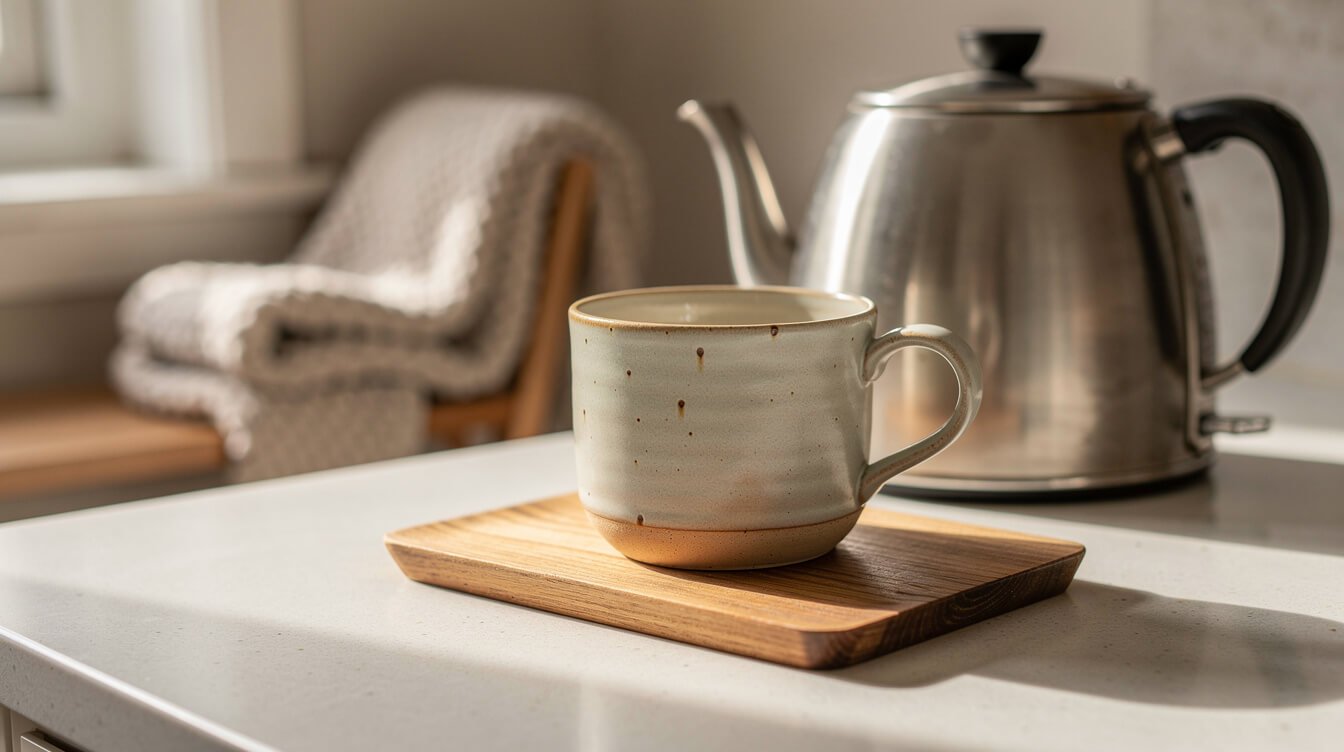
A ritual does not need to be elaborate to work. It needs to be repeatable, and it needs to ask nothing complicated of you at seven in the morning. Start the night before: set the kettle out, choose the mug, leave both somewhere you will see them before you see your phone. That one small act of preparation is doing more work than it looks like, because it removes the only decision that could derail the morning of, which mug, which tea, where is the kettle.
In the morning, the order matters. Boil the water first, and while it heats, do nothing that opens a screen. Look out the window. Stretch. Fold yesterday’s blanket back into place. The kettle gives you roughly three unstructured minutes, and those three minutes, not the drink itself, are the actual ritual. The mug is simply the reason you are standing still.
Pour, then sit somewhere specific. A ritual that happens standing at the counter while you scroll is not a ritual, it is a pit stop. Choose one chair, one spot on the windowsill, one corner of the couch, and let that place become associated with the mug over time. Consistency of location does more for a ritual’s staying power than any object in it.
Hold off on the first sip until it has cooled slightly and you have taken one full breath without doing anything else. That pause, more than the tea or the mug or the light, is the whole point. Five minutes, no phone, same chair, same mug. It works because it is boring in the best sense: nothing to plan, nothing to get right, just a small repeated thing that belongs entirely to you before the day claims the rest.
Weekdays and weekends will not look identical, and that is fine. On a rushed weekday the ritual might shrink to three minutes standing at the counter with the phone genuinely out of reach in another room. On a slower Saturday it can stretch to fifteen, with the second cup poured before the first has even cooled. What stays constant across both versions is the order of operations, kettle first, screen last, sit down before the first sip, not the exact number of minutes on the clock.
What makes a mug actually read as cottagecore
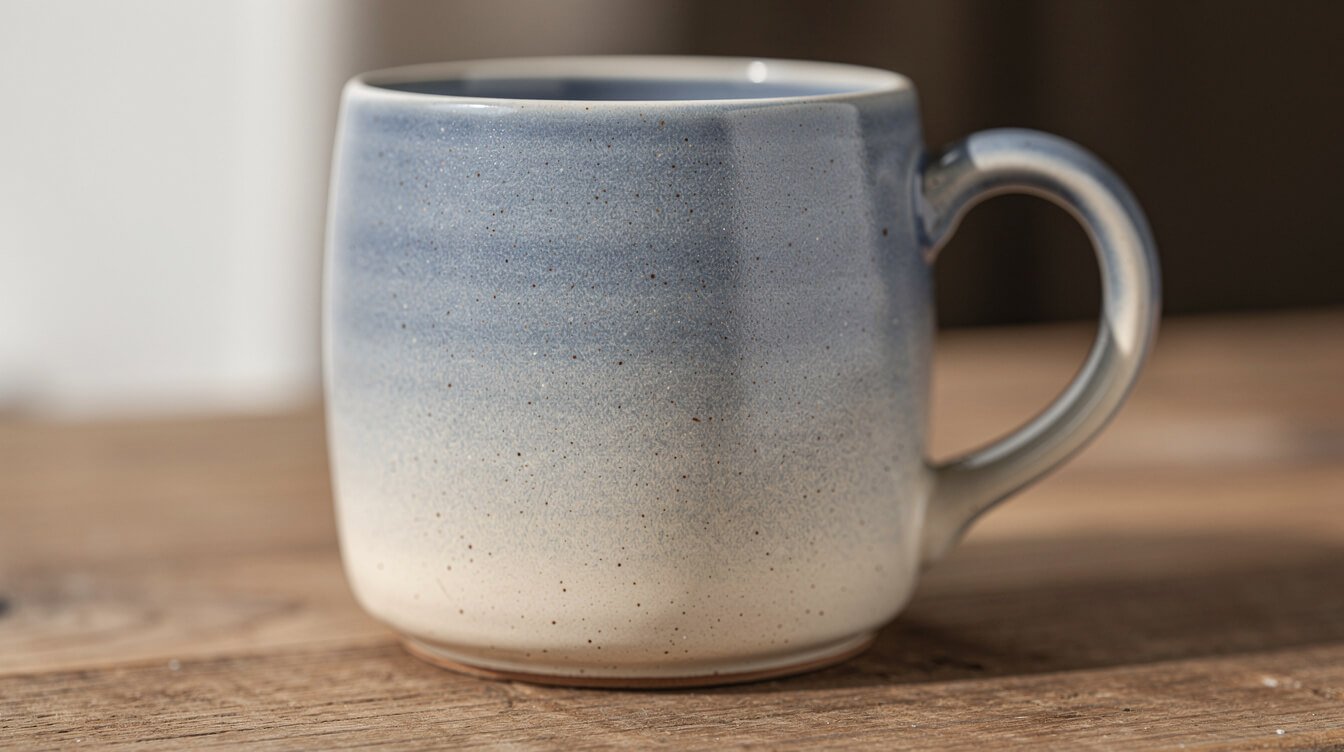
Once the ritual is in place, the mug itself is worth choosing with a little care, mostly for how it reads rather than how it performs. Shape comes first. Cottagecore favors rounded, slightly heavy stoneware over the thin, straight-sided mugs common in office kitchens. A gentle curve in the body and a handle with real room for your fingers both signal handmade rather than mass produced, even when the mug is neither.
Glaze does more than color does. Matte and semi-matte finishes read as cottagecore far more reliably than high-gloss ones, because gloss reads modern and matte reads farmhouse. Speckled, reactive, or slightly uneven glazes in sage, cream, rust, or dusty blue are the aesthetic’s home palette, the sort of colors that look like they came from a dye garden rather than a color chart.
Motif is the part people notice first and should weigh last. Mushrooms, pressed botanicals, tiny gingham checks, and small round animals are the recognizable cottagecore vocabulary, but a plain, well-shaped mug in the right glaze will out-cottagecore a busy printed one every time. If you are choosing between a loud pattern in the wrong shape and a quiet, unglazed rim in the right one, choose the quiet mug. The aesthetic rewards restraint far more than it rewards decoration.
For the fuller mechanics of picking a mug that will actually hold up to years of daily use, thickness, handle stress points, dishwasher safety and the like, our guide to choosing a cute mug that lasts covers that ground properly. This section is only about how a mug reads, not how it wears.
Pairing it with tea, not coffee culture

Coffee culture, for all its charm, is built around speed. Espresso is measured in seconds. A pour-over is a small performance timed to the minute. Even a slow Sunday coffee tends to borrow the vocabulary of the cafe, and cafes exist to move people through quickly. None of that is wrong, it is just built for a different pace than a cottagecore morning is reaching for.
Tea, especially loose leaf tea, has a built-in pause that coffee mostly does not. Steeping takes three to five minutes no matter how impatient you are, and that waiting is not a delay, it is the ritual doing its job. Chamomile, rooibos, and lightly floral green teas all sit comfortably in a cottagecore morning, and a honey stir at the end gives the hands something small and unhurried to do while the tea cools.
This is not an argument against coffee. A slow-poured coffee, drunk seated and undistracted, does the same work as tea. The real contrast is not the drink, it is the pace, cafe efficiency against unhurried steeping, and a cottagecore mug tends to ask for whichever drink lets you wait a little before the first sip. If coffee is what you love, let the kettle boil for a French press instead of reaching for a pod, and give yourself the same three minutes of waiting.
If you are choosing a tea to keep on hand specifically for this ritual, lean toward blends that reward the wait rather than fighting it. Chamomile with a little dried apple reads soft and unhurried. Rooibos with vanilla has enough body to feel substantial without the caffeine jolt that can make sitting still feel harder, not easier. A loose leaf over a bag also gives your hands one more small, unhurried task, measuring a spoonful into an infuser, that a bag skips straight past.
Mug, book, and blanket: building a small scene

A ritual grows sturdier when it has a physical setting instead of floating in whatever room you happen to be standing in. The classic cottagecore trio, a mug, a book, and a blanket, works because each object invites the same kind of stillness the others do. None of them are fast objects. You cannot rush a page, a blanket, or a mug of something too hot to gulp.
Pick one chair near natural light and let it slowly become “the” chair. Keep a soft throw folded over the arm so it is never a decision to reach for it. Keep whatever you are reading, even if it is only two pages a morning, on the side table rather than shelved away where it takes effort to retrieve. The goal is to remove every small obstacle between you and five quiet minutes, because obstacles are exactly what a rushed morning uses as an excuse to skip the ritual entirely.
A candle, unlit most mornings but present, does something similar. Its job is not to be burned every day, it is to make the corner feel considered rather than incidental. A small scene like this, chair, blanket, book, mug, unlit candle, turns an ordinary corner of a room into a place your body recognizes as the slow part of the day, which makes the ritual easier to return to than if it depended on willpower alone.
Gifting the ritual, not just the cozy cottagecore mug
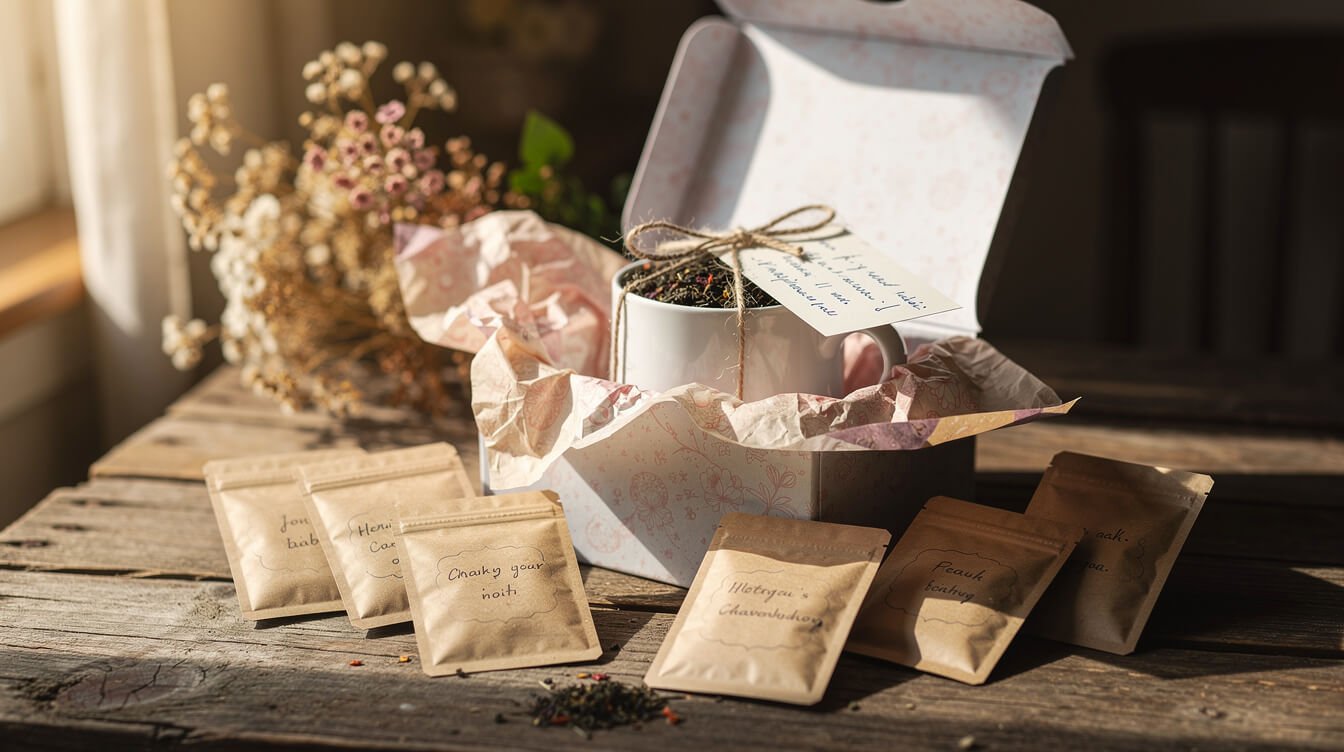
The mistake most gift givers make is handing over the object and assuming the ritual comes with it. It does not. A mug alone, however pretty, is a mug alone. What actually lands is the whole small scene, handed over together: the mug, a few sachets of a specific loose leaf tea, and a short note describing the five-minute version of the morning you are hoping they will build.
Keep the note practical rather than sentimental. Something like “steep three minutes, no phone until the first sip” gives the ritual instructions, not just a wish. That small nudge is often the difference between a mug that gets used once and a ritual that actually sticks, because most people need permission, not inspiration, to protect five minutes of their own morning.
If you are shopping specifically for this kind of gift, our cottagecore gift ideas guide has more objects that pair naturally into a small scene like this one, and the cozy gifts guide walks through building a fuller gift basket around the same idea if a single mug feels like too little. Either way, the rule holds: gift the ritual, and let the mug be the smallest part of it.
This also solves the usual gifting problem of not knowing someone’s taste precisely enough to pick the right mug. A ritual is far more forgiving than an object. Even a recipient who would not have chosen that exact glaze or motif for themselves can still take the instructions and build the five minutes around whatever mug they already own, which means the gift lands even when your guess at their taste does not.
A few favorite cottagecore mug details worth looking for
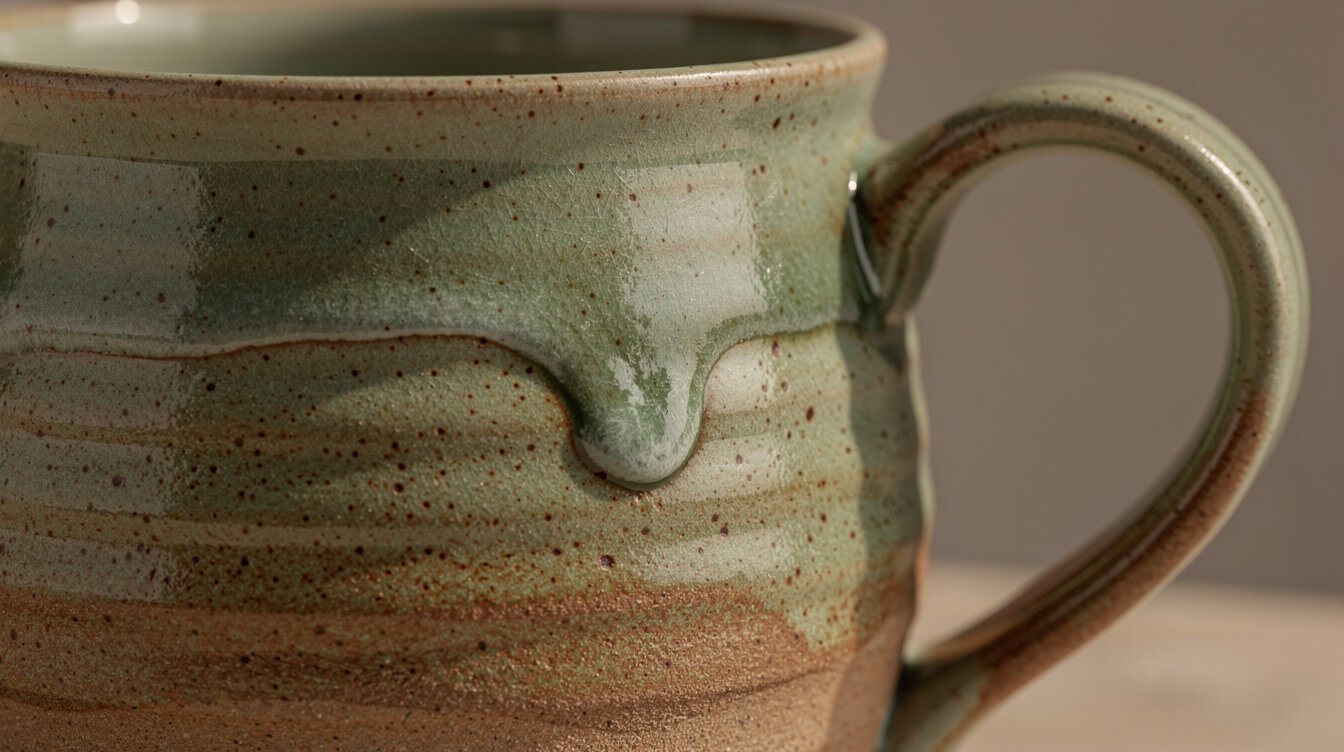
A weighty base that will not tip easily on a nightstand or a windowsill ledge. A handle wide enough for two fingers, since a cramped handle turns a slow sip into an awkward grip. A rim that stays comfortably cool to the touch even when the tea inside is not, which matters more than it sounds like it would during a five-minute ritual where you are meant to be relaxed, not careful.
Reactive glazes, the kind that shift slightly in tone from one mug to the next, tend to feel more considered than a flat, uniform color, because no two are exactly alike. A slightly irregular rim or a visible thumbprint in the glaze is a feature here, not a flaw, since it reads as handmade even on mugs that were not.
If cottagecore’s seasonal cousin is more your speed, our cute Christmas mugs guide covers the holiday version of the same idea, gifting a whole small ritual instead of a single object. And if you are still deciding whether the aesthetic is for you at all, what cottagecore actually means is the right place to start.
Frequently asked questions about a cozy cottagecore mug ritual
Do I need an expensive handmade mug to do this right?
No. A plain, well-shaped mug used the same deliberate way every morning outperforms an expensive one used carelessly. The ritual is what makes it cottagecore, not the price.
How long should the ritual actually take?
Five minutes is the target, and three still counts on a rushed day. The important part is the phone staying away and the sitting down, not the clock.
What if mornings are too chaotic for a ritual like this?
Move it to whichever part of the day is actually quiet. An evening tea in the same mug, same chair, works just as well. The principle is the pause, not the hour on the clock.
Is tea required, or does coffee work too?
Coffee works fine as long as it is slow-poured and unhurried. The contrast in this guide is with fast coffee-culture habits, not with coffee itself.
What is the easiest way to start if I own nothing cottagecore yet?
Start with the ritual, not the shopping. Use whatever mug you already own tomorrow morning, sit in one chair, and skip the phone for five minutes. Add the aesthetic later.
Can this work in a small apartment with no reading nook?
Yes. The scene only needs one consistent spot, a corner of a couch, a windowsill wide enough for a mug, even the edge of a bed. Size of the space matters far less than repetition of the spot.
How do I keep a new ritual from quietly fading out after a week?
Anchor it to something you already do without fail, like boiling water or getting dressed, rather than treating it as an extra task competing for willpower. Rituals that attach to an existing habit tend to survive. Ones that float on their own tend to disappear by the second busy week.
Final thoughts
A cozy cottagecore mug earns its name through five quiet minutes, repeated, far more than through glaze or motif. Choose one chair, one mug, one small drink you actually enjoy waiting for, and let the object be the smallest part of the ritual rather than the whole point of it. Do that consistently, and almost any mug in the cupboard starts to feel like the right one.
If this kind of small, considered morning is your language, our cozy gifts guide has more ideas built around the same idea, or you can browse the shop for a soft little something of your own.