The peacock jumping spider: why a spider the size of a grain of rice dances in color
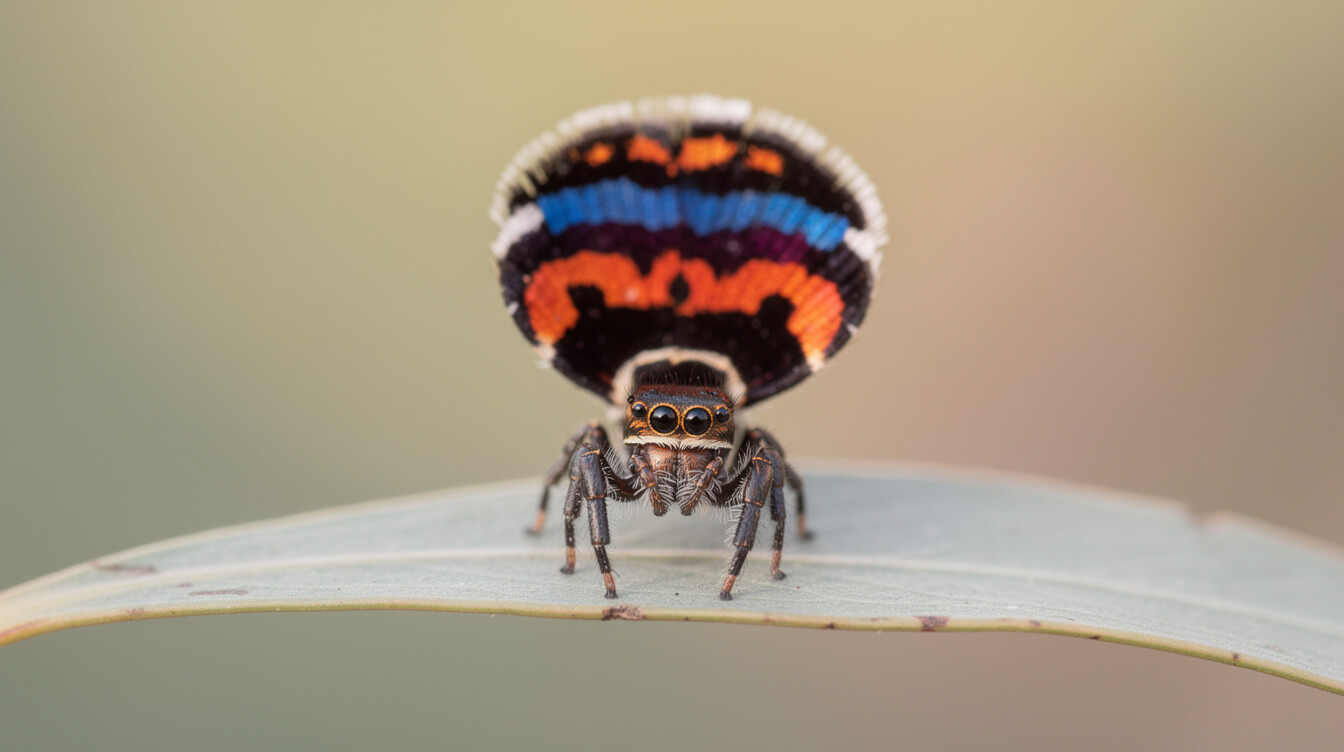
The peacock jumping spider is about the size of a grain of rice, and it carries a painted fan on its back. When a male finds a female, he lifts that fan like a small stage curtain, raises two striped legs over his head, and dances for her, sometimes for most of an hour. If you have watched one of those videos and thought, how is something that small allowed to be that bright, you are asking exactly the right question.
This is a gentle guide to the peacock spider for people who are not scientists and do not need to become one. We will cover what it is, how the dance actually works, where the color comes from (it is stranger and lovelier than paint), why the female is the one in charge, and whether you could ever meet one. No scary close-ups of fangs, we promise. Mostly sparkle.
What is a peacock jumping spider?
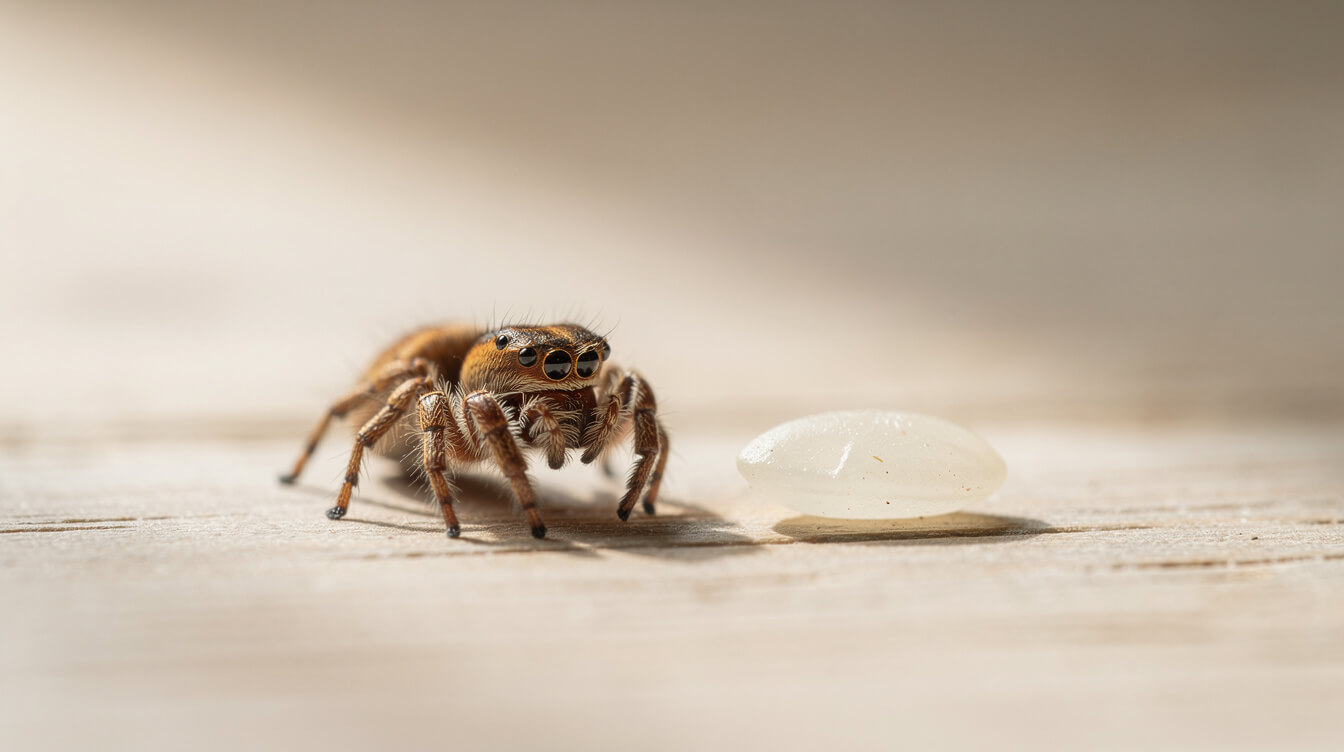
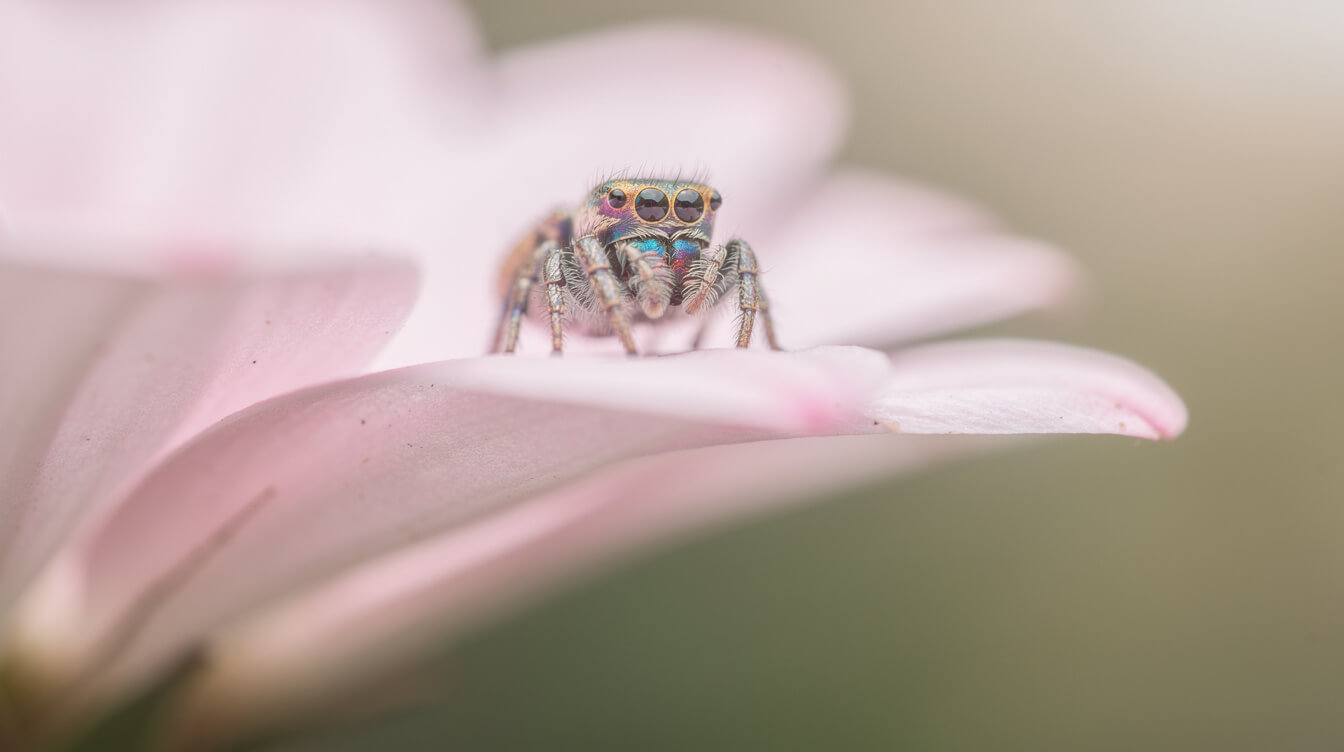
A peacock jumping spider is any member of Maratus, a genus of jumping spiders that lives in Australia. People usually shorten the name to peacock spider, and both names point at the same little animals. There are more than 100 known species, and new ones are still being described, many of them from small pockets of bush in the south and west of the country.
They are jumping spiders, so they belong to the same big friendly family as the bold jumper on an American windowsill. If you want the wider family tree, our guide to the cutest jumping spider species walks through the regal jumper, the zebra jumper, and a few other favorites. The peacock spiders are the family’s show-offs.
How small is small?
Most peacock spiders measure about 4 to 5 millimeters long, and a few species are smaller still. In everyday terms:
- About the length of one grain of uncooked rice.
- Small enough to stand on the nail of your little finger with room to spare.
- Light enough that a male weighs only a couple of milligrams, roughly the weight of a few grains of sugar.
This is why so many people go years in Australia without noticing one. They live low, in leaf litter, grass, and shrubs, and they move in quick little hops that read as a speck of dust unless you are looking closely.
Only the boys are dressed up
Here is the first surprise. The bright colors belong almost entirely to adult males. Females and young spiders of both sexes are brown, cream, and mottled, which is perfect camouflage on dry leaves. The color is not for hiding or for warning predators. It is for one audience only, and she is wearing brown.
The dance, step by step: the fan, the legs, and the drumming
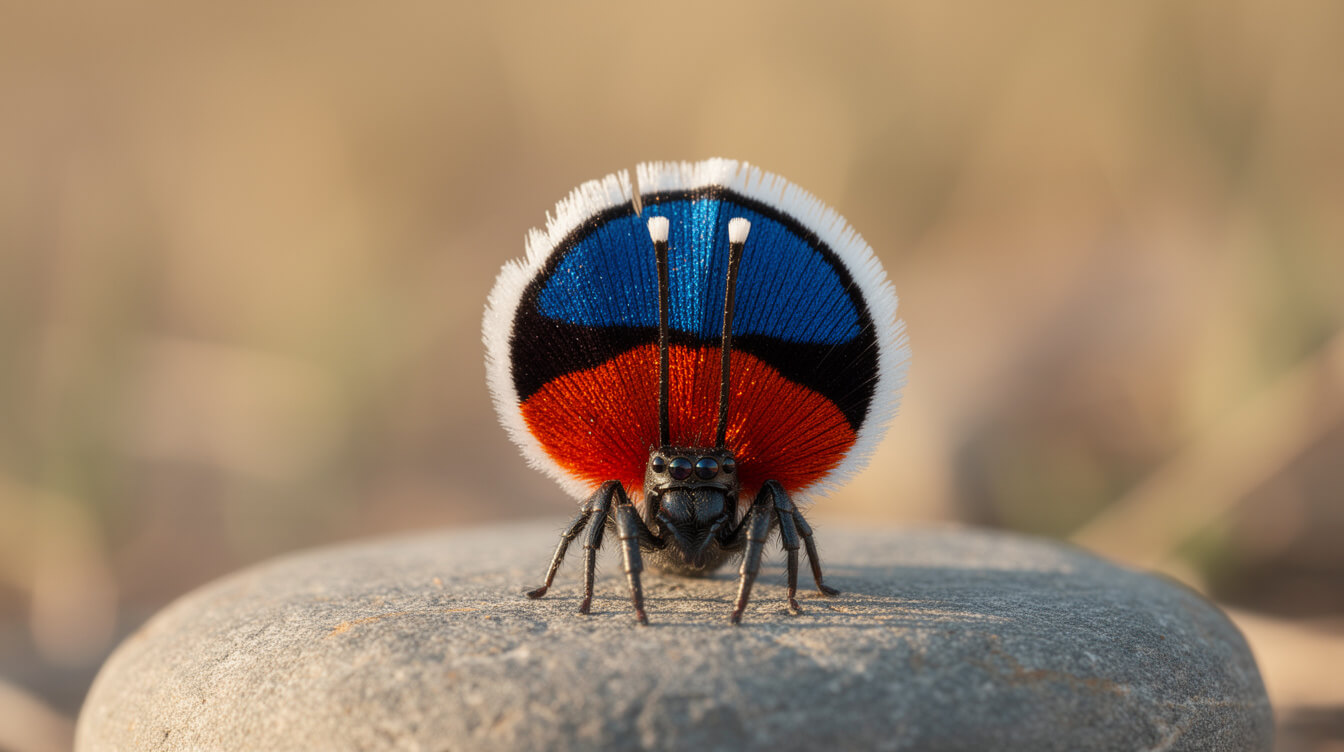
The courtship of a peacock jumping spider is one of the most elaborate displays in the animal world, which is a lot to say about something you could lose under a coin. It is not one move. It is a routine, and researchers who study it have broken it down into parts that happen in a fairly reliable order.
1. Finding her
Before he ever sees her, a male can pick up a female’s trail. Females leave fine silk drag lines as they walk, and those lines carry chemical signals. A male tracks them with his feet and palps, and he can start courting behavior from the scent alone. Once he actually spots her, the real show begins.
2. Raising the fan
The male lifts his abdomen upright behind him and unfolds flaps along its sides, so the top of his abdomen opens into a round, fringed disc of color. In many species it is a pattern of red, orange, blue, and black, edged in white hairs. It looks a little like a tiny painted shield, or a peacock’s tail if the peacock were the size of a sesame seed.
3. The third legs
At the same time, he raises his third pair of legs high over his body. In many species these legs are longer than the others and decorated with black brushes and white tips. He waves them, taps them, and sometimes claps them together, like someone signaling across a crowded room.
4. The side-to-side shuffle
With fan up and legs high, he dances from side to side, swinging the fan and stepping sideways in little arcs, always keeping himself in her line of sight. Slowly, over many minutes, he works his way closer.
5. The drumming you cannot hear
The part that videos usually miss is the sound. While he dances, the male vibrates his abdomen against the ground, sending tiny buzzes through the leaf or twig they are both standing on. She feels them through her legs. Researchers who recorded these signals gave them wonderful names: rumble-rumps, crunch-rolls, and grind-revs. The rumble-rumps run through most of the courtship, and the crunch-rolls and grind-revs come near the end.
6. The final approach
If she has not left, he lowers his body almost to the ground, folds the fan away, and switches to a very precise closing routine with his legs stretched forward toward her. Then he moves in. The whole performance usually lasts around twenty minutes, and it can run anywhere from a few minutes to close to an hour.
How a spider that tiny makes color that bright
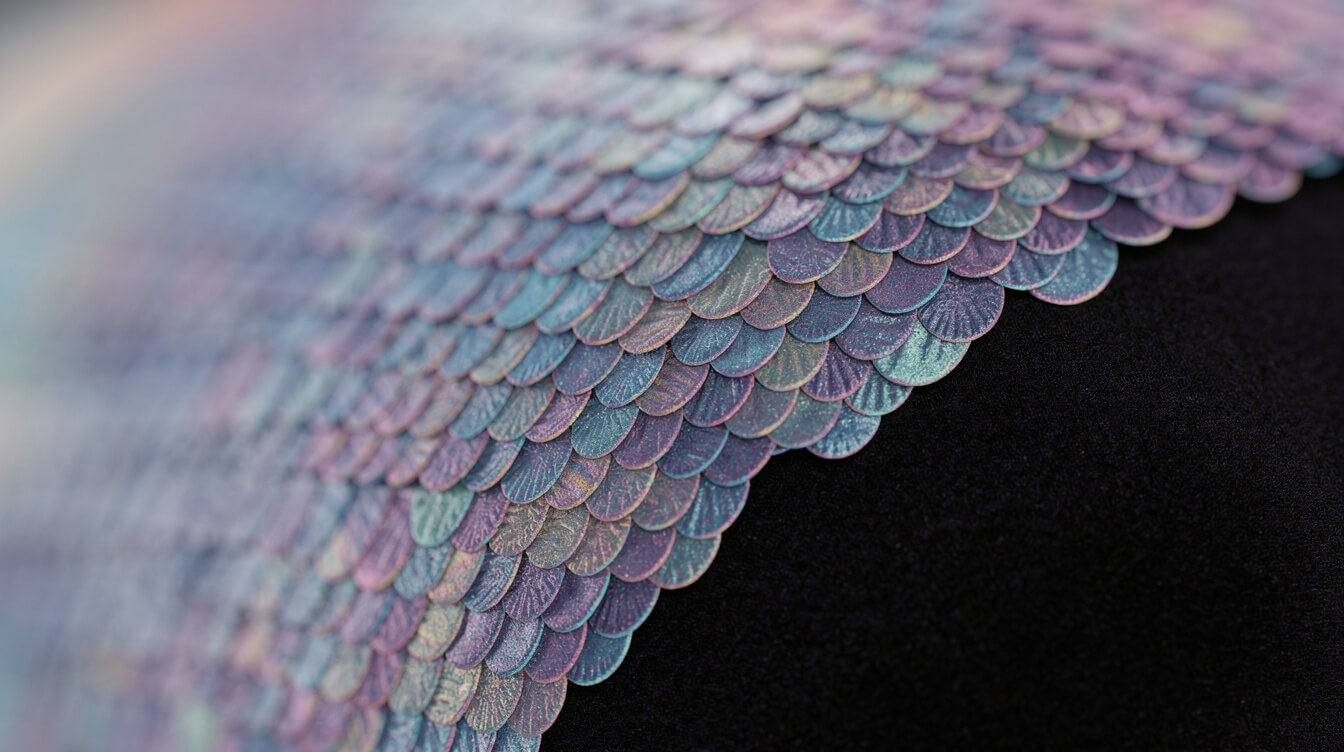
This is the question that sends people down the rabbit hole, and the answer is genuinely beautiful. Most of a peacock spider’s color is not made the way a crayon is made. A lot of it is made with shape.
Some colors are pigment
The fan is covered in tiny scales, which are flattened, modified hairs. Some of those scales hold pigment, and pigment is where many of the reds, whites, and creams come from. That part works the way most animal color does: a chemical in the scale absorbs some light and bounces back the rest.
The blues are made of structure
The blues are different. Researchers who studied the splendid peacock spider found that its blue scales contain arrays of incredibly fine structures, much smaller than a wavelength of light. Those structures reflect blue light and let other colors pass, so the blue comes from the architecture of the scale rather than any blue chemical. This kind of color is called structural color. It is the same family of trick that makes a soap bubble shimmer, and it does not fade the way pigment can.
A rainbow on a single scale
A couple of very small species take it even further. In a 2017 study, a team looked at two peacock spiders whose fans shimmer through a whole rainbow as they move. Each scale turned out to be curved like a tiny airplane wing and lined with ridges so fine that they split white light into its colors, a little like the shine on the back of a CD. The researchers were interested enough to suggest the design could inspire new miniature optics. A spider the length of a rice grain, quietly teaching engineers about lenses.
Super black, so the colors pop
Then there is the black. Some peacock spiders have velvety black patches right next to their brightest colors. A 2019 study found that these patches are covered in scales shaped into microscopic bumps that trap light, so they reflect only a tiny fraction of what hits them. It is called super black, and it belongs in the same class as the deep black feathers of birds of paradise, which use a similar idea. The black frames the color the way a dark gallery wall frames a painting, so the orange and blue look almost lit from within.
Put all three together and you get something remarkable: pigment, structure, and darkness, arranged on a disc a few millimeters wide, designed by a long history of picky females.
What the female is looking for, and why she is the one who decides
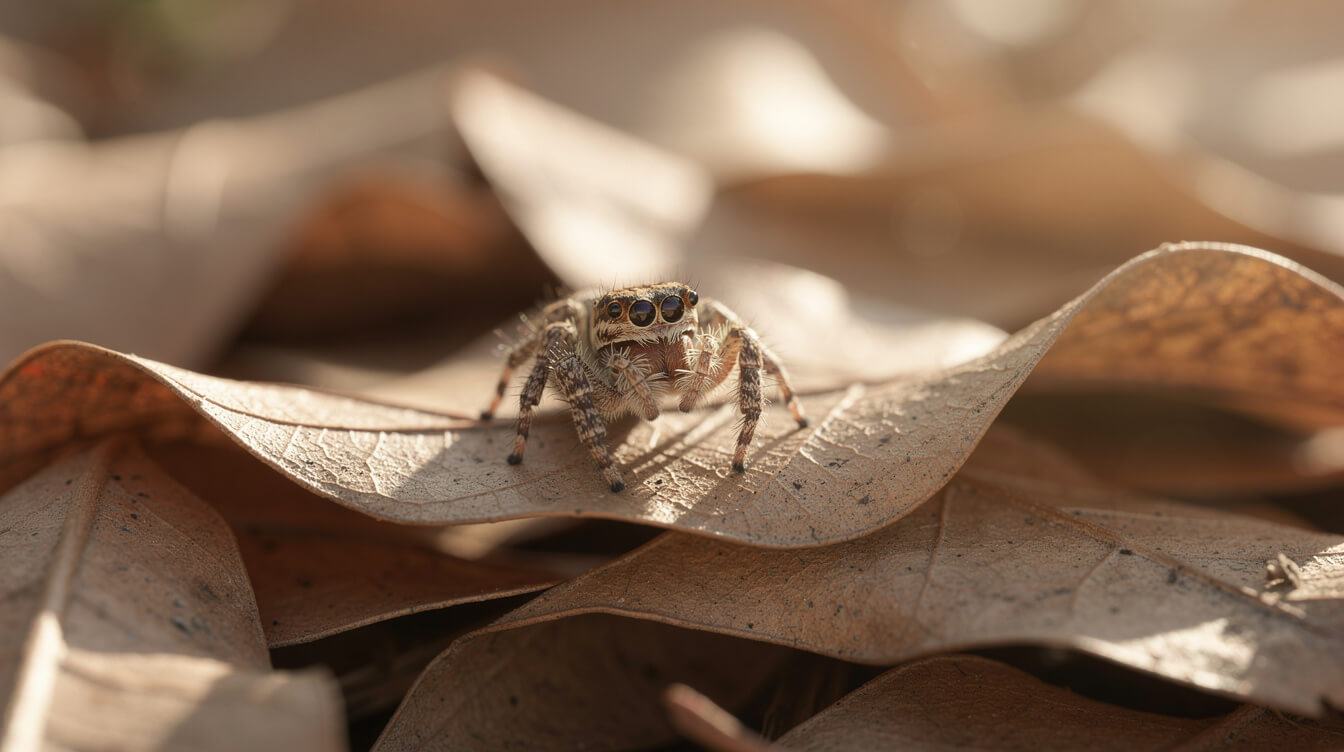
It is easy to watch the male and miss the real main character. The female is the reason any of this exists. She watches, she feels, and she chooses, and in peacock spiders her choice has real stakes.
She is judging effort
Studies of courting peacock spiders found that males who put more into the display, more time dancing, more vigorous vibrations, staying close and keeping her in view, tend to have more success. Both the visual show and the vibrations matter, but the visual side seems to count most. The working idea is that a long, energetic dance is hard to fake, so it tells her something honest about how healthy he is.
Jumping spiders are famous for their eyesight, which is why a dance this visual works at all. If you want to know more about how they look at the world, and at us, our piece on whether jumping spiders are friendly covers what that attentive little stare really means.
She can say yes, or very clearly no
A female who is interested may answer him, signaling back with her own third legs. A female who is not interested has her own body language, a kind of polite but firm stop sign. Females of at least some species seem to mate only once, so a female who has already mated tends to be much less patient with a new suitor.
And if he does not listen
Here is where it stops being purely sweet. If a male keeps dancing after she has signaled no, she may lunge at him, and in some cases she will catch and eat him. Observers more often describe headbutts and chases, with the male bouncing away unhurt, but the risk is real. That risk is part of why the signals exist at all: a clear no saves him from wasting energy, and it ends a bright, wiggling show that might also attract a predator to both of them.
It also explains a fun finding from 2025. Researchers filming peacock spider jumps found the males have the fastest acceleration ever measured in a jumping spider, and they leap at a steeper angle than females do. One likely reason is the obvious one. When your date might eat you, a very good exit matters.
The cutemerch letter
A small good thing, once a week
One short, kind email with our coziest posts and new round animals from the shop. No spam. Unsubscribe anytime.
Is a peacock jumping spider dangerous, rare, or a pet?
These are the questions people search for most, so here are honest answers.
Is it dangerous?
No. A peacock jumping spider is harmless to people. Like almost all spiders it has venom for its prey, which is mostly tiny flies and other small insects, but its fangs are far too small to matter to a human. They are also shy of us, and the most likely response to a big hand is a quick hop away.
Is it rare?
It depends on the species. Some peacock spiders are fairly common in the right places, including bushland and even gardens around cities like Sydney. Others are known from a single small area and only a handful of sightings. The genus as a whole is not rare so much as overlooked. They are tiny, they live low, and most of the color only shows when a male is dancing.
Can you keep one as a pet?
Not in the US, practically speaking. Every species lives in Australia, and Australia tightly restricts the export of its live native wildlife, so peacock spiders are not part of the pet trade abroad. Even in Australia, the few specialists who breed them describe them as delicate and demanding to keep. The kindest way to love a peacock spider is in the wild, on video, or in photographs.
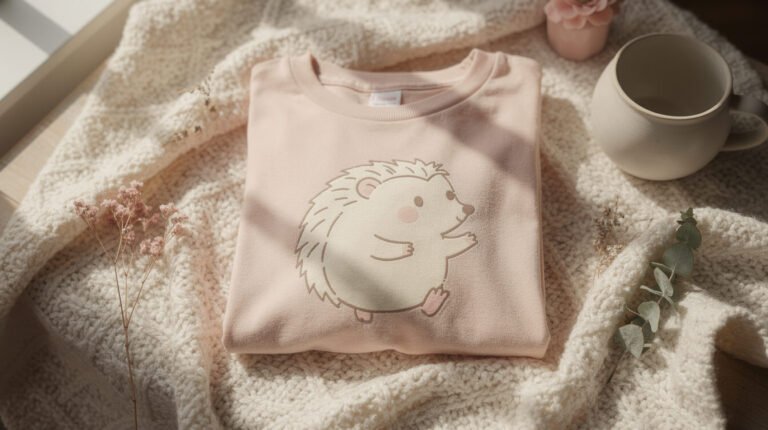
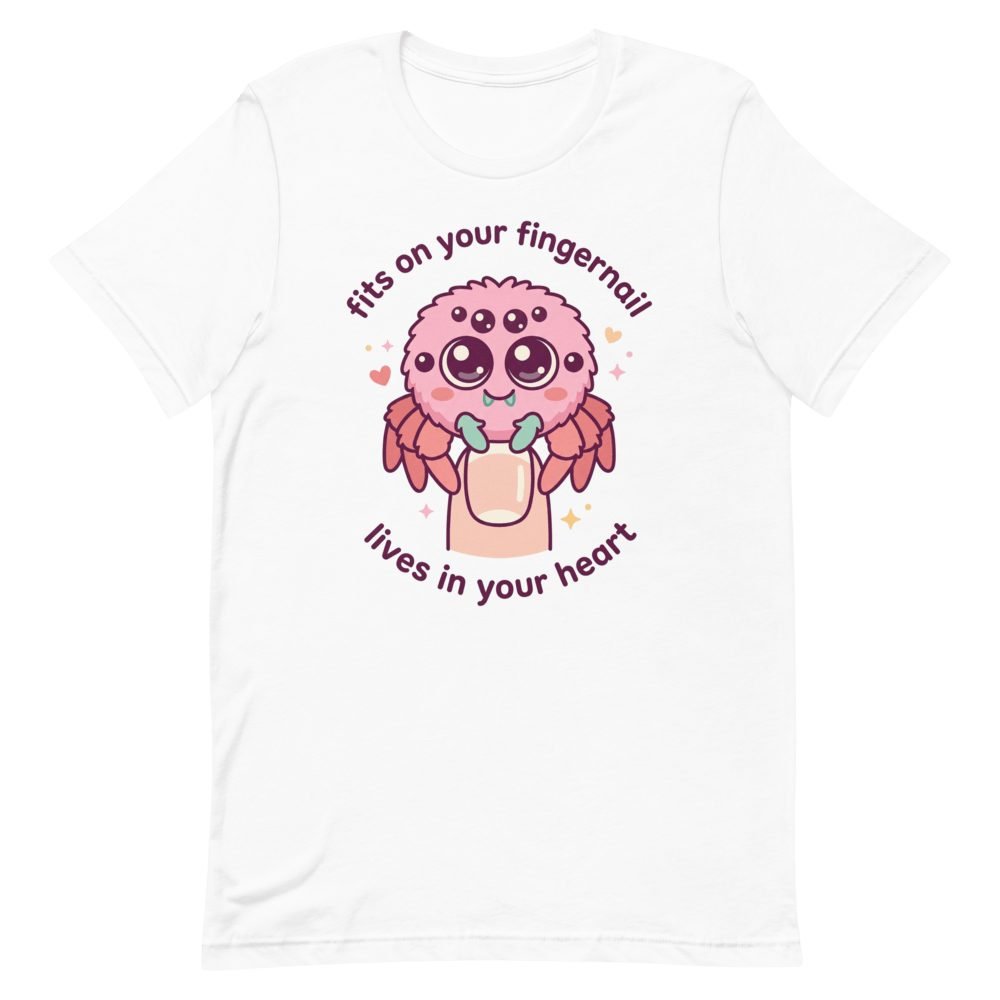
If you would like a small one of your own anyway, ours is made of cotton. The Fits On Your Fingernail Cute Jumping Spider T-Shirt is a soft pink peacock spider, fan spread, perched on a fingertip, which is close to life size if you squint. It needs no enclosure and will never judge your dancing.
A peacock spider you can actually keep
A soft pink peacock spider, fan spread wide, sitting on a fingertip at nearly real size. For the friend who stops to look at the small things, and then sends you the video.
How to see one: photos, maps, and the people who film them

Most of us will meet peacock spiders through a screen, and that is a lovely way to do it, because some of the people filming them are the same people naming them.
Watch the dance on video
Much of what the world knows about these spiders came from close, patient macro photography. Jürgen Otto, an Australian biologist and photographer, and his colleague David Hill have described dozens of Maratus species between them, and Otto’s dance videos are the reason many people learned peacock spiders existed at all. Look for courtship footage filmed in the field rather than staged clips, and watch with the sound on if you can, since some recordings include the vibrations.
Explore the sightings map
On iNaturalist you can search the genus Maratus and see where people have photographed peacock spiders, species by species. It is a quiet, cozy way to spend an evening, scrolling through hundreds of tiny fans from gardens and road verges across southern Australia.
If you are lucky enough to be in Australia
- Go in spring. Adult males and their displays turn up mostly in the Australian spring, roughly September through December.
- Pick a sunny day. Peacock spiders are active in daylight and like warm, fine weather.
- Look low. Scan leaf litter, low shrubs, and grass at knee height or lower, and watch for movement, not color.
- Leave them where they are. Take photos, not spiders. A peacock spider’s whole life happens in a patch of ground smaller than a picnic blanket.
Frequently asked questions about the peacock jumping spider
Is a peacock spider the same as a peacock jumping spider?
Yes. Both names refer to spiders in the genus Maratus, which are jumping spiders. “Peacock spider” is just the shorter, more common version.
How many kinds of peacock spider are there?
More than 100 species have been described, and the number keeps climbing as researchers find new ones in remote patches of Australia. Each has its own fan pattern and its own version of the dance.
What is a sparklemuffin?
A real spider. Sparklemuffin is the nickname of Maratus jactatus, a red and blue peacock spider described in 2016, nicknamed by the graduate student whose team found it. A related species with white, bone-like stripes was nicknamed Skeletorus at the same time. Science is sometimes very good at names.
Do female peacock spiders have colors?
Not bright ones. Females are brown, cream, and mottled, which keeps them hidden on the ground. The fan and the dance belong to the males.
Where do peacock spiders live?
Australia, mostly in the south and southwest, in bushland, heath, grassland, and sometimes suburban gardens. They live close to the ground among leaf litter and low plants.
How long do they live?
Like many small jumping spiders, they live roughly a year, with most of that spent growing up before a short adult season of courting. For the general pattern, our post on jumping spider lifespan walks through the whole small year.
Why do people find a spider this cute?
Big eyes, a round body, a bright pattern, and a behavior that looks like effort and hope. That is a lot of the same recipe that makes us soft on round animals in general, which we wrote about in our guide to weird cute animals.
Final thoughts
The peacock jumping spider is proof that the small things are often the most elaborate. A spider the length of a rice grain carries color built from pigment, structure, and light-swallowing black, and it spends twenty careful minutes dancing for someone who might say no. It is funny, a little dramatic, and very sincere.
If you ever see one, in a video or on a leaf in the Australian spring, give it your full attention. It is, after all, giving everything it has to an audience of one.
Before you go
Want the next one in your inbox?
We write something soft every day. The best of it lands in one gentle weekly note, for you or for the friend who needs it.