
Weird Cute Animals: Why the Strangest Little Creatures Are the Ones We Love Most
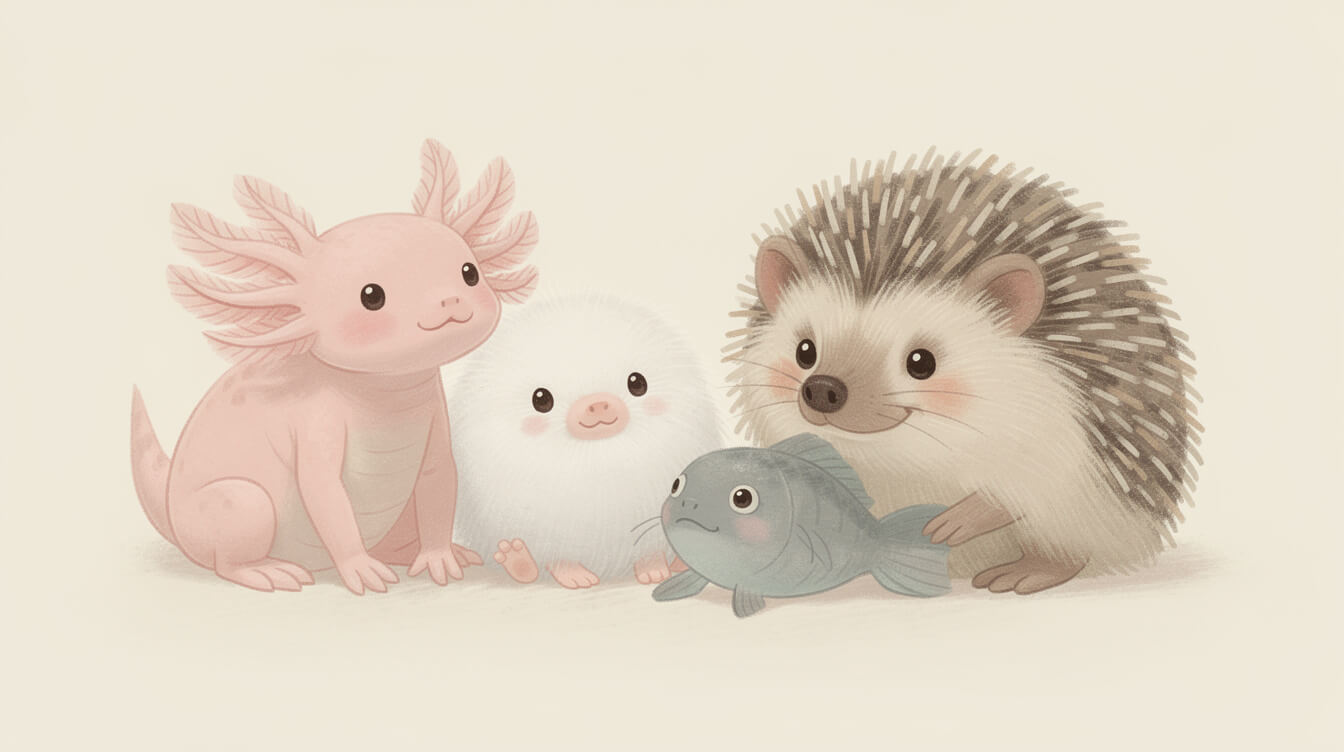
Somewhere in the last decade, the animals the internet calls cute stopped being the ones you would expect. Not the kitten in the basket. Not the puppy with one ear still deciding which way to go. The creatures people save, screenshot, send to a friend at midnight, and eventually want printed on something are stranger than that. A salamander that never grows up. A sea slug the size of a grape. A deep-sea fish that looks like it has given up on the entire day. Weird cute animals have quietly taken over the part of the internet that used to belong to conventional cuteness, and almost nobody stops to ask why that happened.
The question has a real answer, and it is considerably more interesting than another list of obscure species. There is a specific shape our brains go soft on, and it has a name. There is a specific reason oddness makes that softness stick instead of sliding off. And there is a reason the strange ones end up on a t-shirt rather than a poster. This is the thinking that sits underneath every design we draw, so we may as well lay it out properly.
Why weird cute animals took over the internet

The early internet ran on abundance. Cats were the currency because there were a lot of cats, and because a cat in a cardboard box is reliably charming to almost everyone. That worked for years. Then it stopped working, for a reason that has nothing to do with cats and everything to do with how attention behaves when something becomes common.
A picture carries information only when it tells you something you did not already have. The ten thousandth photo of a conventionally adorable kitten is lovely and completely redundant, so it slides past. A photo of a pale pink salamander with feathery external gills, grinning at nothing in particular, stops the scroll because you have no slot to file it in. The surprise does work that the sweetness alone cannot do.
You can watch this preference take shape in the kind of article that now dominates the search results for this topic. Almost all of them are built on the same promise, some version of animals you never knew existed. That phrasing is the tell. The appeal being sold is not cuteness, which was never scarce. It is discovery. The cuteness is the reason you stay, and the strangeness is the reason you clicked.
There is a supply problem underneath it too. The roster of conventionally cute animals is small and finished. Cats, dogs, rabbits, a handful of farm animals, the occasional fox. Nobody is making new ones. The long tail of odd little creatures, on the other hand, is effectively bottomless, and most of it has never been drawn kindly by anyone. For a culture that runs on novelty, that is an enormous unspent reserve.
The last piece is tone. Sincere affection for a kitten can feel a little obvious, a little pre-approved, which is exactly why people get self-conscious about it. Affection for a sea slug cannot be anything but genuine, because nobody handed it to you. That quiet protection from cynicism matters more than it sounds, and it is a large part of why weird cute animals travel so well between friends. The same thing happened to frogs a few years ago, which we got into at length in our look at why frogs became the internet’s favorite cute animal.
Baby schema, the shape our brains go soft on
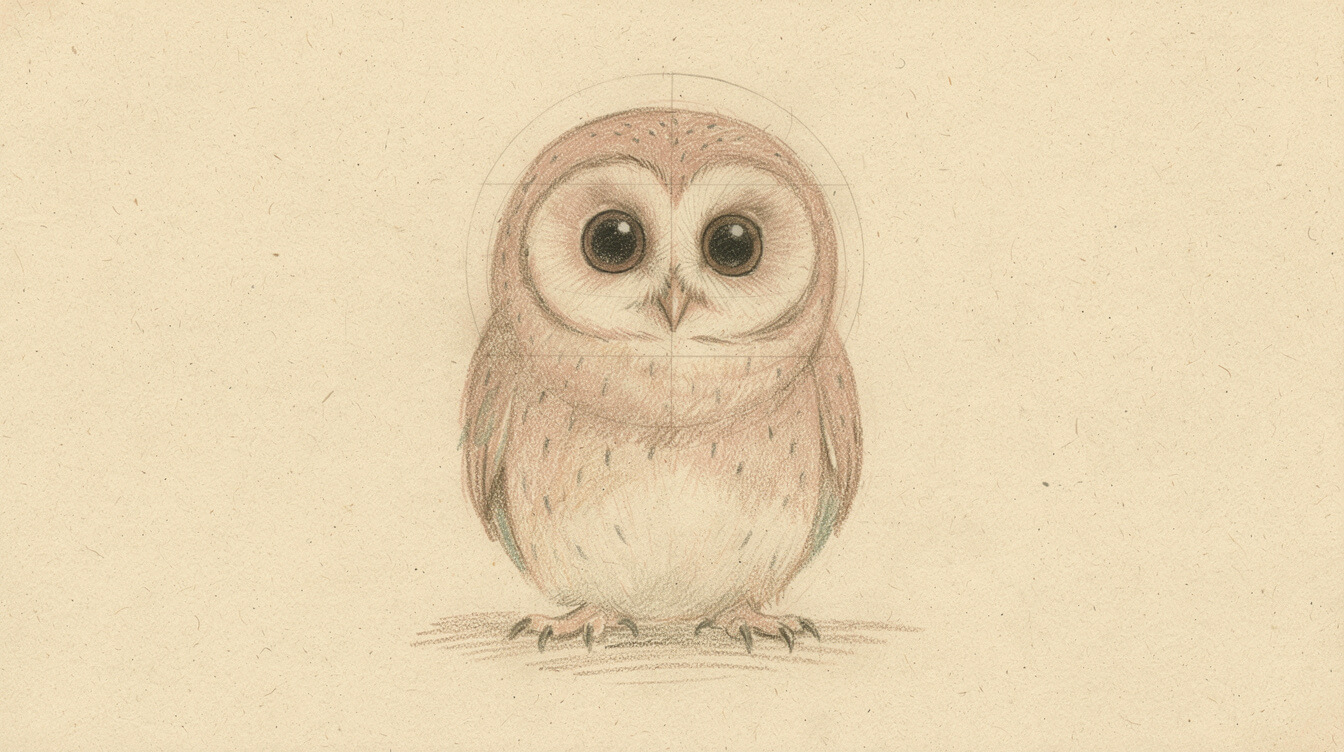
Start with the part that is not about weirdness at all, because you cannot see what oddness adds until you know what it is adding to.
In 1943, the Austrian ethologist Konrad Lorenz described something he called Kindchenschema, which translates roughly as baby schema. His observation was that the caregiving response in humans is not triggered by babies as such. It is triggered by a small cluster of visual proportions, and anything carrying enough of them gets the response whether or not it is a baby, whether or not it is human, and whether or not it is alive.
The cluster is short and surprisingly specific:
- A head that is large relative to the body
- Eyes that are large relative to the face, and set low on it
- A high, rounded forehead and a domed skull
- A small nose and a receding chin
- Round, soft body contours with no hard angles
- Short limbs and movement that is slightly unsteady
Those features are not arbitrary. They are what an actual infant looks like, for structural reasons. A baby’s brain develops early and fast, so the cranium is big before the face catches up, which pushes the eyes low and leaves the chin small. Clumsiness follows from a nervous system still learning its own equipment. Every item on the list is an honest, hard-to-fake signal of being new and needing help.
Why the response fires so easily, and so often by mistake
Here is the part that explains the whole phenomenon, and that none of the popular articles on this subject mention. The baby schema response is deliberately overtuned, and the reason is an imbalance in what mistakes cost.
If you feel a flicker of tenderness toward something that is not a baby, you have lost nothing at all. A moment of misplaced warmth at a round rock. If you fail to feel tenderness toward something that is a baby, the cost is catastrophic and permanent. When the price of a false alarm is near zero and the price of a miss is unbearable, the sensible setting is a hair trigger. So that is the setting we have.
Which is why the response leaks everywhere. It is why cars with large round headlights set low on the hood read as friendly, why a teapot can look apologetic, and why a mossy stone with two pale spots on it can stop you in a forest. We are not being sentimental when this happens. We are running a very old detector that would rather be wrong a thousand times than wrong once in the other direction.
This is also where baby schema reaches its limit, and the limit is the actual subject of this piece. Baby schema explains why round and big-eyed reads as cute. It does not explain why strange reads as cute, and it certainly does not explain why a sea slug outperforms a kitten. For that you need a second idea. If you want the shape conversation specifically as it applies to what a design does on a garment, we took it apart in our guide to the round animal t-shirt, and the emotional side of wearing one is covered in the emotional support animal shirt trend.
What weird cute animals have that conventional cute does not

Baby schema is a ceiling, not a ladder. That single sentence is the key to all of this.
You can push a design toward rounder, bigger-eyed, and softer, and it will get cuter, right up until it does not. Past a certain point the additional roundness stops registering, and a little past that the thing starts to feel wrong in a way people struggle to name. Eyes too large for any living skull. A head with no structure under it. The warmth curdles into something faintly unsettling, which is a problem every illustrator meets eventually, usually by accident.
So maximizing the formula is a dead end, and it has a second cost. Everything that maxes out the same formula arrives at the same place. A thousand designs chasing peak roundness become a thousand nearly identical designs, which is precisely the generic gift-shop cute that most people can no longer see at all.
Oddness is the variable that is still free.
Strangeness is what makes cute memorable
Try something. Picture a generic cute cartoon bunny. You probably produced a vague pale blur, because you have seen several thousand and they have averaged each other out into nothing. Now picture an axolotl. You almost certainly got the frills. Specific, pink, unmistakable, instantly retrievable.
That is not a difference in how much you like them. It is a difference in whether there is anything to hold on to. Memory needs a hook, and a hook has to be unusual by definition, because a feature that everything shares cannot distinguish anything. One strange, unexpected detail gives recall something to grab. A smooth, perfectly conventional design gives it nothing, which is why so much cute merchandise is pleasant in the shop and forgotten by the car.
The squeeze reflex, and what it tells us
There is a stranger piece of evidence for how forceful this response really is. Researchers have studied what is usually called cute aggression, the odd and very common urge to squeeze, clench, or gently crush something unbearably adorable. People say “I could just squish it” and mean no harm whatsoever. The current reading is that it is a regulating response, a contrary impulse the mind produces to keep an overwhelming positive feeling from running away with itself.
The useful thing about that finding is what it implies. The cute response is not mild approval, like noticing a tidy room. It is strong enough to need managing. And the designs that provoke it most reliably are almost never the smoothest ones. They are the ones carrying something slightly too much, slightly off, slightly specific. The oddness is not a tax on the cuteness. It is the amplifier.
Cute you discovered belongs to you
One more thing separates weird cute animals from the conventional kind, and it is about ownership rather than psychology. Conventional cute was handed to you, pre-sorted, agreed upon in advance. Nobody needs to be told that a duckling is sweet. But the first time you saw a sea bunny, you worked something out for yourself. You decided, with no help, that this absurd fuzzy thing was wonderful.
Liking something you arrived at alone feels different from liking something everybody already likes. It feels like taste rather than agreement. That is a surprisingly durable form of affection, and it is the reason these creatures end up on people rather than just on their phones. We get into the design side of the same instinct, how to keep one odd feature from tipping a whole piece into unsettling, in our piece on what makes a soft-but-strange design land.
Four weird cute animals that prove the point

Rather than run through a catalog of species, it is more useful to take four creatures and ask what each one teaches. These are not profiles. They are four different demonstrations of how oddness and tenderness interact.
The axolotl, and the power of a single feature
The axolotl is the clearest case in the whole category. Strip away the frills and you have a fairly plain pale amphibian. Add them and you have one of the most recognizable animals on the internet, a creature that reads instantly at thumbnail size and survives being drawn badly.
Its famous smile is worth being honest about, because it is not a smile. The mouth of an axolotl is a wide, gently curved line, which is simply how that jaw is built. We are reading an expression into a structural feature, and we cannot stop reading it, which tells you something about how eager the whole system is. The design lesson is that one well-chosen feature can carry an entire character. If you want the animal itself, the biology and the reason it stays young its whole life, we wrote a full piece on what an axolotl actually is.
The sea bunny, and borrowed familiarity
The sea bunny is a sea slug. It has no fur, no ears, and no relation to a rabbit of any kind. What it has is a pair of sensory organs called rhinophores sitting on its head in roughly the position ears would occupy, and a covering of small sensory projections that scatter light like fuzz.
So your eye files it as a tiny rabbit before the rest of your brain can object, and the delight comes from the gap between those two readings. This is borrowed familiarity, and it is one of the most reliable mechanisms in the category. A strange thing becomes lovable the instant it resembles a thing you already love. We covered the creature in full in our piece on what a sea bunny really is.
The blobfish, and why presentation is everything
The blobfish is the most unfairly treated animal on this list, and the most instructive. It became famous through a single photograph, where it appears as a slumped, droopy, faintly sorrowful blob. It was voted the world’s ugliest animal on the strength of that image.
The photograph is an artifact. The blobfish lives at depths where pressure is enormous, and its body is built for exactly that pressure. Hauled to the surface, it decompresses and collapses. In its own habitat it looks like a reasonably ordinary fish. The famous ugliness is not the animal, it is the injury.
The lesson is that cuteness and ugliness are both fragile, and both are properties of presentation rather than facts about a creature. The same animal, drawn with a steady posture and a calm face, becomes endearing immediately. That is not a trick. It is closer to a correction.
The aye-aye, and where the line actually sits
The aye-aye is the hard case, and the reason it belongs here. It is a lemur with enormous eyes, which by the baby schema list should make it devastatingly cute. It also has a long, thin, skeletal middle finger that it uses to tap on wood and fish out grubs, wiry hair that sticks out in all directions, and a fixed, startled expression. Most people meeting one for the first time are unsettled rather than charmed.
So the big eyes are not sufficient, and that is the whole point. The aye-aye shows that oddness is a lever that can be pulled too far, and that the direction matters as much as the amount. Strangeness that reads as gentle invites you closer. Strangeness that reads as sharp, fast, or hungry pushes you back. The line between weird cute animals and merely weird animals is not about how many unusual features there are. It is about what those features seem to want from you.
The cutemerch letter
A small good thing, once a week
One short, kind email with our coziest posts and new round animals from the shop. No spam. Unsubscribe anytime.
Why the weird ones end up on a shirt instead of a poster

Here is a question nobody in this corner of the internet seems to ask. Conventional cute sells perfectly well as decoration. Posters, calendars, cards. But weird cute animals behave differently. People want to wear them. That difference is not an accident of merchandising.
A poster decorates a room. A shirt makes a small claim about a person. When you put something on your body and walk around in it, you are saying this is a thing about me, which is why the choice gets more careful the closer it comes to being worn.
Conventional cute does not survive that move very well. A generic sweet animal on a chest says almost nothing, because it could belong to anyone. It is agreeable, and agreeable is not information. An odd little creature says something considerably more specific. It says you looked past the obvious, that you know a thing most people do not, and that your affection has a particular shape rather than a general one.
It also works as a quiet signal. Most people who pass you will see a nice drawing of an animal. The handful who recognize it will feel something like recognition, and occasionally say so. That is a very low-stakes, very pleasant way of finding your people, and it is most of the reason this category of design exists at all.
Our Emotional Support Axolotl shirt was drawn with exactly that in mind, a calm little creature with its frills doing all the talking, printed on a blank that is worth keeping. We put the strange ones on good shirts because a design you want to be seen in deserves to survive the wash.
For the psychology of why an animal on a shirt feels steadying in the first place, we went deep on the emotional support animal shirt trend, and for the practical side of wearing one without feeling costumed, our round animal t-shirt guide covers fit, styling, and how to tell a print that lasts from one that does not.
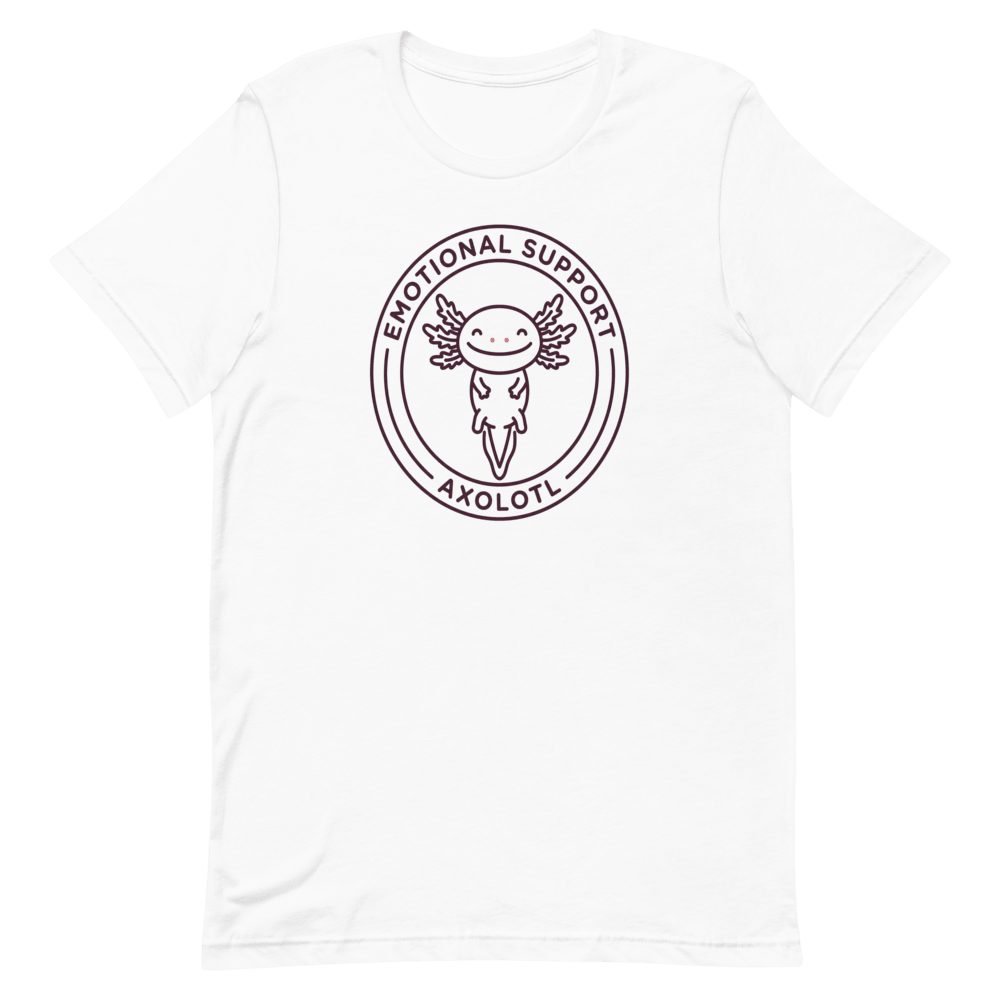
The axolotl, on a shirt worth keeping
A calm little creature with its frills doing all the talking, printed on a soft blank that holds its shape through the wash. For the person whose favorite animal has always been the strange one.
Drawing weird cute without tipping into ugly, a note from our desk

Drawing weird cute animals is the part we spend the most time on, and where the margin for error is narrowest. Everything above is observation. This is what we actually do about it.
Keep exactly one strange thing
The most common failure is enthusiasm. A designer finds an odd creature, loves the oddness, and amplifies every unusual feature at once. The frills get bigger, the eyes get bigger, the proportions go further, and the result is noisy rather than striking. One strange feature on an otherwise calm body reads as charming. Four strange features reads as a monster. We treat oddness as a budget to be spent in one place.
Be careful with the eyes
Large eyes are the first lever everyone reaches for and the easiest to overpull. Past a certain size the face stops reading as alive and starts reading as a doll, and a doll that is trying to be alive is unsettling for reasons that have been well documented. We keep eyes generous but believable, set them low on the face, and let the roundness of the head carry the rest.
Suggest texture, never render it
Many genuinely odd animals have textures that are difficult in close detail. Wrinkled skin, wet surfaces, visible teeth, bristles. Rendered literally, these go clinical fast, and clinical is the end of warmth. A soft shape and a hint of pattern will communicate the same creature while leaving the tenderness intact. Restraint is doing most of the work.
Subtract rather than add
A strange animal is already interesting, which means it needs very little help. Accessories, props, and little hats tend to dilute the one feature that made the creature worth drawing. When a design is not landing, our first move is almost always to remove something rather than to add something.
Check the expression last, and keep it calm
A wide grin pushes a drawing toward cartoon, and cartoon is a different and much more crowded business. A calm, slightly pleased, slightly absent expression tends to age better and reads as a creature going about its day rather than performing for you. It is also, not coincidentally, what makes a design still likable on the fiftieth wearing. The misread-expression idea is worth sitting with, which is why we wrote a whole piece on why hedgehogs always look a little grumpy.
How to find your own weird cute animal
Everyone who is into this eventually ends up with one creature that is particularly theirs. It is a nicer thing to have than you would expect, and it is not hard to find.
Notice what you send to people. The real signal is not what you like looking at, it is what you forward unprompted. The animal you have sent to three different friends without being asked is already your answer, whether or not you have noticed.
Try drawing it from memory. This is the most reliable test we know. If you can produce something recognizable in thirty seconds with a bad pen, the creature has a strong, simple, memorable feature. That is the same quality that makes a design work, which is why the test transfers so well.
Look small and slow. The majestic animals are well covered and difficult to feel tenderly about. The category rewards the small, the round, the unhurried, and the slightly unbothered. Most of the creatures in this piece could be described that way.
Read about how it actually lives. This is the one that separates a passing novelty from something lasting. Find out what your creature eats, where it lives, and how it manages. If you like it more afterward, it has real staying power. If the charm evaporates once it becomes a real animal with a real life, it was only a surprising picture, which is fine but different.
Follow the mechanism, not the species. Once you know what you respond to, whether that is frills, round bodies, sleepy faces, or an improbable nose, you can find more of it forever. Most people who love weird cute animals are really loyal to one particular feature and have not put it into words yet.
Frequently asked questions about weird cute animals
What makes an animal weird cute rather than just weird?
The weird cute animals that land tend to do two things at once. A creature needs enough baby schema to trigger the soft response, round shapes, a large head, big low-set eyes, and then one unusual feature that makes it memorable. Oddness on its own produces interest. Oddness on top of those gentle proportions produces affection.
Is there an actual scientific reason we find strange animals cute?
The underlying mechanism is baby schema, described by Konrad Lorenz in 1943, a set of infant proportions that triggers caregiving feelings in us regardless of what is carrying them. The strangeness is not what triggers the response. It is what makes a particular creature memorable and distinctive once the response has already fired.
Why do people love animals that are usually called ugly?
Partly because the ugly label is often unfair, as with the blobfish, which is only misshapen when removed from the pressure it is built for. Partly because affection you arrived at yourself feels better than affection everyone agrees on. Choosing the overlooked one is a small act of taste.
What is the difference between weird cute and creepy cute?
Direction, mostly. Weird cute keeps the creature gentle and unthreatening, so the oddness invites you closer. Creepy cute deliberately holds a little tension, something slightly eerie sitting next to something sweet. They are neighbors, and the distance between them is usually one expression.
Are weird cute animals a passing trend?
The specific creatures rotate, certainly. The underlying preference does not, because it rests on a response that is thousands of generations old combined with a need for novelty that is never satisfied for long. Something odd and gentle will always be making its way toward the front.
How do I know a design is not copying a licensed character?
The honest test is whether the design is drawn from the real animal or from somebody else’s drawing of it. Original work starts at the creature, its actual proportions and features, and arrives somewhere specific. If a design only makes sense as a reference to a character you already know, it is borrowing rather than drawing.
Final thoughts
The thing worth taking from all of this is that with weird cute animals, the oddness was never a flaw to be forgiven. It is the active ingredient. Smooth, perfect, maximally round cuteness is pleasant and almost immediately forgettable, because there is nothing in it for your memory to hold. A creature with one improbable feature stays with you for years.
That is true of designs as well as animals. The pieces people keep, wear until they are soft, and quietly mourn when they wear out are almost never the most conventionally pretty ones. They are the ones with something a little particular about them, the detail that made you feel like you had found it rather than been sold it.
So if your favorite animal is a salamander that never grew up, a sea slug pretending to be a rabbit, or a deep-sea fish that was photographed on the worst day of its life, you are not being contrary. You are paying attention to the part that was always doing the work. We think that deserves a good shirt.
Before you go
Want the next one in your inbox?
We write something soft every day. The best of it lands in one gentle weekly note, for you or for the friend who needs it.


5 Comments