
The African rain frog: which round, squeaky frog is which
Somewhere on the internet right now, a small round frog is standing in the sand, puffed up to its full height of about two inches, making a noise like a squeaky dog toy at a camera. If that clip is how you got here, you are in good company. The African rain frog has become one of the most shared animals online, and almost nobody who shares it can say which frog they are actually looking at.
That is because “African rain frog” is not one frog. It is a whole family of them, all round, all grumpy-looking, all living most of their lives underground. This is our friendly field guide to telling them apart, and to the strange, lovely reasons they are built the way they are: why they are so round, why one of them squeaks, how they grow up without ever being tadpoles, and the honest answer to whether one belongs in a tank at home.
What is an African rain frog?
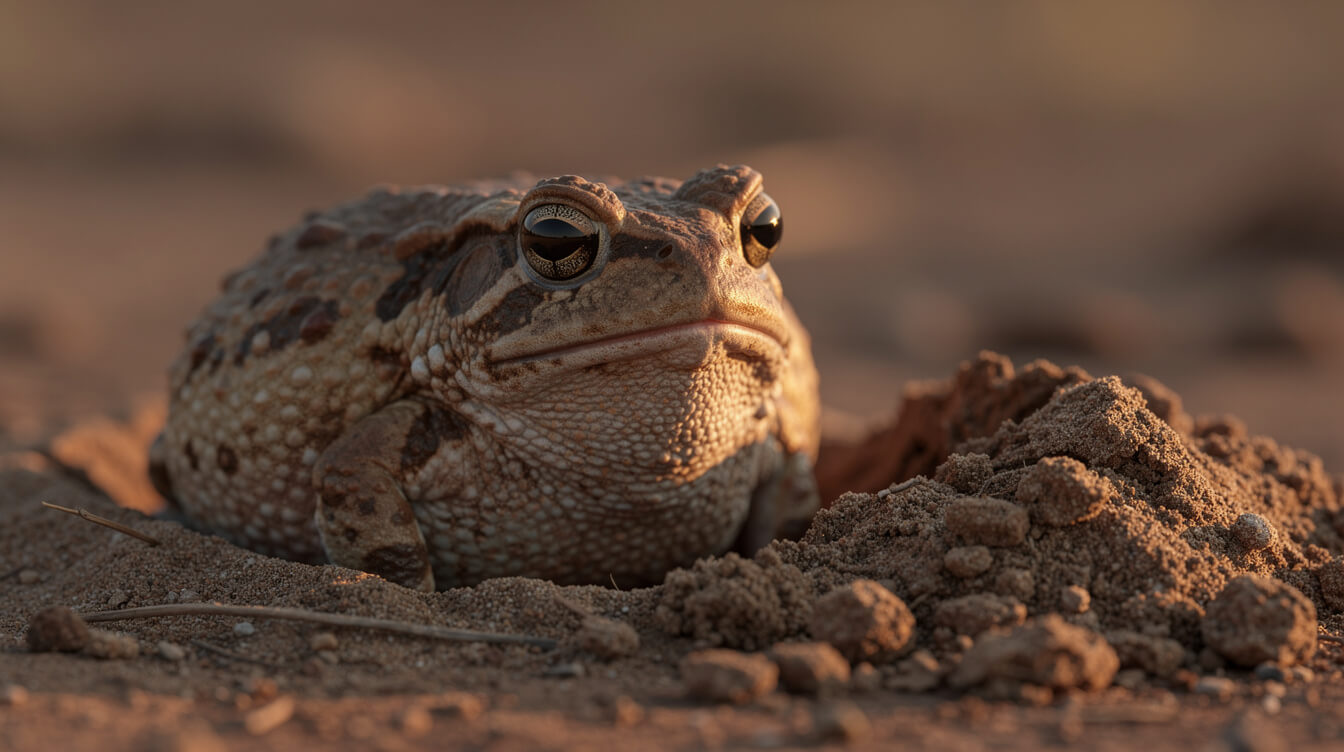
An African rain frog is any of the roughly twenty species in the genus Breviceps, a group of small burrowing frogs from eastern and southern Africa. The name Breviceps means “short head,” which is a polite way of saying these frogs barely have a face before the body begins. Field guides call them short-headed frogs, and that is accurate, but “rain frog” is the name that stuck.
The rain part comes from their timing. Rain frogs spend most of the year underground, out of sight and out of the heat. After a good rain, the soil softens, the insects come out, and so do the frogs. They surface at night to eat ants, termites, beetles, and other small invertebrates, and to call for mates. Choruses can start almost as soon as the rain stops, which is why people in parts of southern Africa have long taken their calls as a sign that wet weather is on the way.
What every rain frog has in common
Across the genus, the body plan is remarkably consistent:
- A round, stout body with very little neck and a small, flat snout.
- Short legs that are good for walking and digging and not much use for hopping. Rain frogs walk. Some barely manage a waddle.
- Spade-like bumps on the back feet, called metatarsal tubercles, which they use to dig themselves backward into the soil.
- Cryptic coloring in browns, tans, and near-blacks, so that even on the surface a still rain frog looks like a clod of earth.
If you have read our piece on weird cute animals, you will recognize the recipe. A round shape, a small face, and an expression that reads as deeply unimpressed is exactly the combination that makes people stop scrolling.
Desert, black, or bushveld: which African rain frog did you see?

Most of the rain frogs people meet online come from just three species. Here is how to tell them apart without a field guide.
The desert rain frog, the one that squeaks
If the frog in your video was pale, sandy, and standing on a beach-like dune while making a high, indignant squeak, you met Breviceps macrops, the desert rain frog. It lives in one of the oddest frog habitats on earth: a narrow strip of coastal sand, roughly ten kilometers wide, along the Atlantic coast of Namibia and South Africa. That stretch gets only around 60 millimeters of rain a year and has no standing water at all. Moisture comes from the sea fog that rolls in at night.
Desert rain frogs are yellowish brown and usually wear a light coat of sand, because a slightly sticky skin holds onto the grains. They have comparatively large, bulging eyes for a rain frog, short webbed toes, and a translucent patch on the belly where you can see a little of what is going on inside. Adults run about 4 to 6 centimeters long.
The black rain frog, the grumpy face
If the frog was dark brown or nearly black, lumpy, and staring at the camera with an expression of profound personal offense, that was Breviceps fuscus, the black rain frog. It lives on the southern slopes of the Cape Fold Mountains in South Africa, from around Swellendam to the Outeniqua range, in fynbos and along forest edges. Its skin has no true warts but is covered in small, widely spaced bumps, which is where the internet’s favorite comparison comes from: it looks a bit like a very small, very cross avocado.
The black rain frog was first described in 1925 from a specimen collected near Knysna. It grows to about 4 to 5 centimeters and is the face behind most of the “angriest frog in the world” posts. It is not angry. That downturned mouth is simply how its face is shaped, the same trick of anatomy we wrote about in why hedgehogs always look a little grumpy.
The bushveld rain frog, the one in the pet trade
The third common one is Breviceps adspersus, also called the common rain frog or bushveld rain frog. It is brownish with lighter markings and has by far the widest range of the three, spread across grasslands and open woodland from Angola and Namibia across to Mozambique and down into South Africa. This is the species you are most likely to see offered for sale, which matters later.
A quick way to remember them
- Sandy and squeaking on a dune: desert rain frog.
- Dark, bumpy, and scowling in the mountains: black rain frog.
- Brown with markings, and listed in a shop: bushveld rain frog.
Why African rain frogs are so round
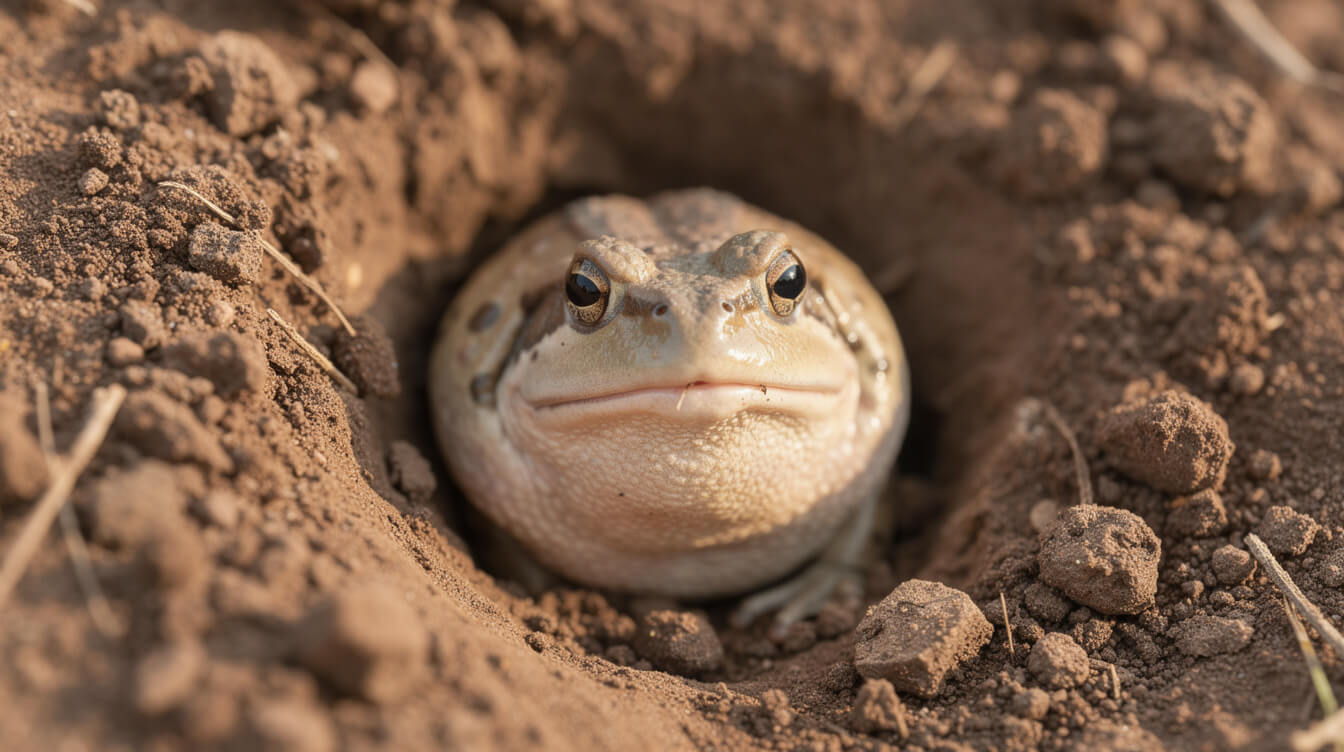
The roundness is the whole point of these frogs, and it is doing at least three jobs at once.
Puffing up to look bigger
A rain frog cannot leap away from a predator, and it cannot swim away either. So when something threatening shows up, it does the next best thing: it gulps air and inflates. A puffed rain frog can swell to several times its resting size, which makes it look larger, rounder, and much harder to swallow. For a snake or a bird working out whether this is an easy meal, a frog that has just turned into a small balloon is a less appealing prospect.
Wedging into the burrow
The same trick works underground. A rain frog that retreats into its tunnel and then inflates becomes wedged in place, pressed against the walls. A snake that follows it in finds it very difficult to pull the frog back out. The black rain frog in particular is known for this, and it is one of those details that makes the round body suddenly make sense. It is not just a cute shape. It is a cork.
Digging backward
Finally, a round body with short, strong legs is a good digging body. Rain frogs bury themselves rear end first, using the hard spade-shaped bumps on their hind feet to scoop soil out of the way while they shuffle backward and down. Within moments, a frog that was sitting on the surface is gone, with only a small pile of loose earth to show where it went. The desert rain frog digs down 10 to 20 centimeters into damp sand to spend the day. The black rain frog tunnels to around 15 centimeters.
Put the three together and you get an animal that is round because round keeps it alive. That is part of why the cuteness lands. Nothing about a rain frog is decorative.
The squeak, explained

The sound that made the desert rain frog famous is a high-pitched squeak it makes when it feels threatened. In the most shared clip, the frog stands its ground on the sand, inflates, and lets out a series of squeaks that sound a lot like a toy being stepped on. People have called it a battle cry. It is closer to a protest.
Why squeak at all? The usual explanation for startle calls like this is defense. A sudden, sharp noise from something that looked like a lump of sand a second ago can make a predator hesitate, and a hesitating predator gives a slow, round frog a chance to dig in. Paired with the puffing, it is a whole small performance designed to say “I am more trouble than I am worth.”
The squeak is not the frog’s only voice. During the breeding season, which runs through the cooler, foggier months, males come out at night and call to females, and those calls are high-pitched too. The black rain frog calls with a short chirp, sometimes from inside its burrow, and its distress call is a quick, high chirp as well. If you ever hear a recording of a rain frog chorus after a storm, it sounds less like a pond full of frogs and more like a room full of very small kettles.
There is something deeply relatable about an animal whose entire defense plan is to get rounder and complain. If that is also your approach to a long week, our Emotional Support Frog T-Shirt was more or less made for you.
The cutemerch letter
A small good thing, once a week
One short, kind email with our coziest posts and new round animals from the shop. No spam. Unsubscribe anytime.
No tadpoles, no ponds: how rain frogs grow up underground
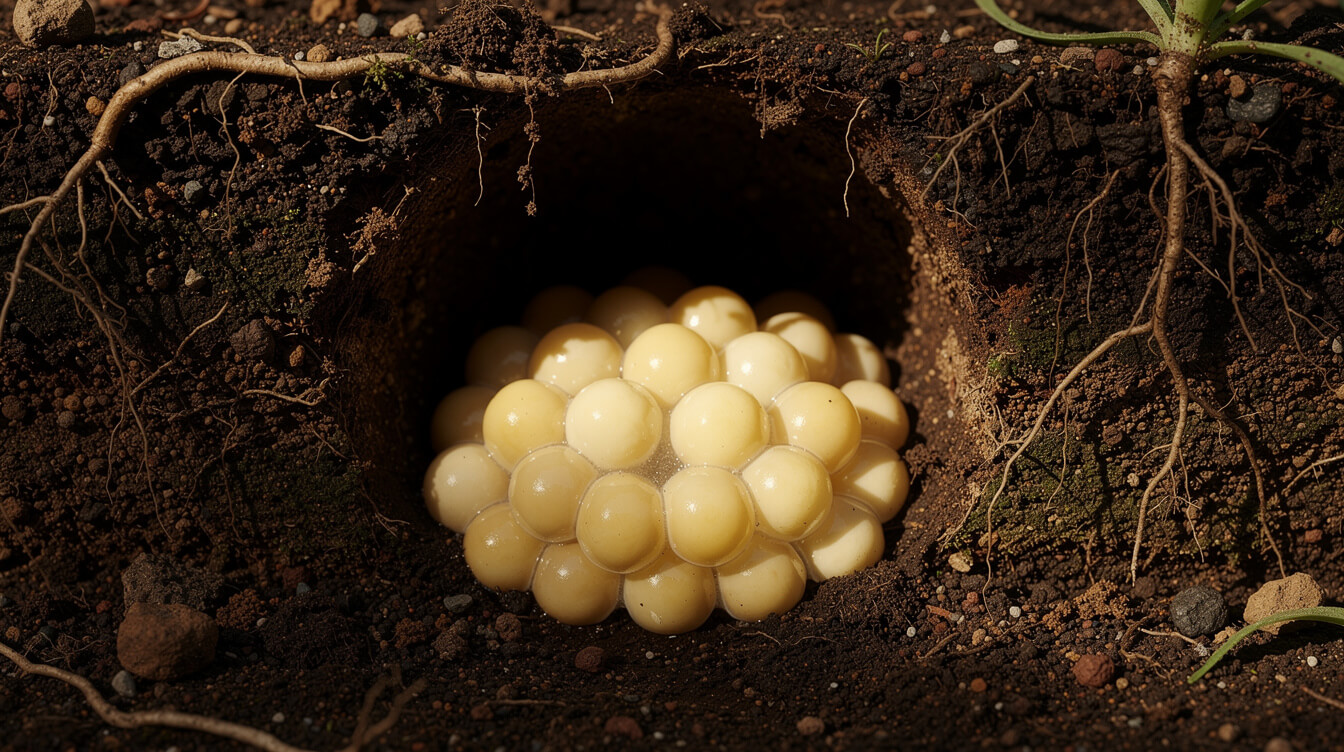
Here is the part that surprises most people. African rain frogs do not need ponds, streams, or puddles to breed. They do the whole thing underground, and their young skip the tadpole life we usually picture.
The sticky courtship
Most male frogs hold onto a female during mating with a firm hug. Rain frogs cannot manage it. The males are much smaller than the females, and their arms are short, so they simply do not reach. Instead, a sticky secretion from the skin glues the pair together. Still attached, they dig backward into the soil to a chamber the female has prepared. In the bushveld rain frog, that chamber can be about 30 centimeters down.
Eggs in a chamber
The female lays a small clutch of eggs in the chamber. In the black rain frog, a nest holds around forty yellow eggs, each about 5 millimeters across inside a clear protective capsule. An adult stays near the nest; male black rain frogs have been heard calling from burrows while guarding eggs.
Froglets, not tadpoles
Instead of hatching into swimming tadpoles, rain frog young develop inside the egg and emerge as tiny froglets, small round copies of their parents. Biologists call this direct development. There is no free-swimming stage and no need for open water. For a frog living in fog-fed dunes or dry mountain soil, that is the only plan that works.
It also explains one of the gentlest facts about them: a rain frog can live its whole life without ever going for a swim. Most of them cannot swim at all.

For the frog in you that would rather stay underground
A cream badge on a soft black tee that simply says Emotional Support Frog. Quiet, a little deadpan, and very much on the side of anyone who needs a round, unbothered friend today.
Can you keep an African rain frog as a pet? The honest answer

This is one of the most searched questions about these frogs, and we understand why. Something that round and that expressive feels like it should come home with you. Our honest answer is that it is a frog for loving from a distance, and here is why.
Most of them come from the wild
Rain frogs are rarely bred in captivity, in part because their underground breeding is so hard to recreate. That means most rain frogs offered for sale, usually bushveld rain frogs, were taken from the wild. Every one of those sales removes an animal from a population, and wild-caught amphibians can also arrive stressed, underweight, or carrying parasites.
You will mostly be looking at dirt
Rain frogs are burrowers first and foremost. In a well-set-up enclosure, a healthy rain frog spends its days buried and comes up at night, briefly, to eat. The frog you fell in love with on video, the one standing proudly on the sand, is a frog that has been disturbed. A happy rain frog is a frog you mostly do not see. That is a strange kind of pet: a box of soil you are told contains someone.
The care is specific
They need deep, appropriate substrate, careful humidity, and a steady supply of suitably small live insects. The desert rain frog in particular lives in a narrow, fog-fed coastal habitat that is very difficult to imitate, and it is listed as Vulnerable on the IUCN Red List, with a fragmented range smaller than 2,000 square kilometers. It is not a species anyone should be buying.
Rules on owning amphibians also differ by state and country, so if you are seriously considering any frog, check what applies where you live first. For frogs in general, our earlier guide on cute frogs and why we cannot stop looking at them walks through which kinds do well with people. For rain frogs, the kindest way to enjoy them is the way most of us already do: on a screen, squeaking, undisturbed by us.
Frequently asked questions about African rain frogs

Can African rain frogs jump?
Not really. Their legs are short and their bodies are round, so they walk, shuffle, and dig instead of hopping. Most cannot swim either.
How big do African rain frogs get?
Small. The desert rain frog is about 4 to 6 centimeters long, the black rain frog about 4 to 5, and the bushveld rain frog ranges from roughly 3 centimeters for small males to 6 for large females. Most would sit comfortably in the palm of a hand.
Are African rain frogs endangered?
It depends on the species. The desert rain frog is listed as Vulnerable, mainly because its tiny coastal range has been squeezed by diamond mining, roads, and new development. The black rain frog and the bushveld rain frog are both listed as Least Concern, though the black rain frog does not tolerate habitat disturbance well.
Why does the African rain frog look so grumpy?
The short head, small downturned mouth, and round cheeks add up to a face we read as a frown. It is the same kind of misreading that makes us think a quokka is smiling, which we wrote about in what is a quokka. The frog has no opinion about you at all.
What do African rain frogs eat?
Small invertebrates: ants, termites, beetles, moths, caterpillars, and similar. The desert rain frog has been found foraging near patches of dung, where beetles and larvae gather.
Is the rain frog the same as the desert rain frog?
“Rain frog” usually refers to the whole Breviceps genus. The desert rain frog is one particular species within it, the sandy coastal one with the famous squeak.
Final thoughts
The African rain frog is a good reminder that the things we find cutest are often doing something serious. The roundness is armor and a cork. The grumpy face is just the shape of a short head. The squeak is a small, brave bluff from an animal that cannot run. And the whole family has quietly worked out how to be a frog without a pond.
So the next time a round little frog stands up in the sand and squeaks at you through your phone, you will know who it is, and you will know it would much rather be back underground. Let it go. Watch the clip again. That is the kindest kind of love there is for a frog like this one.
Before you go
Want the next one in your inbox?
We write something soft every day. The best of it lands in one gentle weekly note, for you or for the friend who needs it.