

Cute capybara: why the calmest animal on the internet is so easy to love
There is a particular kind of quiet that only a cute capybara can pull off. It sits in a pond up to its chin, eyes half closed, a small bird standing on its back, and it looks like nothing in the world could hurry it. People have been sending each other that picture for years now, usually with no caption at all, because none is needed.
We love the capybara for the same reason we love a warm mug on a cold morning: it is calm in a way that makes us a little calmer too. But the calm is not a costume. It comes from a real animal with a real life in the wetlands of South America, and the more you learn about how it lives, the more the softness makes sense. So this is a gentle field guide to the cute capybara: what makes the face so easy to love, why the animal really is that relaxed, why every bird in the marsh seems to sit on it, where the hot spring photos come from, and the honest answer to whether one could ever live in your house.
What makes a cute capybara so cute

Most cute animals win us over by looking young. Big eyes, a round forehead, a small nose, the features researchers call baby schema, are the reason a kitten or an owlet tugs at something in us before we have even thought about it. We wrote about that pull in our piece on weird cute animals, and the capybara is a lovely exception to it.
A grown capybara does not look like a baby at all. It looks like a very sensible loaf. The body is a barrel on short legs, the head is broad and blocky, and the muzzle ends in a blunt square instead of a point. The tail is so small it is barely there. Adults usually weigh somewhere around 77 to 146 pounds, which makes the capybara the largest rodent alive, a cousin of the guinea pig scaled up to the size of a big dog.
The eyes sit on the roof
The detail that does the most work is where the face is arranged. A capybara’s eyes, ears, and nostrils all sit high on the head, close to the top, the same layout a hippo has. That design lets it lie almost completely underwater with just a thin strip of face above the surface, watching and breathing while the rest of it stays hidden. On land, the same layout gives the face its famous expression. With the eyes set so high and the lids often relaxed, a resting capybara looks permanently drowsy and mildly content, like someone listening to rain.
Cute by calm, not by smallness
So the cute capybara works on a different channel than most cute animals. It is not saying “protect me.” It is saying “nothing is wrong.” That is a rarer and, honestly, more useful kind of cute. It is the same quality that makes a grumpy-faced manul or a hedgehog with a frown so lovable: the face tells a little story, and the story here is peace.
If you have ever wondered why a round, unbothered animal on a shirt or a mug feels so good to look at, the capybara is the clearest answer we know. Our round animal t-shirt guide gets into that design idea more, but the short version is that roundness reads as safety, and the capybara is round all the way through.
Why are capybaras so chill

Here is the surprising part. The capybara is a prey animal. Jaguars, ocelots, cougars, caimans, anacondas, and eagles all hunt them, and in the wild most capybaras do not live past about four years. You might expect an animal with that many predators to be jumpy. Instead it is famously unhurried. The calm is not a lack of awareness. It is a strategy, and it rests on a few things working together.
A herd of watchers
Capybaras live in groups, usually around 10 to 20 animals, and in the dry season far more can gather around the water that is left. Every extra pair of eyes is a lookout. When a group shares the job of noticing danger, no single capybara has to stay on high alert all day. Each one can afford to doze, graze, and soak, because someone nearby is paying attention. If a threat appears, they make sharp, dog-like barks and the group moves.
An escape hatch made of water
The second reason is the pond. Capybaras are superb swimmers with slightly webbed feet, and they can stay underwater for up to about five minutes. A safe hiding place is never more than a few steps away. It is easier to relax when your emergency exit is right there.
A slow, steady day
Their daily rhythm helps too. A typical day runs something like this: rest on dry land in the morning, slip into the water during the hottest part of the afternoon to cool off, then graze through the late afternoon and into the night. They do not chase anything. Their food is grass and water plants, so the whole day is about patient munching, not hunting. Even their chewing is unhurried, a back-and-forth grinding motion that suits tough grass.
One honest note, because we would rather be true than tidy: capybaras are not calm every second of their lives. Males sort out who is in charge, groups have their own small politics, and a frightened capybara will bark and bolt. The chill is a baseline, not a guarantee. That just makes it more real.
Why every bird sits on the capybara

If there is one image that made the cute capybara famous, it is the capybara as furniture. A bird on its back, a duckling beside it, a monkey leaning on it, and the capybara looking off into the middle distance as if none of it were happening. It seems like a miracle of friendship. It is partly that, and partly a very practical arrangement.
In the wetlands, several bird species follow capybaras on purpose. As a capybara walks through the grass, it stirs up insects, and the birds catch them. Some birds ride along on its back to get a better view, and some pick ticks and flies off its skin. Studies of these feeding partnerships describe capybaras as mostly indifferent to the birds, which is exactly the face you see in the photos. They are not hosting a party. They simply do not mind.
There is one sweet exception. When a yellow-headed caracara, a bird of prey that eats parasites, comes close, capybaras sometimes lie down and turn their sides and bellies toward it, asking to be cleaned. It is the capybara version of tilting your head for someone to scratch behind your ear.
The fruit on the head
You may also have seen pictures of a capybara with a little citrus fruit balanced on its head. Those come from captive animals in zoos and parks, and they work for the same reason the birds do: a capybara at ease does not bother shaking off something that is not hurting it. We find those photos charming, and we also think the kindest version of that joke is the one where the animal is calm, comfortable, and free to walk away.
Hot spring capybaras and the warm yuzu bath
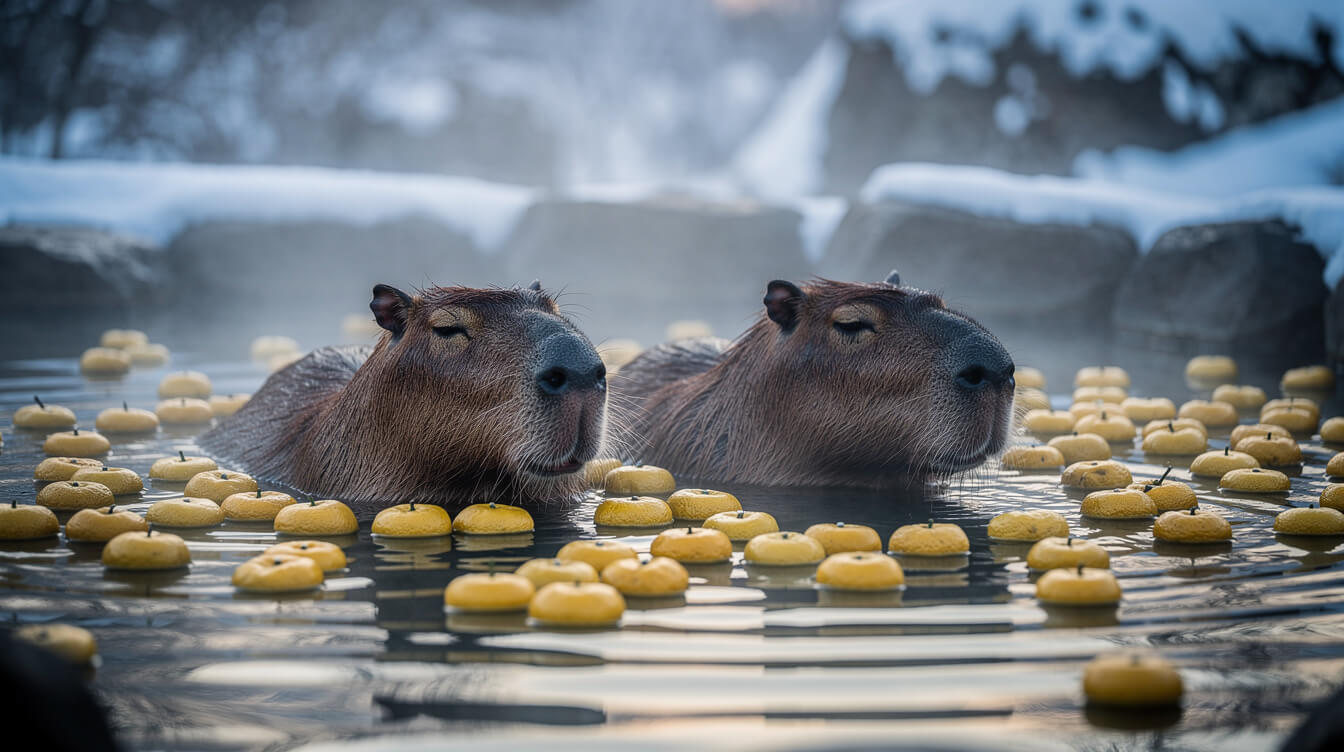
The softest corner of capybara culture started almost by accident. In 1982, at Izu Shaboten Zoo in Shizuoka, Japan, a keeper cleaning the capybara enclosure with hot water noticed the capybaras had gathered together in the warm puddle it left behind. The zoo took the hint. It began preparing a heated bath for them, and the “capybara bath” has been part of the zoo ever since.
In winter and early spring, the keepers float yuzu in the water, a small, fragrant Japanese citrus. Taking a bath with yuzu is a winter custom in Japan, so the capybaras ended up sharing a very human comfort. Other zoos copied the idea, and videos of capybaras soaking with their eyes closed while yellow fruit bobs around them have been watched millions of times.
A role model for feeling okay
Capybaras have big, devoted followings in Japan and China, especially among young people, and one explanation that gets offered is lovely: people see them as role models of emotional well-being. Unflappable, sociable, happy to share the pool. The internet has described their personality as almost Buddha-like. Whether or not a capybara has any opinion about inner peace, it is easy to see why someone having a hard week would want to look at one.
That is also why the capybara keeps turning up as the internet’s unofficial emotional support animal. We have a soft spot for that idea, which we explored in our piece on the emotional support animal shirt trend. We have not made a capybara design yet, but our Emotional Support Axolotl tee comes from the same place: a calm, quietly smiling creature in a clean emblem, made to be the soft thing you carry through an ordinary day.
The cutemerch letter
A small good thing, once a week
One short, kind email with our coziest posts and new round animals from the shop. No spam. Unsubscribe anytime.
Are capybaras friendly

Mostly, yes, in the sense that they are docile. Capybaras that live around people, in South American parks and city edges or in zoos, often tolerate being close to humans and will happily accept food. They have adapted well to cities in South America, and in one famous case outside Buenos Aires, a herd kept grazing the lawns of a gated neighborhood built on top of their old wetland, as if they still owned the place, which in a way they do.
But “docile” and “wants to be held” are different things, and this is where we want to be the kind friend instead of the fun one.
- They carry ticks. Contact with capybaras is generally discouraged because their ticks can carry Rocky Mountain spotted fever. Looking is lovely. Petting a wild one is not a great idea for either of you.
- Handling for photos stresses them. Animal welfare groups have been clear that grabbing, posing, or crowding capybaras for social media content causes real stress, even when the animal stays still. A capybara that does not run is not always a capybara that is fine.
- They are still wild animals. Those big front teeth grow all their lives and are made for cutting tough grass. A frightened adult can bite, and they are strong.
If you get to see capybaras in person, the best way is the way they seem to prefer: from a little distance, with no hurry, watching them graze and soak and ignore the birds. That is the whole show, and it is a good one.
The quiet, unfussy kind of friendship capybaras show each other is what we tried to put into a shirt you can wear on days that need a little gentleness.

A calm little friend for your chest
No capybara design yet, so here is the next best thing: our Emotional Support Axolotl tee, a quietly smiling water creature in a clean emblem. Same soft energy, same unhurried pond.
Could a capybara be a pet

It is the natural question after watching a hot spring video, and the honest answer for almost everyone is no. Not because capybaras are mean, but because what they need is a lot bigger than what most homes can give.
What a capybara actually needs
- Water to swim in. Not a bowl, not a kiddie pool. Capybaras have dry skin and need a real swimming area to stay healthy and cool.
- Company of their own kind. They are herd animals. One capybara alone is a lonely capybara, so responsible keepers plan for at least two.
- Space and grass. An adult can eat several pounds of grass a day and needs room to graze and roam.
- A careful diet. Like their guinea pig cousins, capybaras cannot make their own vitamin C. Without enough of it in captivity, they can develop gum problems linked to scurvy.
- A long commitment. They can live around 8 to 10 years, and sometimes up to 12 in good care.
On top of that, the rules for keeping one vary a great deal from state to state and city to city, and many places require permits or do not allow it at all. If you are ever seriously considering it, your state wildlife agency is the place to start, and a long visit to an accredited zoo that keeps them is the place to start before that.
For most of us, the right relationship with a capybara is the one we already have: admiring them, learning about them, and keeping a little capybara calm close by in other ways. A favorite photo as your phone background, a soft blanket, a slow bath on a cold night. If you love animals you cannot keep, you are in good company here. Our guides to the quokka and the axolotl come from the same place.
Cute capybara FAQ

How big does a capybara get?
Adults are usually about 3.5 to 4.4 feet long and about 20 to 24 inches tall at the shoulder, and they typically weigh 77 to 146 pounds. Females tend to be slightly heavier than males.
Are capybaras related to guinea pigs?
Yes. Capybaras are rodents, and their close relatives include guinea pigs and rock cavies. There is also a second, smaller species called the lesser capybara.
What sounds does a capybara make?
More than you would guess. Capybaras communicate with barks, chirps, whistles, huffs, and purrs. The bark is usually an alarm, and the soft purrs and chirps are part of everyday group life.
Are capybaras endangered?
No. The capybara is listed as Least Concern, and its population is stable across most of its range in South America, though hunting has reduced numbers in some areas and habitat loss is a pressure.
Do capybaras really eat their own poop?
They do, and it is clever rather than gross. Grass is hard to digest, so capybaras eat some of their own droppings to get helpful gut bacteria and pull more nutrition out of their food. They also bring food back up to chew again, a little like a cow.
Is it true a capybara was once called a fish?
That is the legend. The story goes that church authorities long ago classed the swimming capybara as a fish so it could be eaten during Lent, and in parts of Venezuela capybara is still a traditional Lenten dish. It is better told as a legend than a documented fact, but it is a good one.
Why is a cute capybara so calm with other animals?
A mix of temperament, safety in numbers, and the fact that most small animals around it are not a threat. Birds that perch on capybaras are usually hunting insects or picking off parasites, so the capybara loses nothing by letting them stay.
Final thoughts on the cute capybara
We think the cute capybara has lasted so long online because it offers something most cute things do not. It does not ask you to feel protective, and it does not ask you to be excited. It just shows you what it looks like to be okay. Sit in the warm water. Let the bird stay. Eat slowly. Keep your friends close and your exit nearby.
None of that is a lesson the capybara means to teach, of course. It is simply how a large, gentle animal survives in a wetland full of things that would like to eat it. But there is something comforting in knowing that the calm is real, that it comes from good company and a safe place to rest, and that those are things people can build too.
So the next time someone sends you a capybara soaking in a yuzu bath with its eyes closed, you will know the whole story behind it: a keeper with a hose in 1982, a herd that keeps watch for each other, and an animal that has never once seen a reason to rush. We hope it makes your ordinary day a little softer. It does for us.
Before you go
Want the next one in your inbox?
We write something soft every day. The best of it lands in one gentle weekly note, for you or for the friend who needs it.




2 Comments