
Cute sea animals: the softest faces in the ocean, and why they look that way
Some animals look cute on purpose, or at least it feels that way. A sea otter floating on its back with its paws folded on its chest. A beluga with a forehead like a soft pillow. A tiny yellow fish shaped like a die with polka dots. If you have ever searched for a cute sea animal to send a friend on a gray afternoon, you already know the ocean has more of them than it really needs.
Most lists of cute sea animals stop at the picture. A photo, a fact pasted underneath, and on to the next one. We wanted to do something a little more useful. So this guide starts with the honest question of why some sea animals read as cute and others do not. Then it takes a slow tour of the ocean, from tide pools to the deep, with one true detail for each animal. It ends with the part most lists skip: a few of the cutest animals in the sea are also among the most toxic, and the kindest way to love them is from a distance.
What makes a cute sea animal look cute?
Our brains have a soft spot for a particular set of shapes: big eyes, round heads, short faces, and soft, chubby bodies. Scientists call it baby schema, and we wrote about it properly in our piece on weird cute animals, so we will not re-teach it here. The interesting part is that the ocean keeps building animals that fit the pattern, for reasons that have nothing to do with us.
Round bodies are warm bodies
Cold water pulls heat out of a body far faster than cold air does. Animals that live in it tend to wrap themselves in something: a thick layer of blubber, like a beluga or a seal, or the densest fur of any animal on earth, like a sea otter. Insulation rounds off every edge. A blubbery animal has no sharp shoulders and no visible neck, just one smooth, soft curve from nose to tail. That is exactly the silhouette our eyes read as cuddly.
Big eyes for dim water
Light fades quickly as you go down. Many animals that hunt or hide in dim water have large eyes to catch what little light there is, and large eyes in a small face are one of the strongest cute signals there is. The flapjack octopus, which we will meet in the deep sea section, is a good example: most of what you notice about it is two big, dark, calm eyes.
Slow, soft movement
Water holds a body up, so plenty of sea animals do not need to be stiff or strong to get around. They drift, hover, flutter, and bob. Slow movement reads as gentle to us, which is why a pufferfish puttering along with its tiny fins looks sweet even though, as we will see, it is anything but harmless.
None of these traits evolved to charm anyone. They are solutions to cold, dark, and pressure. It just happens that the ocean’s solutions look a lot like a plush toy.
Cute sea animals of the tide pool and reef
The shallow, sunny edge of the ocean is where most people meet their first cute sea animals. Reefs and rocky pools are crowded with small things, and small things are where the ocean gets its sweetest faces.
The pygmy seahorse
Bargibant’s pygmy seahorse is usually less than 2 centimeters tall, small enough to sit on a fingertip. It lives its whole adult life on a single sea fan, a kind of branching coral called a gorgonian, and it is covered in little round bumps that match the coral’s polyps so well that nobody noticed it in the wild. It was found in 1969, when a scientist collecting sea fans for a museum in New Caledonia spotted a pair of tiny seahorses on one of them while it sat on his dissection table. The Red List currently rates it Least Concern, though living on one kind of coral for life makes it a quiet reminder of how much depends on healthy reefs.
The yellow boxfish
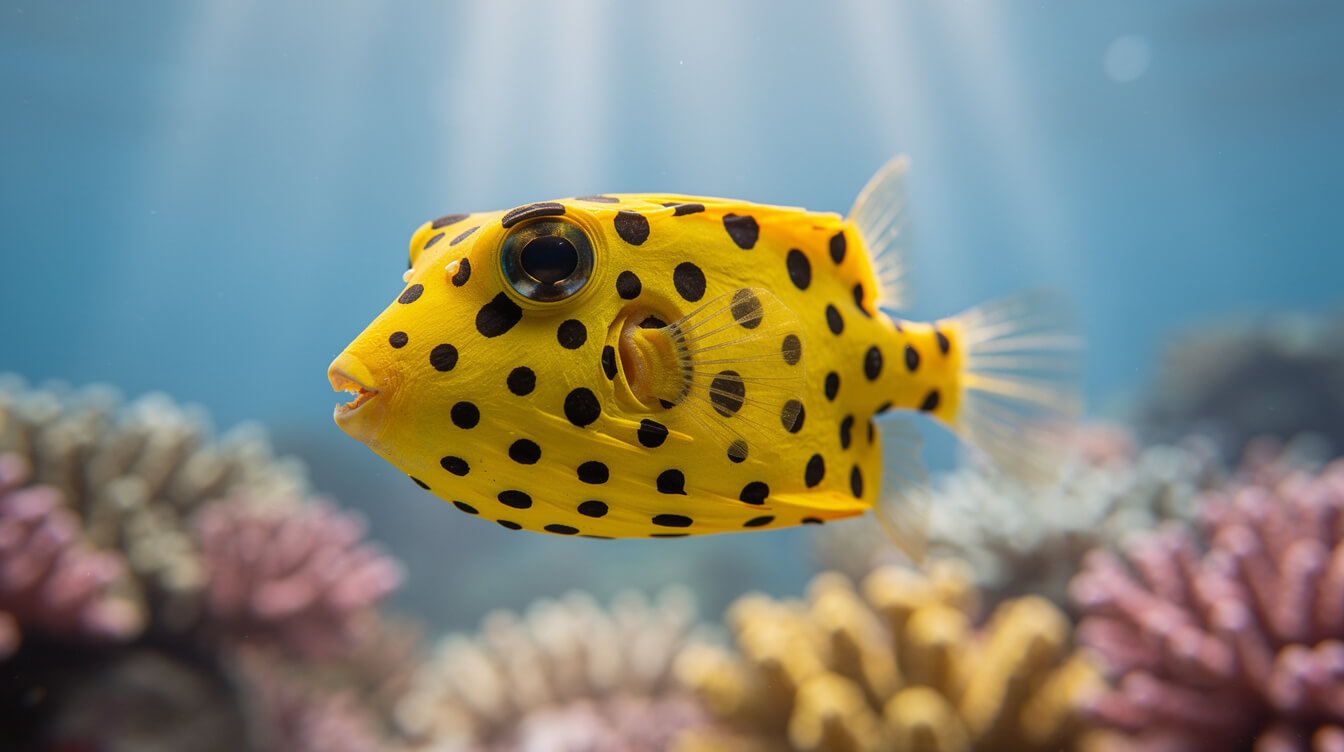
A young yellow boxfish looks like someone drew a fish with a ruler and then added polka dots. It is bright lemon yellow with neat black spots, a square body inside a stiff, bony case, and a tiny pursed mouth. Its scientific name, Ostracion cubicum, roughly means “little box, cube shaped”, which is about as honest as names get. The cuteness fades a little with age: adults can reach about 45 centimeters, and the bright yellow turns duller. Keep it in mind for later, because that sweet little box has a defense.
The pufferfish
There are around 200 species of pufferfish, and most of them look gently surprised all the time. Their trick is famous: when threatened, a puffer gulps water into a stretchy stomach and swells into a ball, sometimes bristling with small spines. It is a lot of effort, and it is hard on the fish, so a calm puffer is the one you want to see, round eyes and little beak and fluttering fins going about its day.
Sea slugs, the reef’s softest residents
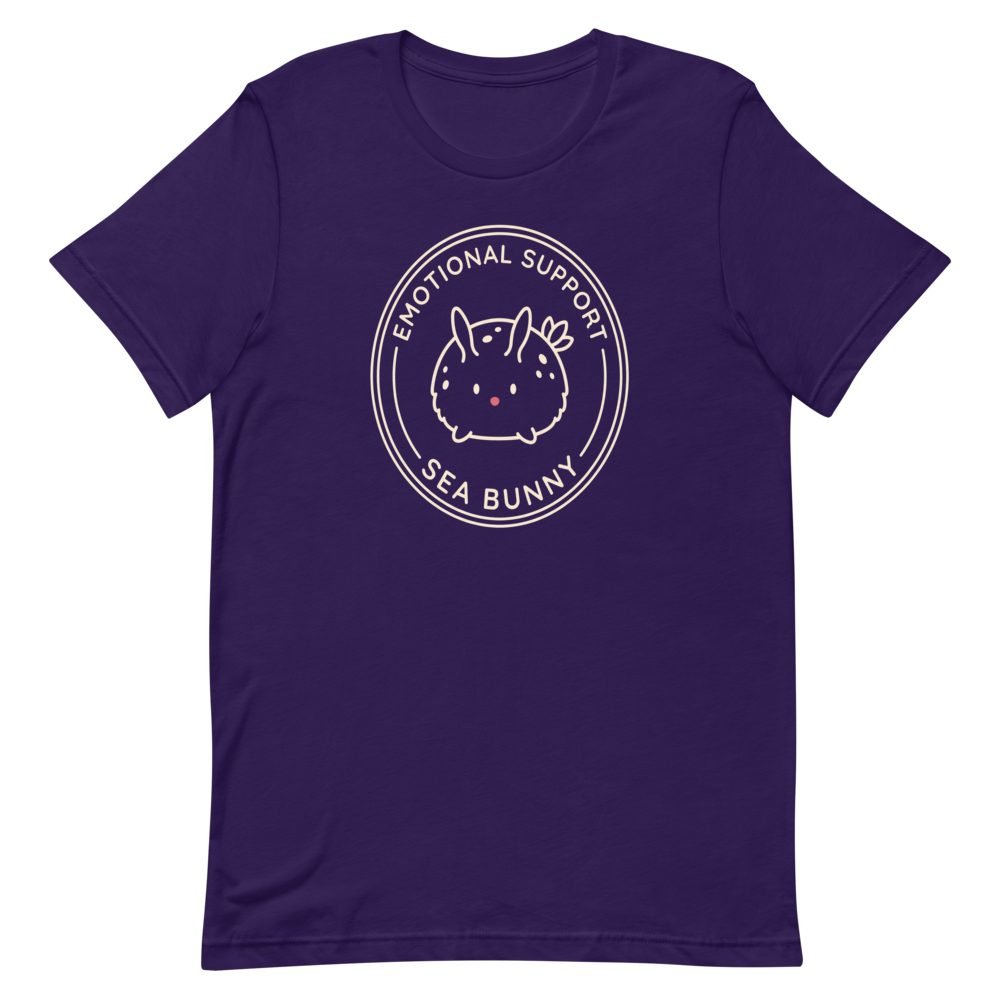
We could write a whole guide just about sea slugs, and we sort of have. There is the fluffy, white sea bunny, which looks like a tiny rabbit made of felt. There are the bright, warning-colored nudibranchs that wear borrowed stings. And there is the leaf sheep, a slug with a lamb’s face that keeps the sunlight it eats. If the sea bunny is the one that got you, it is also the one on our Emotional Support Sea Bunny T-Shirt, drawn in soft cream line art with one small pink nose.
Kelp forests and coastlines: whiskers, paws, and naps

Cold coastal water, especially along the North Pacific, grows forests. Giant kelp can rise from the rocky seafloor all the way to the surface, and these swaying, golden-green forests are home to one of the most beloved animals in the whole ocean.
The sea otter
The sea otter is the best case for the “round bodies are warm bodies” idea. Unlike most marine mammals it has no thick blubber layer. Instead it has the densest fur in the animal kingdom, and it spends a large part of its day grooming it, fluffing air into the coat to keep the cold water off its skin. That constant fluffing is part of why a sea otter looks so plush.
The details only get sweeter. When a sea otter rests, it floats on its back, and to keep from drifting away it may wrap itself in kelp like a blanket it found on the way to bed. It has a loose pouch of skin under each forearm, and it tends to favor the left one, where it stashes food it gathered on a dive and sometimes a favorite rock. Back at the surface, it lies on its back, sets the rock on its chest, and cracks shellfish against it. It is one of the few mammals that uses tools at all.
Sea otters also matter far beyond their looks. They eat sea urchins, and in much of their range they keep urchins from mowing down the kelp. Fewer otters can mean fewer kelp forests. The species is listed as Endangered, which is part of why we wrote a whole, honest piece on whether you can have a pet otter (the short answer is no, and the long answer is kinder than it sounds).
The harbor seal
Harbor seals haul out on rocks and beaches along these same coasts, round as loaves of bread and spotted like river stones. We gave seals a full guide of their own, including which one wins, in our post on the cutest seal.
Open water and the ice edge
Past the coastline, the ocean opens up, and the animals get bigger. Bigger is usually less cute, but the open sea has a few gentle giants with faces worth knowing.
The beluga
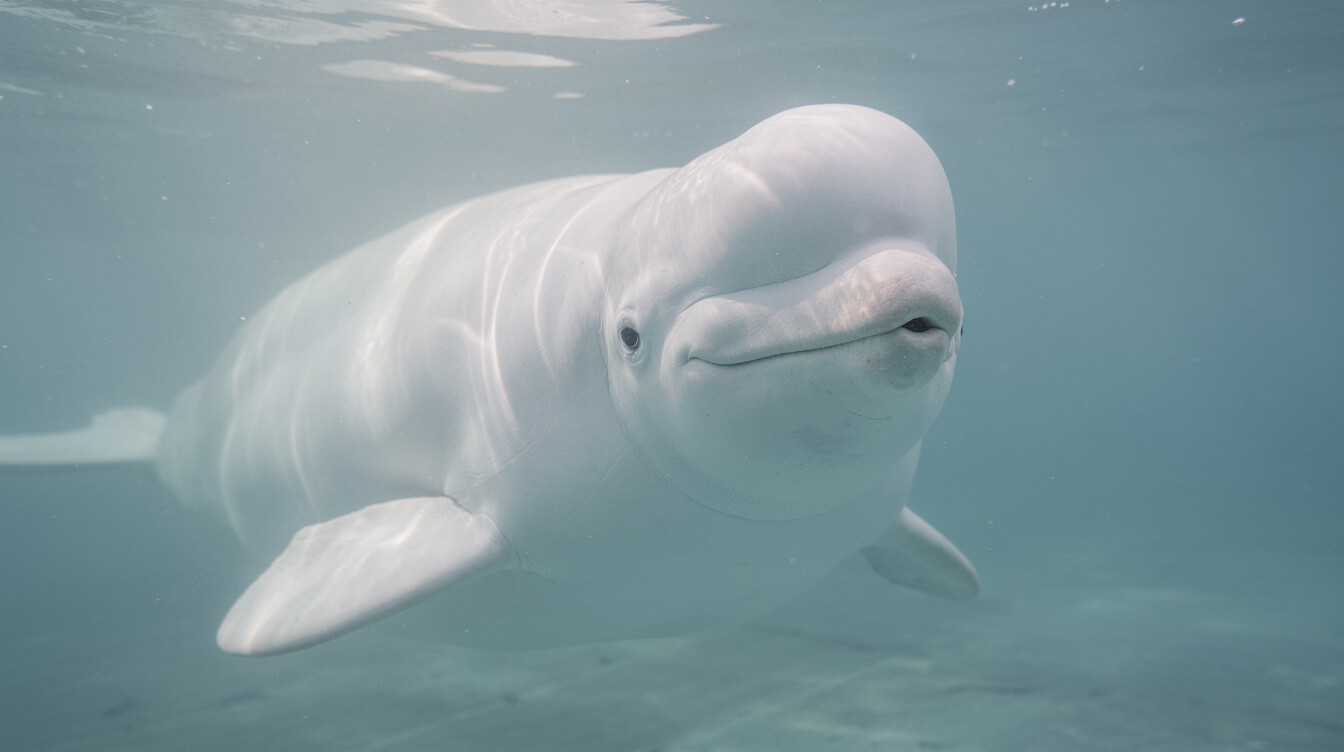
The beluga might be the cutest whale, and it has some genuinely unusual reasons. Its forehead is a large, soft, rounded bump called the melon, which it uses for echolocation, and in belugas the melon can actually change shape. Unlike most whales, a beluga’s neck bones are not fused together, so it can turn and nod its head, which gives it a much wider range of what look like expressions. It has no dorsal fin, which lets it swim easily under sea ice, and it is so chatty, with whistles, squeaks, and clicks, that sailors called it the sea canary. The species as a whole is rated Least Concern, though some local groups, like the belugas of Alaska’s Cook Inlet, are endangered.
The bottlenose dolphin
A dolphin always seems to be smiling. It is worth knowing that the smile is the shape of its jaw, not a mood. A dolphin wears the same face on a good day and a bad one, which is one more reason to give wild dolphins their space rather than reading that grin as an invitation.
The green sea turtle
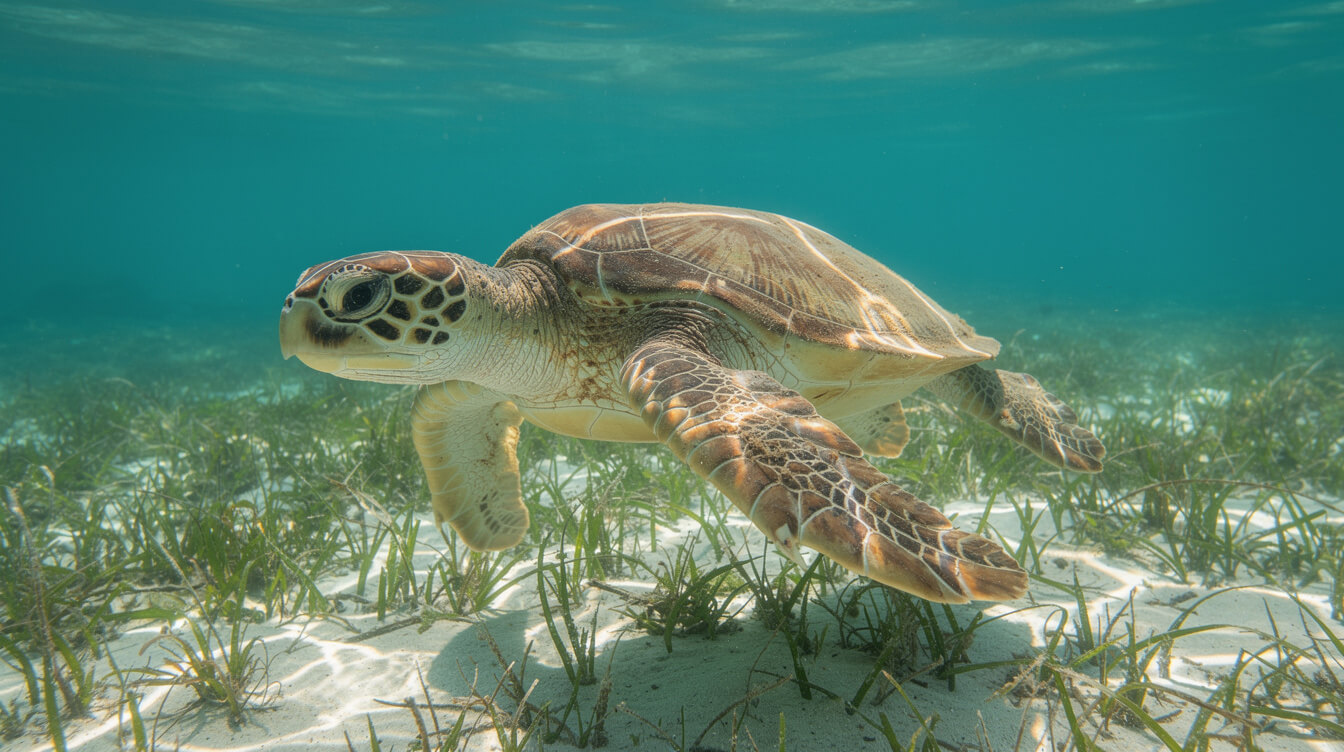
Green sea turtles have one of the calmest faces in the ocean, and adults live a calm sort of life, grazing on seagrass and algae in warm, shallow water. They are named for the green color of their fat, not their shells. And they are a rare piece of good news: after decades of protecting nesting beaches, the global Red List now rates the green turtle as Least Concern, even though several regional populations still struggle.
The Adélie penguin
At the far southern ice edge, Adélie penguins build their nests out of small stones on bare rocky ground. Good stones are scarce, and Adélies are known to quietly steal them from the neighbors’ nests when nobody is looking. Few things in nature are as relatable as a small penguin in a tuxedo making off with a pebble.
The cutemerch letter
A small good thing, once a week
One short, kind email with our coziest posts and new round animals from the shop. No spam. Unsubscribe anytime.
The deep sea’s soft little strangers
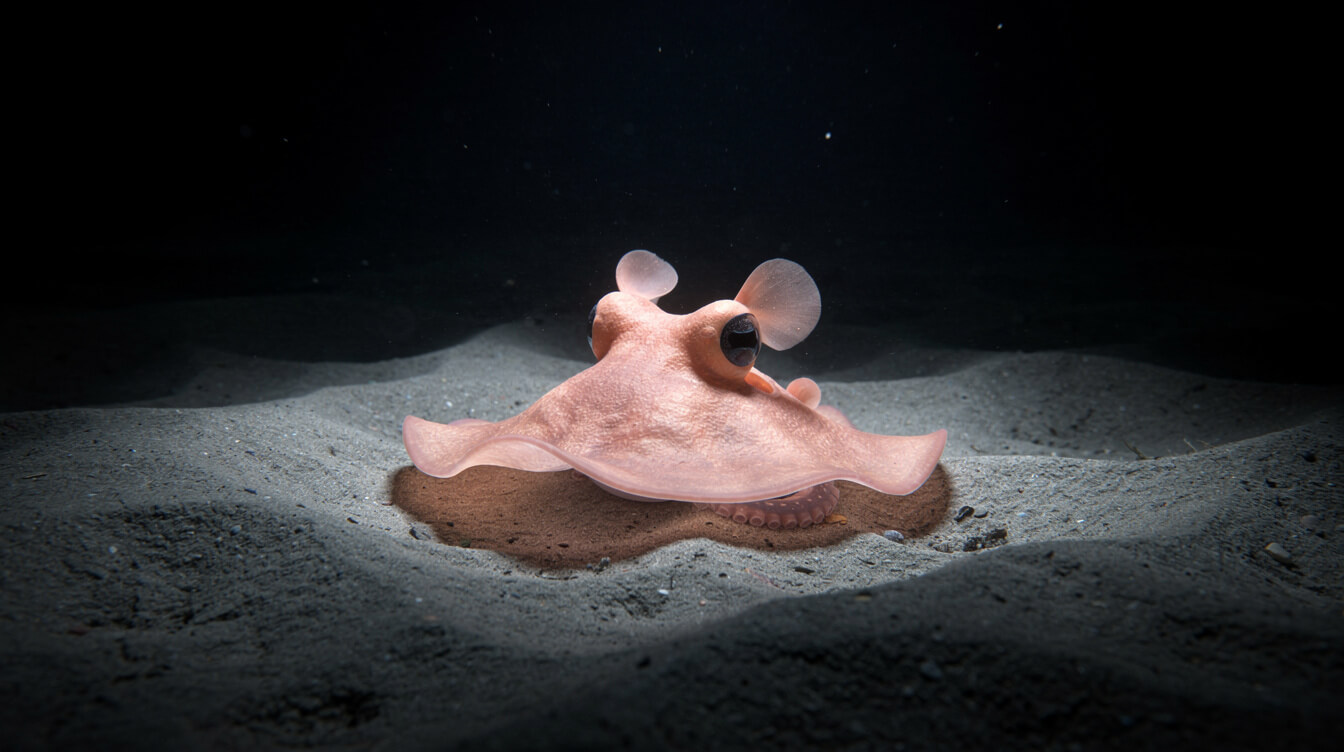
The deep sea has a reputation for monsters, and it does have a few. But the dark, cold water far below the surface is also home to some of the softest, strangest, and most quietly adorable animals on the planet. Many deep-sea animals have soft, watery bodies, and many move slowly. Food is scarce down there, so there is little reason to build heavy muscle.
The flapjack octopus
The flapjack octopus lives in the North Pacific, including the deep canyon off Monterey, California. It is small, with a body up to about 20 centimeters long, and it is pinkish, a little see-through, and gelatinous, like a gummy candy that learned to swim. Its eight arms are joined by webbing into an umbrella shape, and it has two small fins on top of its head that look a lot like ears. When it rests, it settles flat on the seafloor like a pancake, which is where the name comes from. To move, it flaps those little fins and pulses its webbed arms. Unlike shallow-water octopuses, it has no ink and cannot change color, which seems only fair, since it is already the right color.
Grimpoteuthis, the deepest octopus
The flapjack has finned cousins in the genus Grimpoteuthis, small umbrella octopuses with two large fins that flap like wings. They are the deepest-living octopuses we know of, usually found between about 1,000 and 7,000 meters down. In 2020, one was filmed nearly 7,000 meters deep in the Java Trench. Living that far down is a kind of protection: these little octopuses face very few direct threats from people.
The sea pig
The sea pig is not a pig, and it is barely a sea animal in the way most people picture one. It is a sea cucumber, about 4 to 6 inches long, pink and plump, walking across the muddy deep seafloor on small tube feet and eating whatever drifts down from above. Researchers at the Monterey Bay Aquarium Research Institute have often seen young crabs riding on top of sea pigs or hiding underneath them, which has earned the sea pig a gentle nickname as a deep-sea babysitter. Down here you would also find the giant isopod, a deep-sea cousin of the roly poly in your garden.
The sea angel
A sea angel is a small, see-through sea snail with no shell, and instead of a crawling foot it has two little wings that flap as it swims. The best-known species, Clione limacina, lives in cold northern water from near the surface down into the twilight zone, and the largest ones reach about 7 to 8 centimeters. Here is the honest, slightly less angelic part: it eats almost nothing but sea butterflies, tiny shelled swimming snails, and it grabs them with hooked tentacles that unfurl from its head. It can also go a full year without food, which is its own small marvel.
The softest face in the sea, on a soft tee
One round little sea bunny in a cream line badge on a rich purple tee, ears up, gill plume fanned, one tiny pink nose. For anyone who thinks the ocean’s best work is its smallest.
Look, don’t touch: the cute ones that carry a warning

This is the part of the ocean’s cute that deserves a gentle, honest word. Some of the sweetest-looking animals in the sea are also some of the most dangerous to handle, and their cuteness is not a sign that they are safe.
Pufferfish and tetrodotoxin
Many pufferfish carry tetrodotoxin, a nerve toxin concentrated in organs like the liver and sometimes the skin. It is serious. In lab tests on mice, tetrodotoxin swallowed by mouth is more than 20 times as deadly as potassium cyanide, weight for weight. You may have read a much bigger number online, and that one gets copied from site to site without a source, so we are sticking with the measured one. This is why fugu, the pufferfish served in Japan, is prepared only by specially trained chefs who know exactly which parts are safe. For a diver or snorkeler, the rule is simple: never touch or chase a puffer. Stressing one into inflating can hurt the fish, too.
The blue-ringed octopus
The blue-ringed octopus is small, usually about 12 to 20 centimeters, and it lives in tide pools and reefs from Japan to Australia. Resting, it is a mild yellowish brown. When it feels threatened, its 50 to 60 rings flash bright, shimmering blue in about a third of a second, and that beautiful flash is a warning. Its venom contains tetrodotoxin, made by bacteria living in its salivary glands. The bite is tiny and often painless, there is no antivenom, and it can be deadly. A blue-ringed octopus is docile and rarely bites anyone who leaves it alone, so leaving it alone is the whole plan.
The boxfish, again
Remember the little yellow box with polka dots? When threatened, boxfish release a toxic mucus from their skin. It is mostly a danger to other fish, especially in an aquarium where there is nowhere for it to wash away, but it is one more reason to admire reef fish without trying to hold them.
Wild mammals bite
Sea otters, seals, and sea lions are wild animals with strong jaws, and a curious-looking otter on a dock is not asking to be petted. NOAA, the US agency that looks after marine life, asks people to stay at least 50 yards from seals, sea lions, and sea turtles, and at least 100 yards from whales. That is about half a football field for a seal, and a whole one for a whale.
How to meet cute sea animals kindly

The good news is that you do not have to be a diver to fall in love with cute sea animals. You just have to meet them in a way that leaves them as well off as you found them.
Visit an accredited aquarium
A good aquarium is the easiest way to see a sea otter, a sea pig, or a sea angel up close. In the US, look for aquariums accredited by the Association of Zoos and Aquariums (AZA), which holds members to standards for animal care, education, and conservation. Many of the animals you see in accredited aquariums are rescued, bred in human care, or part of research that helps their wild relatives.
Watch a live cam
If an aquarium is not nearby, the Monterey Bay Aquarium runs free live cams, including a Sea Otter Cam, a Kelp Forest Cam, and a Jelly Cam. Leaving the otter cam on in a browser tab while you work is one of the nicer small habits we know.
Go tide pooling, gently
- Check the tide chart first. The best pools appear at low tide, and the water comes back faster than you think. Never turn your back on the waves.
- Step on bare rock. Avoid stepping on mussels, barnacles, anemones, and seaweed, which are all alive and easy to crush.
- Look more than you touch. If touching is allowed where you are, use one wet finger, gently, and never pull an animal off a rock.
- Put rocks back as you found them. If you turn one over, turn it back the same way up. The animals underneath depend on it.
- Take photos, not animals. Shells with someone still living in them, sea stars, and crabs all stay in the pool. Many parks and reserves protect tide pool life by law.
Give wild animals room
Whether you are on a beach, a kayak, or a whale-watching boat, follow the distance guidance above, never feed wild marine animals, and let them decide how close they want to be. A seal that lifts its head to look at you is already telling you that you are close enough.
Cute sea animal FAQ
What is the cutest sea animal?
Honestly, it depends on what kind of cute you love. For classic, fluffy cute, the sea otter is hard to beat. For tiny cute, the pygmy seahorse or the sea bunny. For gentle, expressive cute, the beluga. For strange, soft cute, the flapjack octopus. If you made us choose just one, we would quietly choose the sea otter wrapped in kelp.
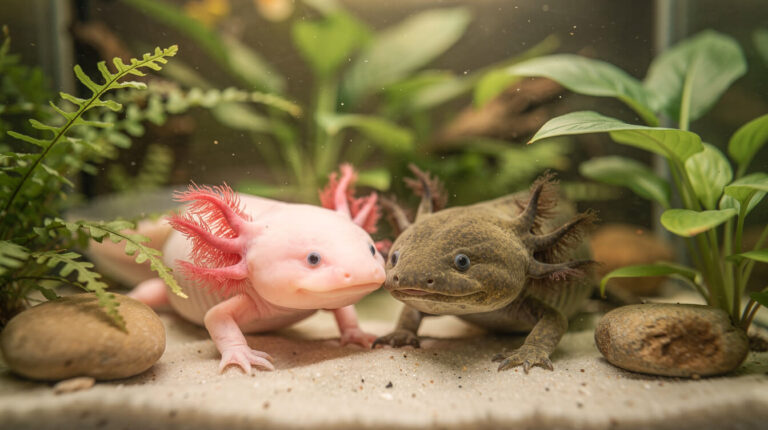
Is an axolotl a sea animal?
No, even though it often turns up on lists of cute sea animals. The axolotl is a salamander that lives in freshwater lakes and canals near Mexico City. Salt water would not suit it at all. If you love axolotls, our guide to how long an axolotl lives is a gentle place to start.
What is the smallest cute sea animal?
Among the ones in this guide, the pygmy seahorse, which is usually less than 2 centimeters tall. Some sea slugs, including the sea bunny and the leaf sheep, are about the same size or smaller.
Are sea otters endangered?
Yes. The sea otter is listed as Endangered on the global Red List. Populations were nearly wiped out by the fur trade and have recovered in some places, but they still face oil spills, disease, and other threats.
Can you touch a pufferfish?
Please do not. Many pufferfish carry tetrodotoxin, and handling one stresses the fish and can push it to inflate, which is hard on its body. Admire it from a respectful distance.
Final thoughts
The ocean did not make cute sea animals for us. It made round bodies to stay warm, big eyes to see in the dark, and soft, slow bodies because the water holds them up. That we look at all of it and feel a small, warm tug is a happy accident, and maybe one of the nicer ones in nature.
So the next time a sea otter in a kelp blanket or a tiny polka-dot boxfish makes your day a little softer, let it. Then let it be. The kindest way to love a cute sea animal is to want it to stay wild, healthy, and exactly where it belongs.
Before you go
Want the next one in your inbox?
We write something soft every day. The best of it lands in one gentle weekly note, for you or for the friend who needs it.