
Goblincore outfits for people who actually go outside
Search for goblincore outfits and you mostly get a wall of pins: beautiful, moody, and very hard to copy, because you cannot see the fabric, the fit, or what happened when the person in the photo walked through a wet field. This guide is the part the pins leave out. Goblincore is the aesthetic of moss, mushrooms, frogs, and pockets full of small found things, and the clothes that suit it best are the ones built to go outside and come back a little muddier. Here is how to put those outfits together from real pieces, in real weather, without it ever turning into a costume.
If you are brand new to the aesthetic itself, our gentle introduction to what goblincore is and why it counts as cute covers the feeling behind it. This piece stays with the wardrobe: the colors, the fabrics, five outfit formulas you can build this week, the one creature rule, and how to shop secondhand without bringing home something that falls apart by November.
What goblincore outfits actually are (and what they are not)

The simplest way to describe goblincore outfits is this: clothes for someone who is about to kneel down to look at a mushroom. Everything else follows from that one picture. The pieces are loose enough to crouch in, sturdy enough to get a bit of dirt on, warm enough for a damp morning, and full of pockets for whatever turns up along the way.
That is the real difference between goblincore and its close relatives. Cottagecore outfits imagine the garden from the kitchen window: clean linen, a pressed apron, a basket of bread. Fairycore is about light and gauze and tiny wings of fabric. Goblincore is the one that actually went outside, sat on a log, and lost track of time watching a snail. The clothes look like they have a history, because ideally they do.
What it is not
It is not a fantasy costume. You will see plenty of pinned looks with pointed hoods, tattered capes, and prop accessories, and they can be lovely as photography. They are not what most people mean when they say they dress goblincore, and they are hard to wear to a grocery store. It is also not “messy” in the sense of careless. The best goblincore outfits are quite deliberate about color and texture. They simply choose comfort and character over polish.
And it is not gendered. The related searches for this topic split neatly into men’s and women’s versions, but the actual wardrobe barely changes between them. Corduroy, knitwear, overshirts, sturdy boots, and earth tones work on everybody. Where a skirt or a pair of dungarees appears below, read it as one option, not a rule.
The goblincore outfits palette: dressing like the forest floor

Color is where goblincore outfits either click or quietly fall apart, and the good news is that the forest has already done the color theory for you. Look down on any walk in autumn and you will see the whole palette: moss, bark, wet leaves, lichen, a pale mushroom cap, one bright red berry.
The core colors
- Moss and olive greens. The backbone. Olive reads as practical, moss reads as alive, and both sit happily next to brown.
- Bark, walnut, and chocolate browns. Your neutral. Brown does for goblincore what black does for most city wardrobes.
- Mushroom cream and oatmeal. The light note. A cream knit or a natural linen shirt keeps a dark outfit from feeling heavy.
- Rust, ochre, and muted orange. Fallen-leaf colors. Use one at a time, as an accent.
- Slate grey and stone. For people who find brown too warm. Grey with olive looks like a rainy riverbank.
The three-color rule
Pick two or three colors from that list per outfit and repeat them. This is the single most useful trick for making a thrifted, mismatched-on-purpose look feel intentional rather than random. An olive overshirt, brown cords, and cream socks is three colors. Add a rust scarf and you have an accent. Add a purple jacket and the outfit stops reading as a forest and starts reading as a closet.
One warm surprise
Real forest floors are not purely brown and green. There is always one small, unexpected color: a red berry, a blue jay feather, the pink inside a shell. A single soft note in an otherwise earthy outfit, like a dusty rose tee under an olive overshirt or a berry-colored beanie, makes the whole look feel more found and less like a uniform. Keep it to one, and keep it muted rather than neon.
Texture does the work: corduroy, knits, canvas, and the worn-in test

If the palette is the forest floor, texture is what makes it feel touchable. A goblincore outfit in smooth, flat fabrics looks oddly unfinished, even in the right colors. The same outfit in ribbed, nubby, and slightly rough materials suddenly looks right. Most of the styling is really fabric choice.
Fabrics that belong here
- Corduroy. Wide-wale cords are the closest thing goblincore has to a signature fabric. They are warm, they age well, and the ribs catch light like a ploughed field.
- Wool and wool-blend knits. Chunky cables, fisherman ribs, and slightly uneven hand-knit textures. Wool stays warm when it is damp, which matters more than it sounds.
- Canvas and waxed cotton. For jackets, overshirts, and bags. Canvas softens beautifully over years, and waxed cotton shrugs off drizzle.
- Linen and heavy cotton. For warm months. Linen wrinkles, and in this aesthetic a wrinkle counts as character.
- Flannel. The overshirt that turns any plain tee into an outfit.
Worn-in versus worn-out
Goblincore loves things with a past, which makes it very easy to talk yourself into a garment that is simply falling apart. The difference between worn-in and worn-out is worth learning, because it is the difference between a piece you will wear for ten years and one that will be in a donation bag by spring.
Worn-in is good: softened fabric, a gentle fade along the seams, a little pilling on a knit, a scuff on boot leather, a small mended spot. These are signs the garment has been loved and survived it.
Worn-out is not: fabric that has gone thin enough to see light through when you hold it to a window, seams pulling apart under a light tug, knit that has stretched out of shape at the cuffs and will not spring back, a cracked boot sole, a zipper missing teeth. These are signs the garment is near the end of its life, and no amount of aesthetic will hold it together.
The quick test in a shop is to hold the piece up to the light, give each main seam a gentle pull, and stretch a cuff slightly to see if it returns. Thirty seconds, and it saves you from the classic thrift heartbreak.
Five goblincore outfits you can build this week

These are formulas, not shopping lists. Each one is built from pieces most people already own in some form, and each is named for the kind of day it suits. Swap freely. The point is the shape of the outfit, not the exact items.
1. The slow walk
Olive or brown corduroy trousers, a plain cream or grey tee, an open flannel overshirt, thick socks, and boots that have actually seen a trail. Add a canvas tote for anything you pick up. This is the everyday goblincore uniform, and it works just as well on a city sidewalk as on a woodland path.
2. The library corner
Dark straight-leg trousers or a long wool skirt, a collared shirt, and a chunky knit sweater vest or cardigan over the top. Small earrings or a pin in the shape of a leaf, a moth, or a mushroom. It is quiet enough for work or class and still clearly yours, because the textures and the one small creature detail do all the talking.
3. The rainy day
A waxed or canvas jacket with a hood, a wool sweater underneath, sturdy trousers you do not mind splashing, and waterproof boots. A wool beanie in rust or moss. Goblincore is unusually good at rain, because the aesthetic was never trying to stay clean in the first place. You can wear this and still enjoy the puddles.
4. The warm afternoon
Loose linen trousers or a cotton midi skirt, a soft graphic tee or a cropped linen shirt, canvas sneakers that are a little scuffed, and a bucket hat. Roll the sleeves. Summer goblincore is mostly about natural fabrics and keeping the palette earthy even when the layers come off.
5. The barely-there version
Your normal jeans, your normal top, and one thing: a corduroy jacket, a frog pin on your bag, a mushroom-print scarf. This reads as an ordinary outfit first and a goblincore one second, which is exactly right for days when you want the feeling without having to explain it. Many people live in this version most of the time.
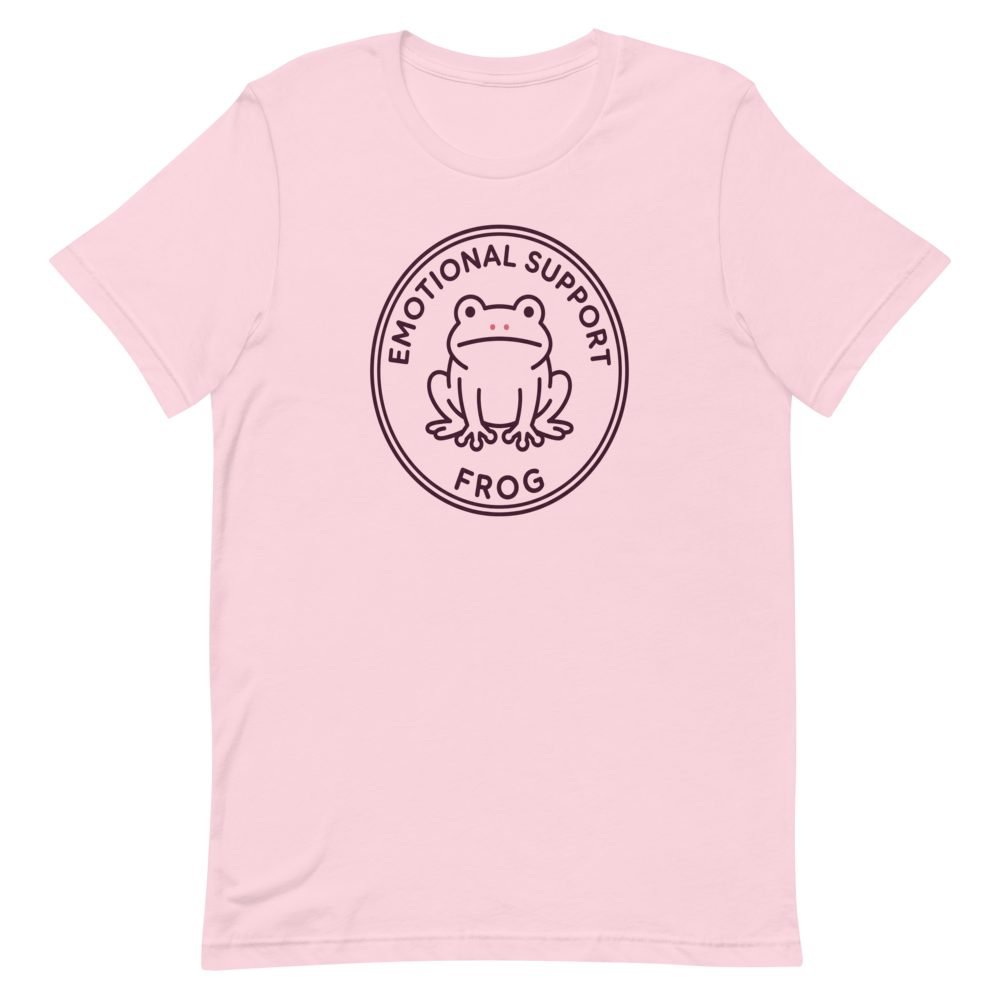
Notice that a graphic tee shows up in two of these. A soft tee with a creature on it is one of the easiest ways to carry the aesthetic, because it sits under any overshirt or cardigan and only appears when you open the layer. Our Emotional Support Frog tee was made for exactly that job: a calm little frog badge on soft pink cotton, the one warm surprise under a brown flannel. If you want more on making any animal shirt look grown-up rather than costumey, our guide to wearing a round animal t-shirt well goes deeper.
The cutemerch letter
A small good thing, once a week
One short, kind email with our coziest posts and new round animals from the shop. No spam. Unsubscribe anytime.
The one creature rule: wearing frogs, snails, and mushrooms

Goblincore has its own small cast: frogs, toads, snails, beetles, moths, and, technically not animals but honorary members, mushrooms. Wearing one of them is the clearest signal of the aesthetic there is. Wearing six of them at once is how a goblincore outfit tips into a costume.
So here is the rule we come back to: one creature per outfit. One frog tee. Or one snail pin. Or one mushroom embroidered on a cardigan pocket. Everything else stays plain and textural, and the creature gets to be the point. It works for the same reason a single good brooch beats a jacket covered in them. The eye has somewhere to land.
Where the creature goes
- On a tee, under a layer. The most wearable option. It is visible when you want it and covered when you do not.
- On a pin or patch. Bags and jacket lapels are perfect. A pin can move between outfits, which makes it the cheapest creature you will ever own.
- In jewelry. A small frog ring, mushroom earrings, a snail-shell pendant. Keep it small and keep it to one piece.
- On socks. A secret creature, only visible when you sit down. Goblincore people tend to love this.
Drawn with affection
One more thing to check before you buy any creature design: does it like the animal? A lot of frog and snail merchandise treats the creature as a gross-out joke. Goblincore people do not find their animals gross. They find them lovely, and a design that gets that backward will never feel right to wear. We wrote more about this test in our cute frog gift guide, and the short version is that affection reads instantly from across a room. If you want to know why frogs in particular have this pull on us, our piece on the real reasons we cannot stop looking at cute frogs has the long answer.
Your one creature, sorted
A calm, unbothered little frog in a simple badge, printed on a soft pink cotton tee. It is the warm surprise under an olive overshirt, and it is drawn with real affection for the frog.
Pockets, boots, and weather: the practical half of goblincore outfits
Here is the part almost nobody writes about, and it is the part that makes goblincore outfits feel real rather than staged. This is an aesthetic for people who go outside, stop, crouch, pick things up, and stay out longer than they planned. Clothes that cannot handle that are only dressing up as goblincore.
Pockets are not optional
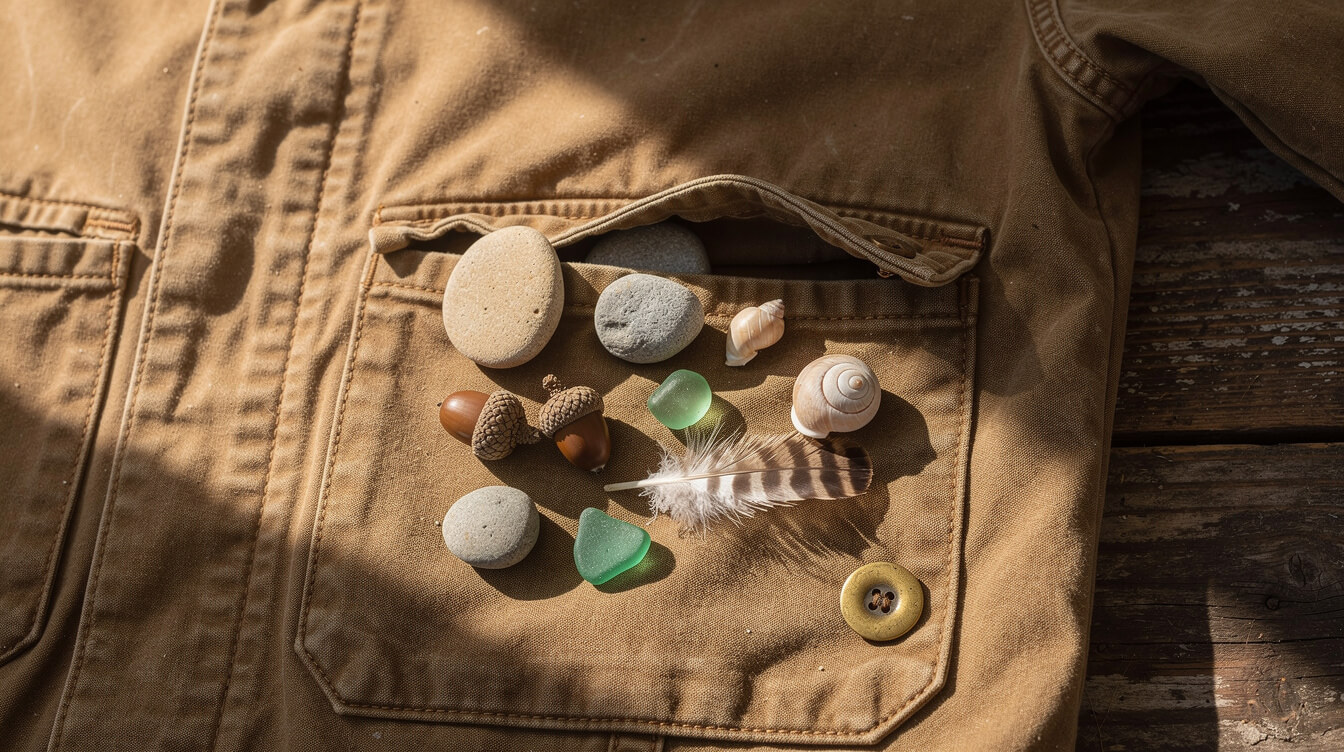
The whole culture runs on found objects: the smooth pebble, the acorn with its little cap still on, the snail shell, the odd brass button from the path. They need somewhere to go. Before you buy any jacket, trousers, or skirt for this wardrobe, put your hand in the pockets. Are they deep enough to hold a pine cone? Do they close, or at least sit at an angle so things do not fall out when you bend? A chore jacket with four patch pockets is worth three beautiful jackets with none.
Boots that can actually walk
Footwear makes or breaks the look and the day. You want soles with real grip, leather or treated canvas that can handle mud, and a fit comfortable enough for an hour of wandering. Scuffs are welcome. Blisters are not. If you are buying secondhand boots, check that the sole is not separating at the toe and that the heel is not worn down on one side, because both are hard to fix and will make every walk less pleasant.
Layers you can take off and carry
Autumn and spring mornings start cold and end warm. Build outfits so the top layer comes off easily and has somewhere to go, either tied around your waist or folded into a tote. That is one reason the overshirt is such a goblincore staple: it is warm when you need it and easy to carry when you do not.
Fabrics that forgive damp
Wool stays warm when wet. Waxed cotton sheds light rain. Heavy cotton dries slowly, so save it for dry days. If you spend much time on damp grass, a pair of wool socks will do more for your comfort than any other single item in this guide.
Washing what you wear outside
Clothes that live outdoors get washed more often, which is hard on prints and knits. Brush dry mud off before it goes in the machine, wash knits cold and dry them flat, and turn graphic tees inside out. Our guide on how to wash graphic tees so the design stays soft and bright covers the details, and it is the difference between a creature tee that lasts one season and one that lasts years.
Building a goblincore wardrobe secondhand, without the heartbreak

Goblincore and thrifting belong together. The aesthetic genuinely prefers clothes with some history, and earthy, slightly dated pieces are exactly what secondhand racks are full of. A brown corduroy jacket that nobody wanted in 2015 is, right now, a small treasure. Here is how to hunt well.
Where to look in the shop
- The men’s knitwear section, whatever you usually shop. It is often the best source of chunky, oversized wool sweaters in exactly the right browns and greens.
- Outdoor and workwear. Chore coats, canvas jackets, flannel shirts, and wool socks built for actual use.
- The scarf and accessory bins. Old brooches, tiny pins, and wool scarves in rust or moss are cheap and do a lot of work.
A small starter wardrobe
You do not need much. A capsule like this one covers almost every day from October to April:
- One outer layer: a canvas chore jacket or a corduroy jacket.
- One overshirt: flannel in olive, brown, or a muted plaid.
- Two knits: one chunky sweater and one cardigan or vest.
- Two or three tees: neutral basics plus one creature tee.
- Two bottoms: corduroy trousers and a sturdy pair of jeans or a long skirt.
- One pair of walking boots and a stack of wool socks.
- One canvas tote for everything you will inevitably find.
That is roughly a dozen pieces, and they all go with each other because they all share the same forest palette. Build it slowly. The aesthetic rewards a wardrobe that looks collected over time, not bought in one afternoon.
Mixing in new pieces
Not everything has to be secondhand. Basics like socks, tees, and boots are often worth buying new so they fit well and last. The goal is a wardrobe that feels like yours and holds up to being worn outside, and the mix of old and new is usually what gets you there. If you like the idea of borrowing from neighboring aesthetics as you build, our overview of cute aesthetics and how to find the one that is yours shows where goblincore overlaps with its cousins.
Goblincore outfits: frequently asked questions
Is goblincore an aesthetic or a fashion style?
Both. It began as an online aesthetic around nature, small creatures, and found objects, and the clothing grew out of it. You can enjoy goblincore without dressing it, and you can wear goblincore outfits without decorating your home that way. Most people do a little of each.
Where can I find goblincore outfits?
Mostly in secondhand shops, outdoor and workwear sections, and your own closet. Earthy knits, corduroy, flannel, canvas, and walking boots are the foundation. Specialty shops sell pieces labeled “goblincore,” but a plain brown corduroy jacket from a thrift rack will often serve the look better than anything with the word on the tag.
What do men’s goblincore outfits look like?
Very much like everyone else’s. Corduroy trousers, a chunky knit or flannel overshirt, a canvas chore jacket, boots, and one creature detail like a frog pin or a mushroom tee. The wardrobe is genuinely unisex, which is one reason the aesthetic has such a broad and welcoming community.
Can I wear goblincore to work or school?
Yes, and easily. Use the library corner or barely-there formula above: neat trousers, a collared shirt or plain top, a knit layer, and one small creature detail. It reads as thoughtful and cozy rather than themed.
Does goblincore have to look messy?
No. It looks lived-in, which is different. Clothes can be clean, well cared for, and well chosen while still carrying a little wear and a lot of texture. Deliberate color and good fabrics are what keep the look from tipping into careless.
What is the difference between goblincore and cottagecore outfits?
Cottagecore leans romantic, tidy, and domestic: florals, linen, pressed collars. Goblincore leans practical, earthy, and outdoorsy: corduroy, wool, pockets, and mud-ready boots. They share a love of nature and secondhand clothes, and plenty of people happily mix the two.
Dressed for the walk
The best goblincore outfits are not the most elaborate ones. They are the ones you can actually live in: soft enough to sit on a log, sturdy enough for rain, warm enough to stay out a bit longer, and with deep enough pockets for whatever the path gives you. A few earthy colors, good textures, one small creature you genuinely love, and boots that can walk. That is the whole wardrobe.
So start with what you have. Pull out the brown sweater, the old cords, the overshirt you forgot about. Put a pebble in the pocket on your next walk. The aesthetic will meet you there, a little muddy and very pleased to see you.
Before you go
Want the next one in your inbox?
We write something soft every day. The best of it lands in one gentle weekly note, for you or for the friend who needs it.