Leaf sheep sea slugs: the tiny solar-powered slug that looks like a lamb
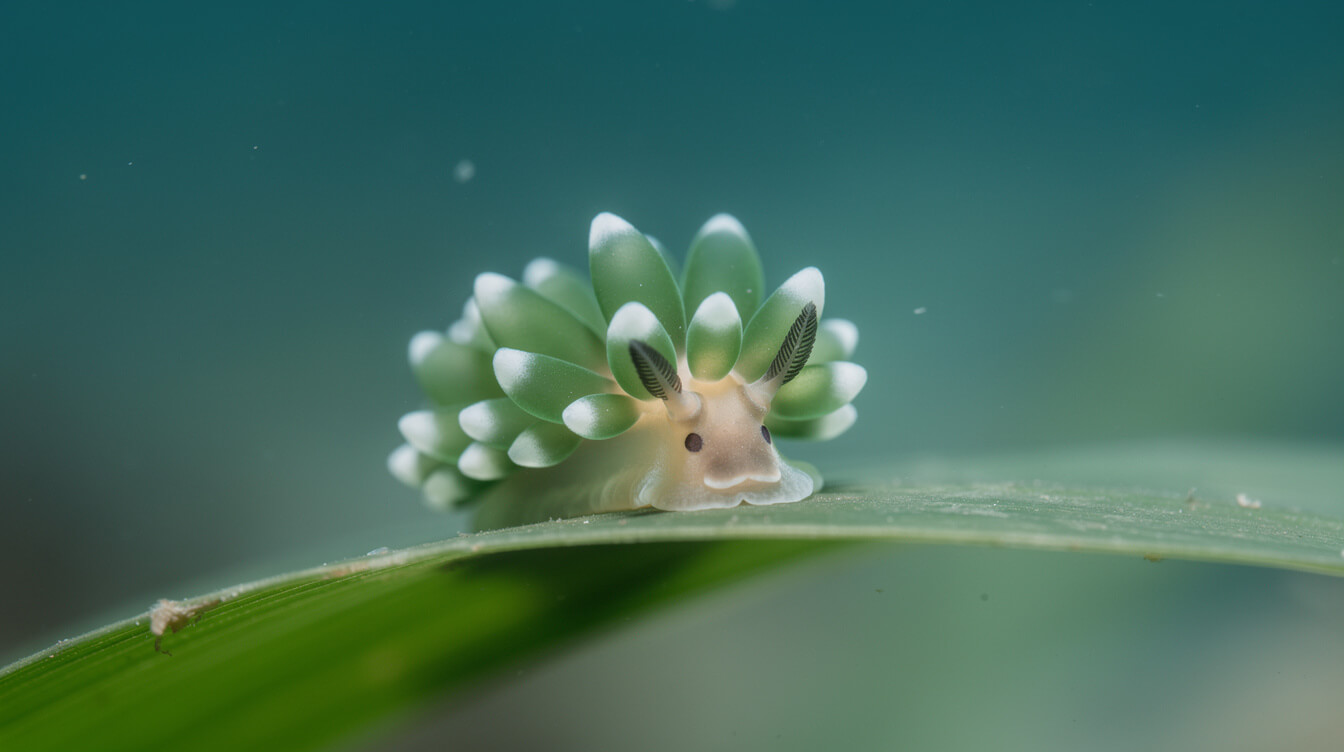
Some animals look like they were invented by someone who wanted to cheer you up. Leaf sheep sea slugs are one of them. Picture a lamb the size of a grain of rice, wearing a coat of bright green leaves, with two dark ears and two tiny dark eyes set close together on a pale little face. Now put it underwater, on a blade of seaweed, somewhere in the warm western Pacific. That is the whole animal, and it is real.
This summer it also became a small celebrity. In August 2026 the leaf sheep won The Guardian’s Invertebrate of the Year reader vote, ahead of the world’s biggest bumblebee and the horseshoe crab, and people have been searching for it ever since. Most of what they find is a short video and a caption that says “solar-powered.” This is the longer, gentler version: what the leaf sheep actually is, why it reads as a lamb, how it keeps the sunlight it eats, and how much of the “solar-powered” story holds up.
What are leaf sheep sea slugs? The short answer

Leaf sheep sea slugs are a single species of tiny marine slug called Costasiella kuroshimae. You will also see it called the leaf slug, the sea sheep, or the little leaf-sheep. Yes, it is a real animal and not a render, which is the first question most people ask after they see a photo.
A few quick facts to hold onto:
- Size: about 5 to 10 millimeters long. A large one is roughly the width of a fingernail. Most are smaller.
- Where: warm, shallow waters around Japan, the Philippines, and Indonesia, with sightings reported elsewhere in the tropical western Pacific.
- When we met it: it was only formally described by science in 1993, from the waters off Kuroshima, a small island in Okinawa. The species name, kuroshimae, means “of Kuroshima.”
- What it eats: green algae from one genus, Avrainvillea, a felt-textured seaweed that grows from fine silt around shallow reefs.
- Conservation status: not evaluated. It has never been assessed for the Red List, which is different from being safe or being endangered. Nobody has done the counting yet.
The family tree matters here, because it explains almost everything else about this animal. Leaf sheep belong to a group of sea slugs called sacoglossans, sometimes nicknamed “sap-sucking sea slugs.” There are only about 284 recognized species of them in the whole ocean. They are distant relatives of the bright nudibranchs you may have seen in reef photos, but they make their living in a completely different way. Nudibranchs mostly eat animals. Sacoglossans eat plants, or more exactly, the insides of algae.
Every sacoglossan has a single row of tiny teeth on its tongue-like radula, and those teeth are shaped for one job: slitting open an algal cell wall so the slug can suck out what is inside. The group’s name even comes from the Greek for “shield” and “tongue.” It is a quiet, careful way to eat, one cell at a time, and the leaf sheep is very particular about which seaweed it will eat it from.
Why a leaf sheep looks like a tiny lamb

Plenty of animals are cute. Very few are cute in such a specific way that half the internet independently landed on the same nickname. “Leaf sheep” works because three separate features line up with how we picture a lamb, and it is worth taking them one at a time.
The coat is made of cerata
Those plump green “leaves” along its back are called cerata (one is a ceras). They are soft, finger-like outgrowths of the body, set in neat rows, often with pale or white tips. Seen from above or from the front, the rows overlap like a fleece that has just been washed and fluffed. They are not decoration. As we will see in a moment, the cerata are where the slug keeps the most interesting thing it owns.
The ears are rhinophores
The two dark shapes that stand up from the head are rhinophores, the slug’s scent and chemical sensors. Most sea slugs have a pair. On the leaf sheep they happen to sit exactly where a lamb’s ears would be, angled slightly outward, darker than the face below them. That single coincidence of placement does a surprising amount of the work.
The face does the rest
Then there are the eyes. Two small, dark, round eyes, set close together on a pale snout, low on the head. That is the arrangement our brains read as gentle and young, the same proportions we covered in our piece on why weird cute animals win our hearts. A leaf sheep’s eyes are actually very simple light sensors, nothing like a lamb’s, but the layout is enough. Put a fleece, two ears, and a soft face together, and the brain fills in the sheep before you have finished looking.
The important thing is that none of it was made for us. The cerata are for feeding and storage, the rhinophores are for smelling the water, and the eyes are for telling light from shade. The lamb is entirely in the eye of the viewer, which, for a creature this small, is a nice reminder that cute is often a happy accident of being shaped for something else.
Kleptoplasty: how leaf sheep sea slugs keep the sunlight they eat

Here is where leaf sheep sea slugs go from cute to genuinely remarkable. When a leaf sheep sucks out the inside of an algal cell, it does not digest everything. It keeps the chloroplasts, the tiny green structures that let plants and algae turn sunlight into sugar, and moves them into its own body.
This has a lovely name: kleptoplasty, from the Greek for “theft” and “formed thing.” Plastid stealing. The stolen chloroplasts end up inside cells lining the slug’s branching digestive gland, and that gland runs right up into the cerata. So the green you see in a leaf sheep’s coat is not the slug’s own pigment. It is borrowed sunlight machinery, packed into the leaves along its back, still intact and for a while still working.
Among animals, this trick is unusual. Sacoglossans are the only animals known to keep working chloroplasts this way. A few single-celled organisms do something similar, but no fish, no coral, no other sea slug group does it quite like this. (Some nudibranchs host living algae inside their bodies, which is a partnership rather than a theft, and which we touched on in our guide to nudibranchs.)
Every generation steals its own
One detail makes this feel a little more tender. A leaf sheep cannot pass its chloroplasts on to its young. The eggs do not come pre-stocked with green. Each new slug hatches, settles, finds the right seaweed, and starts collecting chloroplasts from scratch. Every leaf sheep you have ever seen a photo of built its own green coat, one sip of algae at a time.
Why it is so picky about seaweed
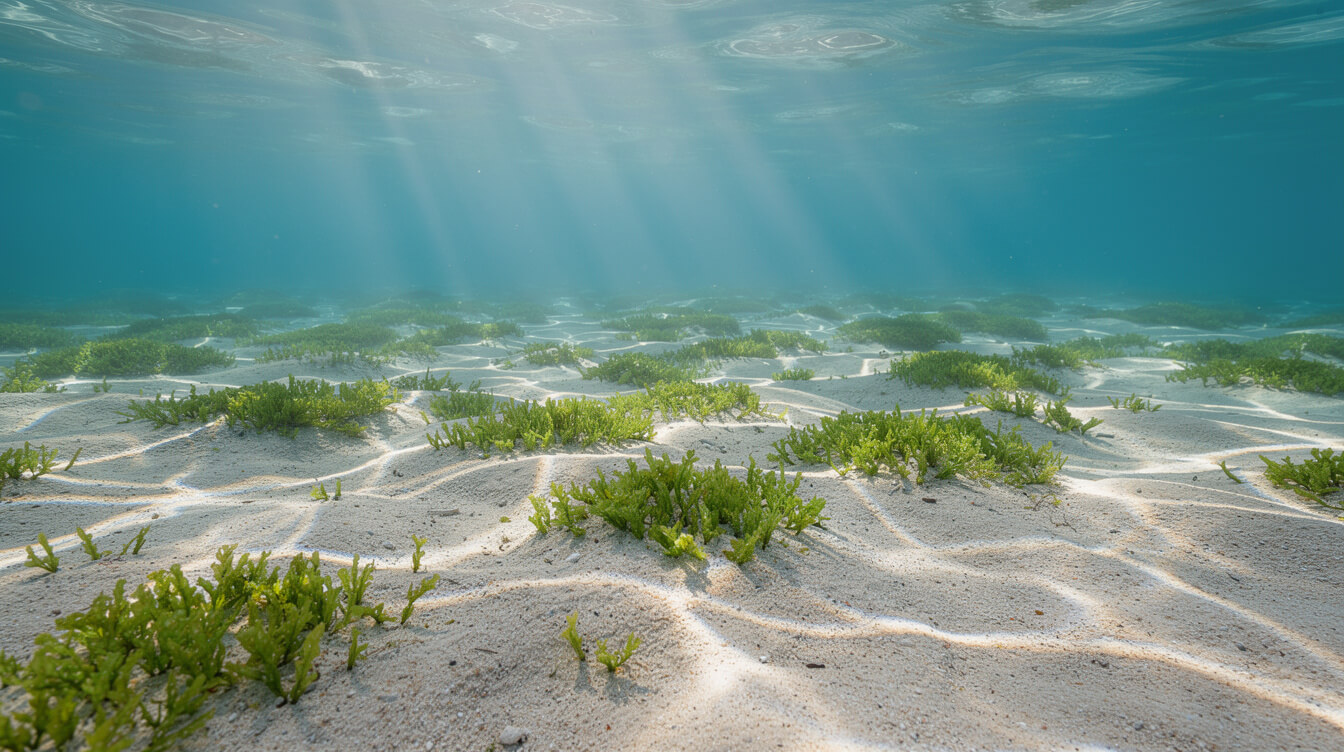
Not every chloroplast survives being moved into an animal. Some fall apart within hours. Others last days or weeks, depending on the slug species and the alga it came from. That is part of why sacoglossans tend to be such specialists. A leaf sheep feeds on Avrainvillea and essentially nothing else, which keeps it tied to the fine, silty patches of shallow reef where that seaweed grows. Its whole life happens on a few clumps of green felt.
Is a leaf sheep really solar-powered? The honest answer
Almost every caption calls the leaf sheep “solar-powered,” and it is a wonderful phrase. It is also only partly true, and we think the real answer is more interesting than the slogan.
The stolen chloroplasts can still photosynthesize after they are moved into the slug, at least for a while. So in a narrow sense, yes, a leaf sheep can carry out some photosynthesis. Research on its genus, Costasiella, describes the chloroplasts as kept for short-term photosynthesis rather than months of steady solar living.
Here is the part the captions leave out. When scientists measure how much sacoglossans actually get from those chloroplasts, the benefit for many species turns out to be small, sometimes described as “marginal at best.” In some experiments, slugs kept in the dark survived about as well as slugs kept in the light. How long a sea slug can last without food seems to depend more on how well that species copes with starving than on how much its chloroplasts are photosynthesizing.
So what are the chloroplasts for? The current best description is something like a pantry. The stolen plastids, and the sugars and starches they hold, act as an emergency store the slug can draw on when food is scarce. They may help a little with growth in some species. They are not a replacement for eating. A leaf sheep still spends its days slowly grazing on seaweed, like a lamb in a very small, very wet field.
The stolen-genes story belongs to a different slug
You may also have read that these slugs “stole plant genes” to keep their chloroplasts running. That claim comes from a different sacoglossan, the eastern emerald elysia, Elysia chlorotica, which can keep its chloroplasts working for up to ten months. Even there, the gene idea has been argued over for years. Researchers looked for the same kind of borrowed algal genes in Costasiella and did not find them. So if you see a leaf sheep video that says it carries plant DNA, that is a mix-up between cousins.
None of this makes the leaf sheep less wonderful. An animal that keeps sunlight machinery alive inside its own cells, even briefly, even as a backup pantry, is still one of the strangest small things in the sea. It is just a little more like a careful saver than a tiny solar panel.
The cutemerch letter
A small good thing, once a week
One short, kind email with our coziest posts and new round animals from the shop. No spam. Unsubscribe anytime.
Leaf sheep vs nudibranch vs sea bunny: which sea slug is which
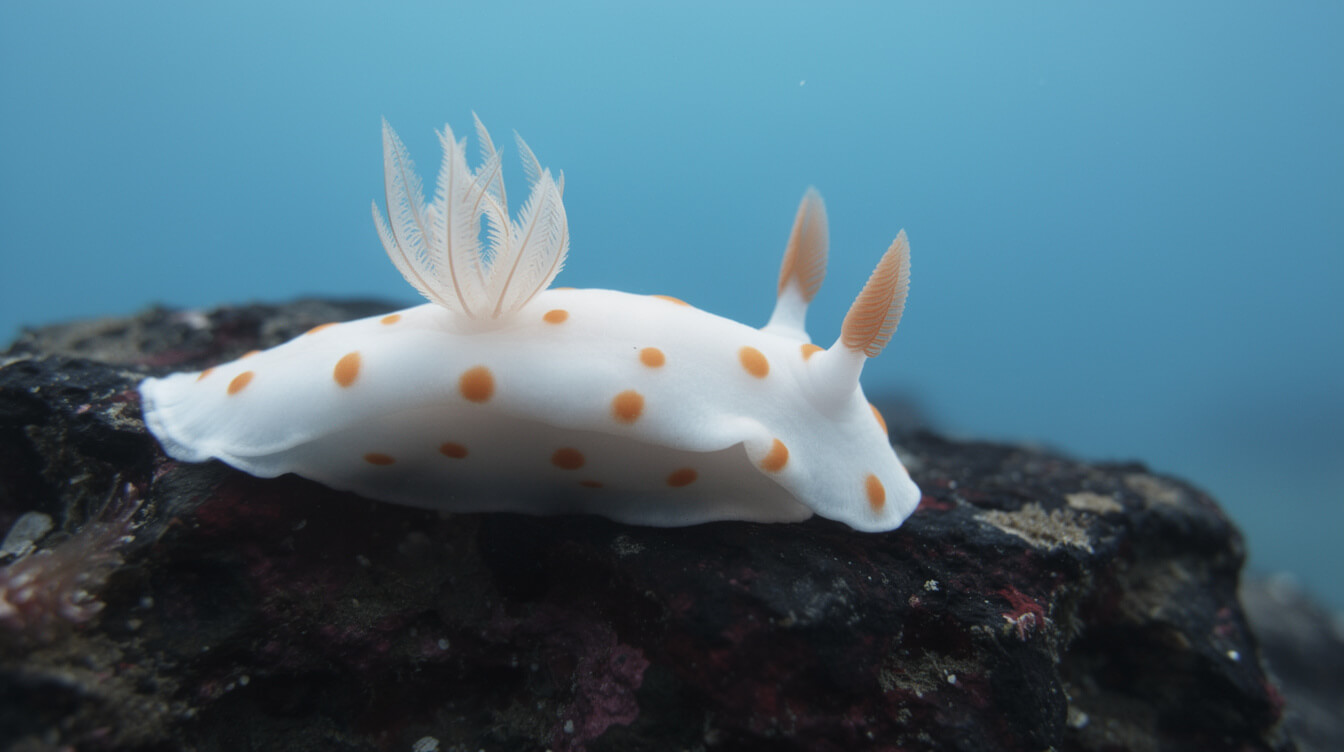
Online, every soft and small sea slug gets filed under one word, and it is usually “nudibranch.” Even some careful science writing captions the leaf sheep as a “sheep nudi.” It is an easy mistake, and a gentle one, but these are different animals with different lives. Here is the short sorting guide.
The leaf sheep: a sacoglossan
Eats algae by piercing cells and sucking out the contents. Keeps the chloroplasts. Green because of what it eats. Has cerata along its back that act as storage for that stolen green. Mostly harmless and mostly vegetarian.
Nudibranchs: the bright reef ones
Nudibranchs are a separate, much larger group, with more than 3,000 species. Most eat animals, things like sponges, sea anemones, and hydroids. Many are brightly colored as a warning, and some even borrow stinging cells from their prey. If you want the full story of how they wear their warnings, our nudibranch explainer covers it, so we will not repeat it here.
The sea bunny: a nudibranch that looks like a rabbit
The sea bunny is a nudibranch, not a sacoglossan. It is the fuzzy white-and-black-spotted one whose rhinophores look like rabbit ears and whose soft-looking surface is covered in tiny sensory projections. It is the leaf sheep’s internet cousin more than its biological one, and we wrote about it in what is a sea bunny.
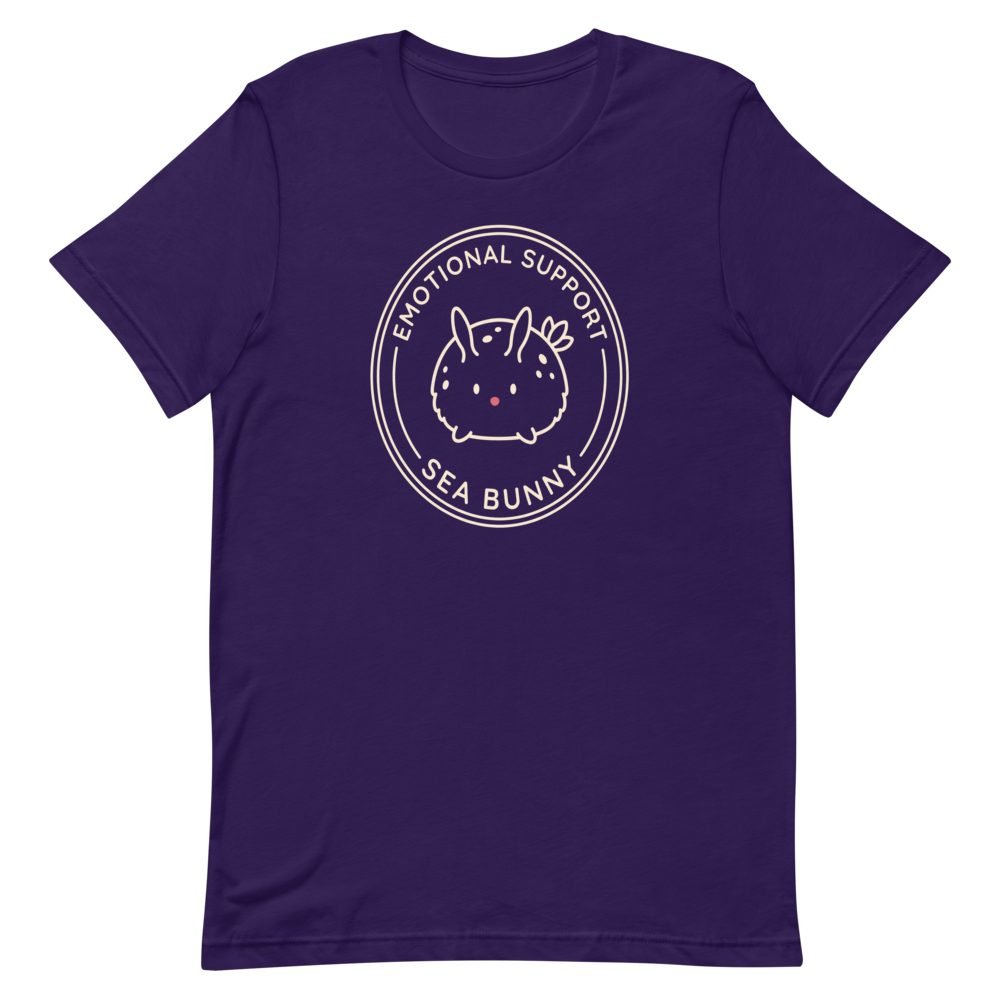
The easy rule: if it is green because it eats seaweed and keeps the chloroplasts, think sacoglossan. If it is bright, eats animals, and has a feathery gill plume or stings, think nudibranch. The leaf sheep and the sea bunny both earn the “too cute to be real” reaction, though, and they share a corner of our desk. We have not drawn a leaf sheep yet, but its closest cousin in the shop is our Emotional Support Sea Bunny T-Shirt, a small cream line drawing of a round sea slug on a soft purple tee.
A soft sea slug for your corner
The leaf sheep’s closest cousin on our shelf: a round little sea bunny in a cream badge, with two tiny rhinophore ears and a small gill plume, on a soft purple tee. No seaweed required. Just a gentle reminder that the ocean is full of small, quiet, impossibly cute things.
Can you keep a leaf sheep, and where do divers find them?

It is a natural wish. Something this small and this sweet seems like it would be happy in a little tank on a desk. The honest answer is no, and the reasons are all about how specific its life is.
- It eats one kind of seaweed. A leaf sheep needs living Avrainvillea, and only that. Keeping a healthy patch of a particular tropical alga going in a home aquarium is hard, and without it the slug slowly starves, pantry or not.
- It is about a centimeter long. At that size it is easily lost, easily eaten by tank mates, and easily pulled into a filter.
- It is fragile in ways nobody has studied much. Its lifespan, its exact needs, and how it handles stress in captivity are not well documented. Guessing with a living animal is not kind.
- Collecting has a cost. As the leaf sheep gets more famous, there is more temptation to take them from the wild. Small local populations on small patches of seaweed do not need that pressure.
The kind version of loving one is to look, which is exactly how most people who have seen a leaf sheep in person have done it.
Where people actually see them
Leaf sheep are mostly found by divers doing what is called muck diving: slow, careful dives over silty or sandy bottoms, looking for small creatures instead of big reef views. Photographs of wild leaf sheep come from places like Anilao in the Philippines, Bali and the Wakatobi islands in Indonesia, and the waters of Okinawa where the species was first named. Sightings are not guaranteed anywhere. You need the right seaweed, good light, a patient guide, and usually a macro lens or a magnifier, because the slug is the size of a grain of rice sitting on something the same color as itself.
It is also worth knowing that most of the famous leaf sheep images are taken with powerful macro lenses and careful lighting. In person, even an experienced diver may at first see only a green speck. The cute is real, but it is very, very small, which is part of its charm. If you love creatures that only reveal their faces when you lean in, you might also enjoy our guide to the axolotl, another animal people often assume is not real.
Leaf sheep sea slugs: a few common questions
Are leaf sheep sea slugs real?
Yes. Costasiella kuroshimae is a real, scientifically described species, named in 1993. The photos you see are real animals, usually photographed with macro lenses. Some images online are color-boosted, so a real leaf sheep can look a little paler and more translucent than the brightest versions you have seen.
How big is a leaf sheep?
About 5 to 10 millimeters long. The biggest are roughly the width of a fingernail, and many are closer to the size of a grain of rice.
Are leaf sheep venomous or dangerous?
No. A leaf sheep has no stinging cells of its own, and unlike some nudibranchs it does not collect stinging cells from its food, since it eats seaweed rather than animals. There is no record of one harming a person. As always with wildlife, look and do not touch, mostly for the slug’s sake.
Are leaf sheep hermaphrodites?
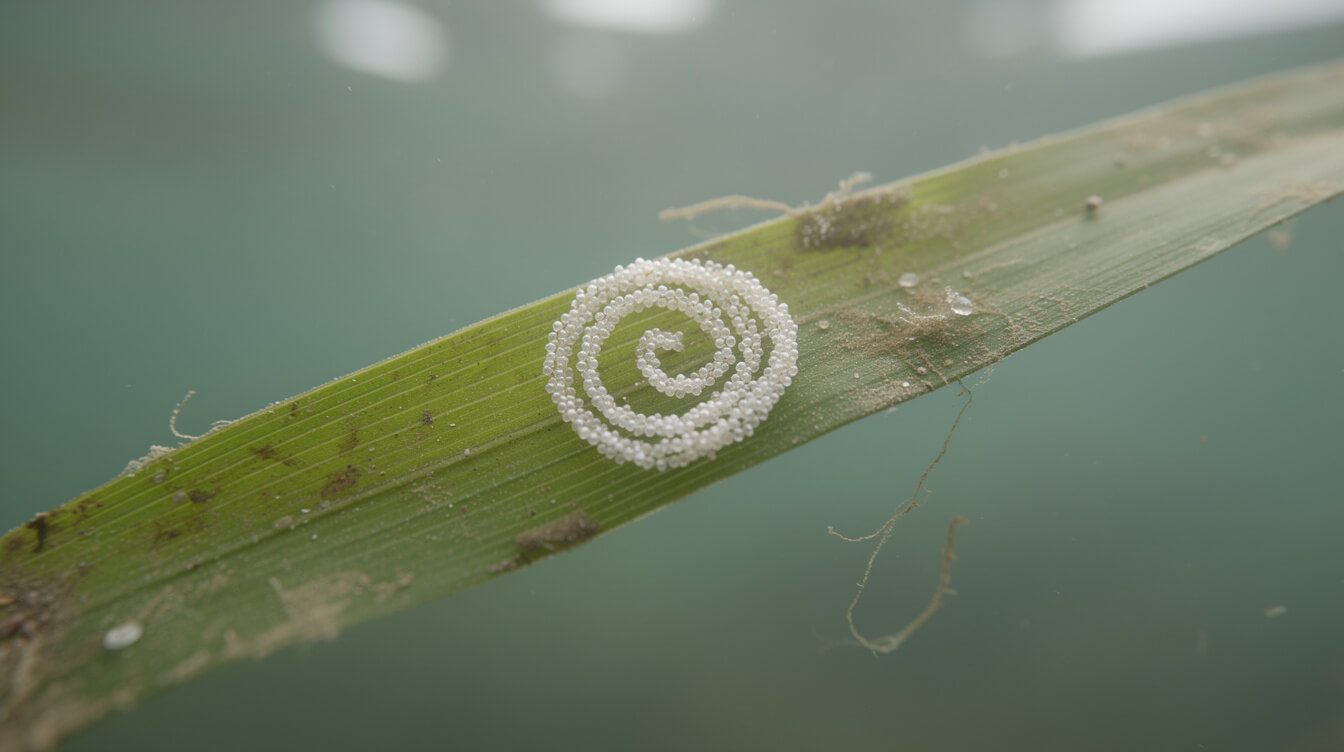
Yes. Like most sea slugs, a leaf sheep is a simultaneous hermaphrodite, which means each one has both male and female reproductive organs at the same time. When two meet, both can go on to lay eggs. They lay them in tiny spiral ribbons on the algae they live on, and, as in many of their sacoglossan relatives, the newly hatched larvae start life carrying a tiny shell that they later lose.
What is kleptoplasty, in one sentence?
Kleptoplasty is when an organism eats algae, keeps the algae’s chloroplasts alive inside its own cells, and uses them for a while, which is what leaf sheep do with the seaweed they eat.
How long do leaf sheep live?
Honestly, nobody has a good published number for this species. It is small, rarely studied, and hard to follow in the wild, so we would rather tell you it is unknown than make up a figure.
Is the leaf sheep endangered?
It has not been assessed. The leaf sheep is listed as “not evaluated,” which means its population has never been formally studied for the Red List. That is not the same as being safe. It does mean that leaving them where they live is the gentle choice.
Final thoughts
Leaf sheep sea slugs are a lovely example of how cute and remarkable can live in the same tiny body. The lamb is an accident of shape: a coat of cerata, two rhinophore ears, two small eyes on a pale face. The green is borrowed, chloroplasts taken one algal cell at a time and kept like a pantry rather than a power plant. The “solar-powered” headline is a little bigger than the truth, but the truth is still extraordinary. An animal the size of a grain of rice, living its whole life on a few clumps of seaweed, holding onto pieces of sunlight it did not make.
If there is a small lesson in it, maybe it is this: the softest things are often the ones you only notice when you slow down and look closely. That is true on a silty reef in Indonesia, and it is true on an ordinary Tuesday too. If the leaf sheep made you smile, you might like our other small, strange creature stories, or the story behind the emotional support animal shirt trend.
Before you go
Want the next one in your inbox?
We write something soft every day. The best of it lands in one gentle weekly note, for you or for the friend who needs it.