
What is a nudibranch? The bright little sea slugs that wear their warnings
What is a nudibranch? Picture a garden slug that skipped the beige and went straight for the paint box. Electric blue with an orange trim. Pale lilac with a row of glowing tips down its back. Deep crimson, ruffled at the edges, and swimming like a scarf caught in a slow wind. Nudibranchs are small, soft sea slugs, most of them shorter than your thumb, and once you have seen one you tend to go looking for the rest.
They are also more interesting than their photos. That frilly bit on the back is how many of them breathe. The bright colors are often a message, though not always the one people assume. Some of them eat stinging animals and keep the stings. This guide walks through what a nudibranch actually is, why it looks the way it does, a few worth knowing by name, and the honest answer to whether you can keep one at home. The short version is please do not, and the longer version is kinder than it sounds.
What is a nudibranch? The short answer
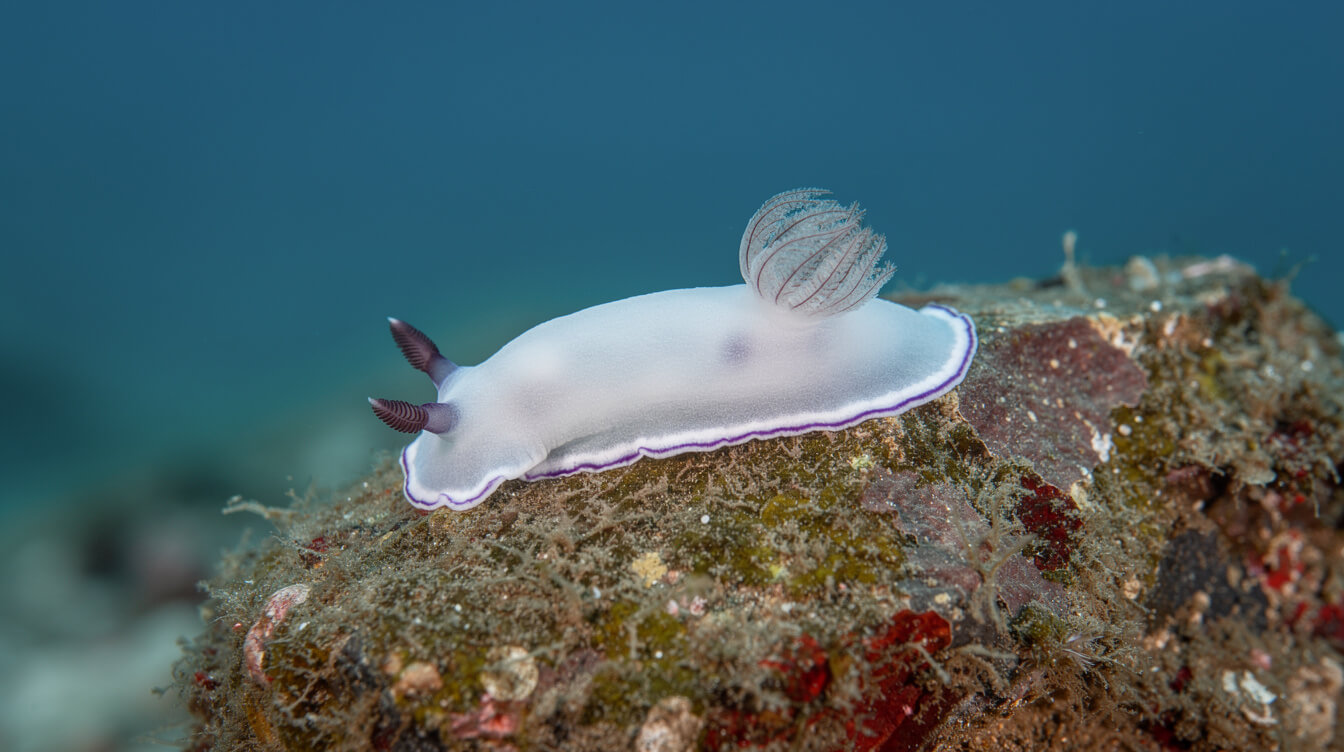
A nudibranch is a sea slug: a soft-bodied mollusk that lives in salt water and has no shell as an adult. Mollusks are the big family that includes snails, clams, octopuses, and the slug you met on the patio last spring. Nudibranchs are the ocean branch of that family that let go of the shell entirely and found other ways to stay safe.
They do start with one, though. Most nudibranchs hatch as tiny swimming larvae carrying a little coiled shell, then shed it when they settle down and change into their adult shape. A few species drop it before they even leave the egg. So every grown nudibranch you see is, in a small way, an animal that decided it did not need the house.
The name means “naked gills”
The word comes from the Latin nudus, naked, and the Greek brankhia, gills. It is pronounced NEW-dih-brank, and more than one is NEW-dih-branks. Not “branches,” though nobody at the tidepool will hold it against you.
The naked gills are the frilly parts on the back. In many species, the feathery tuft near the tail is exactly what it looks like: a set of gills, out in the open water instead of tucked under a flap the way a fish keeps them. The name is a plain description. It just happens to sound like a secret.
Two little horns, two main shapes
Most nudibranchs have a pair of sensory stalks on the head called rhinophores. They work a bit like a nose, picking up chemicals in the water so the animal can find food and find each other. If you have read our guide to the sea bunny, you already know them as its famous “ears.”
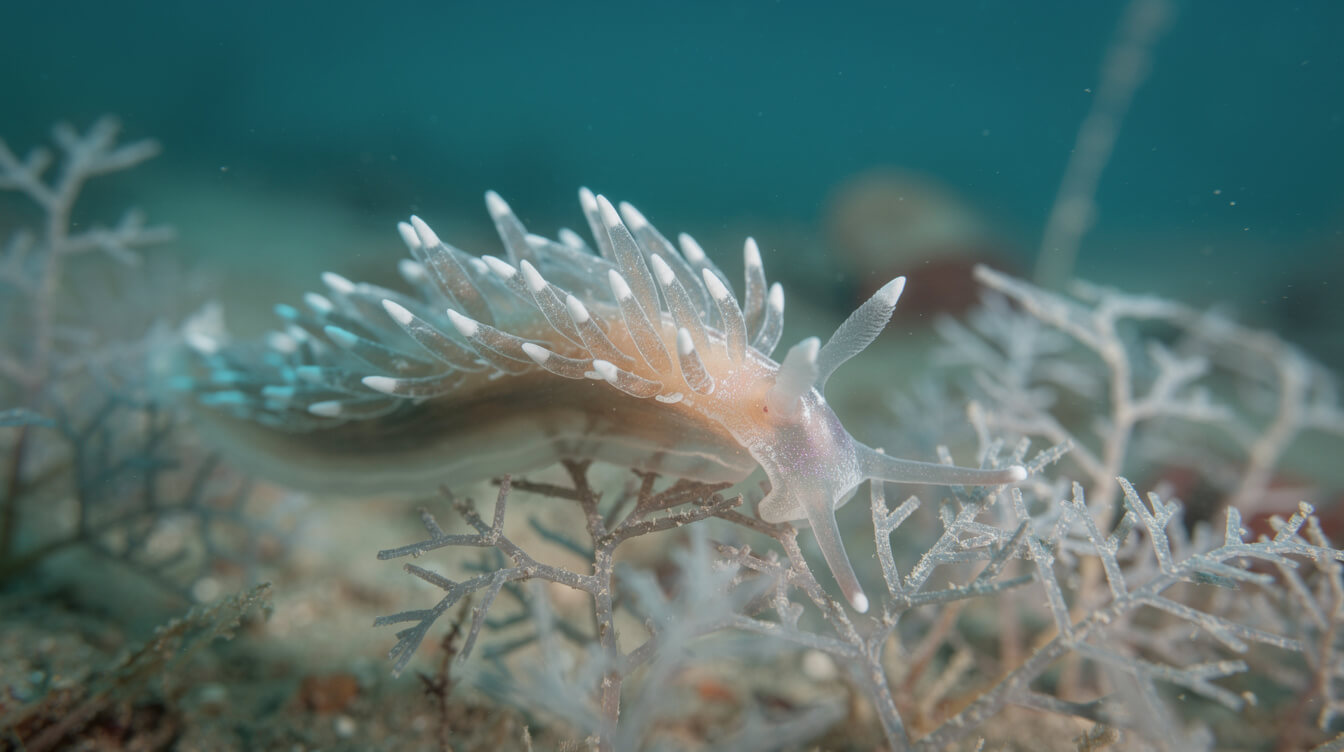
Beyond that, nudibranchs come in two broad body plans. Dorids are the rounder, smoother ones, usually with a single rosette of feathery gills on the rear of the back, like a small flower someone pinned there. Aeolids (sometimes spelled eolids) are slimmer, and their backs are covered in rows of finger-like projections called cerata, which handle the breathing and, as we will see, sometimes a good deal more. If a nudibranch looks like a little bouquet, it is probably a dorid. If it looks like it is wearing a fringed coat, it is probably an aeolid.
Sea slug or nudibranch? Sorting out the names
Every nudibranch is a sea slug, but not every sea slug is a nudibranch. “Sea slug” is a loose everyday name that covers several groups that are only distant relatives. Sea hares are sea slugs. So are the bright green, leaf-shaped slugs famous for keeping working pieces of the algae they eat, so they can make a little food from sunlight. Those leafy ones belong to a cousin group called sacoglossans. They are not nudibranchs, even though they show up in nudibranch photo galleries all the time.
Nudibranchs themselves are a big, varied group. Scientists have described more than 3,000 species, found from the Arctic to the waters around Antarctica, from rock pools at low tide to more than 2,000 feet down. Adults range from a few millimeters long to nearly two feet for the very largest. Most of the ones you are likely to meet are somewhere around the size of a paperclip.
Why nudibranchs are so brightly colored

Most small, soft, slow animals survive by being hard to see. Nudibranchs have no shell, no speed, and no bite worth worrying about, so you might expect them all to be beige. Some are. Plenty of species are colored and textured to match the sponge or coral they live on and eat, and they are almost impossible to spot until you know what to look for.
And then there are the others, painted in colors that seem designed to be noticed. The usual explanation is a word worth knowing: aposematism, the scientific name for warning coloration. It is the same idea as a wasp’s stripes. Many nudibranchs taste terrible or carry chemicals that make them a poor meal, and a bright, high-contrast pattern is an easy way to say so before anyone takes a bite. A fish that tries one and spits it out tends to remember the colors.
The honest part: the warning story is not the whole story
Nudibranchs are often called the textbook example of warning colors in the sea. Marine biologists still debate how far that explanation goes, though, and the reasons are interesting.
- Many bright species come out at night, when nobody can see their colors.
- Red fades fast underwater. A vivid red slug looks dark and dull only a few meters down, because red light is the first color the water swallows.
- Copycats are rare. In groups where warning colors really work, harmless species often evolve to borrow a toxic one’s look. Among nudibranchs, that kind of mimicry turns up less often than you would expect.
For some groups of nudibranchs, the evidence for warning colors is good. For others, the colors may be partly camouflage at a distance, partly a side effect of what they eat, and partly something nobody has figured out yet. We like that answer better than a tidy one. It leaves a little mystery where a little mystery belongs.
They cannot see their own colors
One small detail makes the whole thing feel a bit tender. A nudibranch’s eyes are tiny, set into the skin, about a quarter of a millimeter across, and they can tell little more than light from dark. A nudibranch cannot see its own colors, or anyone else’s. Whatever that blue and orange is saying, it is not saying it to other nudibranchs. They find each other by scent, through those rhinophores. The show is entirely for the rest of the reef.
There is something sweet in that. A creature dressed up for an audience it will never see, with no idea how good it looks. If you have read our piece on why the strangest little creatures are the ones we love most, nudibranchs are close to the perfect case: odd, soft, small, and completely unbothered.
Borrowed stings and borrowed color: what a nudibranch eats and keeps
Every known nudibranch is a carnivore. That surprises people, because they look like something that should be nibbling lettuce. Depending on the species, they eat sponges, hydroids (small, feathery relatives of jellyfish), anemones, sea squirts, barnacles, coral, the eggs of other sea slugs, and sometimes other nudibranchs. Most are picky. Many species eat one kind of prey, or a small handful, and very little else.
That pickiness is what makes their best trick possible. A nudibranch does not just eat its food. Quite often, it keeps a little of it.
Keeping the stings
Some aeolid nudibranchs eat hydroids and anemones, animals armed with stinging cells called nematocysts. You would expect a mouthful of stingers to be a problem. Instead, the nudibranch passes them through its gut without setting them off, then moves them out to small sacs at the tips of its cerata. There they sit, still loaded, ready to fire at anything that bites. Scientists call these stolen stings kleptocnidae, which roughly means “thief nettles.” Exactly how the nudibranch handles them without stinging itself is still not fully understood.
So the soft little fringe on an aeolid’s back can be a borrowed armory. That is the part the photos never tell you. Something that looks like lace trim is, in some species, a row of somebody else’s defenses, carefully rearranged.
Keeping the chemistry, and sometimes the color
Many dorid nudibranchs eat sponges, and sponges are full of strong defensive chemicals. Some dorids take those compounds in and concentrate them in their own bodies, which is a big part of why they taste so bad. Researchers have even found that when these nudibranchs switch to a different sponge, the chemicals in their bodies change to match. A few species make their defensive chemicals from scratch instead, but borrowing is common.
Color can follow food, too. In some species, pigment from the prey shows up in the nudibranch’s own body, so the same kind of nudibranch can look different depending on what it has been eating. You will often see “nudibranchs get their color from their food” stated more broadly than it deserves, since plenty of species make their own pigments. But it is true often enough to be one of our favorite facts about them. In some cases, a nudibranch is quite literally wearing its lunch.
A few take it further still. One Indo-Pacific species keeps tiny living algae from its food inside its cerata, where the algae go on photosynthesizing and share some of the energy with their host. That is the true nudibranch version of the solar-powered trick, separate from the leafy sacoglossan cousins mentioned earlier.
A few nudibranchs worth knowing

With more than 3,000 species to choose from, any short list is a bit unfair. These are the ones we would introduce first.
The Spanish dancer
The Spanish dancer (Hexabranchus) is one of the largest tropical nudibranchs, often longer than your hand. Most of the time it crawls along like any other sea slug, a deep red cushion on the reef. When disturbed, it lifts off and swims, flexing its whole body while the wide, ruffled edges of its mantle unfurl and ripple. Divers say it looks like the flared skirt of a flamenco dancer, which is where the name comes from. Its eggs are laid in a coiled pink-red ribbon that looks remarkably like a rose resting on the rock.
It is also a good example of why the warning-color story is complicated. The Spanish dancer is heavily chemically defended and brilliantly red, yet it is mostly active at night and has no known mimics. Small shrimp often live on its back, riding along like passengers, which is the kind of detail you could not make up.
The blue dragon
The blue dragon (Glaucus atlanticus) is rarely more than an inch long and lives where almost no other nudibranch does: floating upside down at the very surface of the open ocean. It swallows a little air to stay afloat and clings to the underside of the surface film. Its belly, which faces the sky, is a bright blue that blends with the water. Its back, which faces down, is silvery grey and blends with the bright surface when seen from below. Its cerata spread out to the sides in small fans, which is where the dragon part of the name comes from.
It eats the Portuguese man o’ war, one of the most famously painful stingers in the sea, and keeps the stinging cells for itself, favoring the most potent ones. That means a blue dragon can deliver a sting worth respecting. They sometimes wash up on beaches after strong onshore winds, so if you ever find one, admire it where it lies and leave it there.
The ones on your own coast
You do not need a tropical reef. On the Pacific coast of North America, a low tide can turn up the sea lemon, a plump yellow dorid that looks a lot like its name, and the opalescent nudibranch, a slim aeolid with orange cerata and fine electric blue lines along its body. There is even one called the shaggy mouse nudibranch, named for exactly what you are picturing. The Atlantic coast has its own small, bright species too, many of them only a centimeter or two long and easy to miss until your eyes adjust.
The sea bunny, briefly
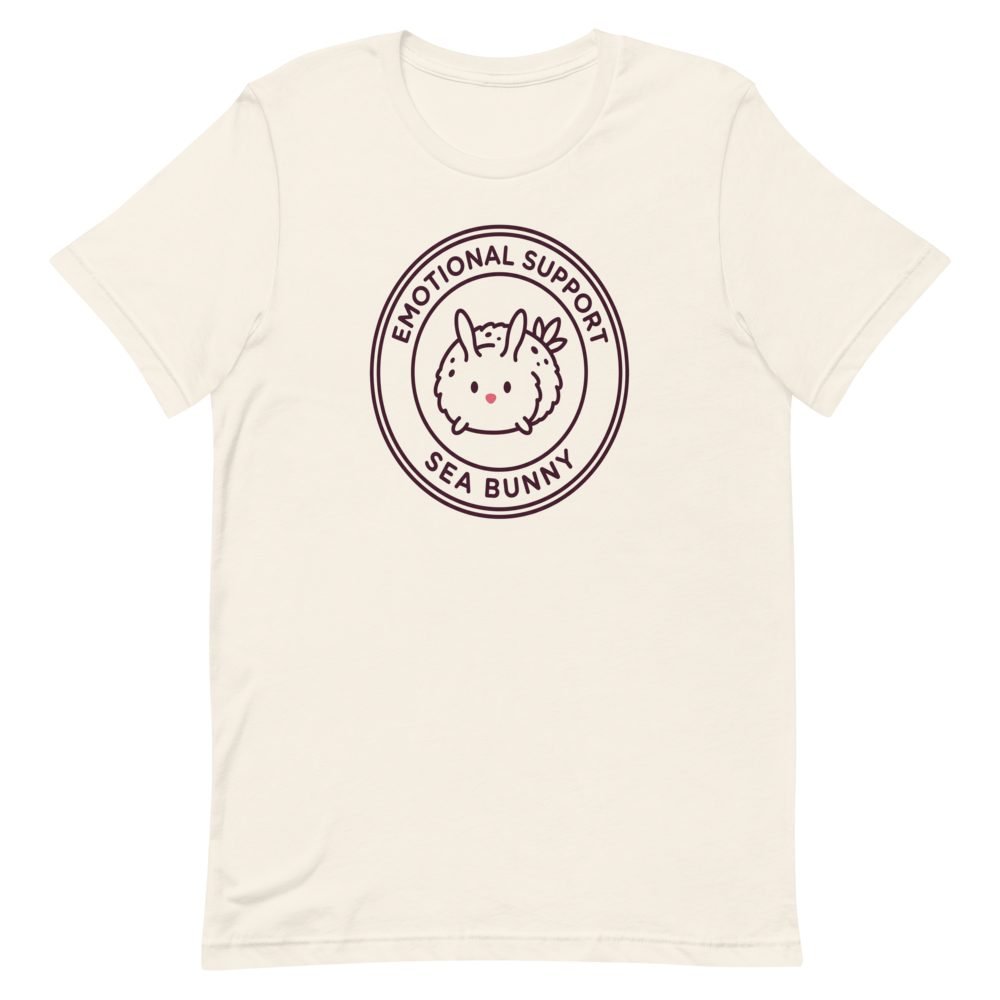
And yes, the internet’s favorite is a nudibranch too. The sea bunny is a small dorid whose round, fuzzy look made it famous, and it has a whole post of its own: what a sea bunny actually is. If it is the reason you ended up here, you are in good company. It is also the reason we made the Sea Bunny Emotional Support Tee, a little line-drawn nudibranch in a badge, for anyone who could use a soft sea creature in their corner.
The cutemerch letter
A small good thing, once a week
One short, kind email with our coziest posts and new round animals from the shop. No spam. Unsubscribe anytime.
Can you keep a nudibranch as a pet?

It is the most common question about nudibranchs, and the honest answer is almost never. The reasons are good ones, and they all come back to the things that make nudibranchs special.
The first is food. Remember how picky they are. Many species eat a single kind of sponge or hydroid, sometimes one found only in the place they came from. A home aquarium cannot supply it for long, and a nudibranch that cannot find its one food will slowly starve. The second is time. Depending on the species, a nudibranch lives anywhere from a few weeks to about a year, so many that end up for sale are already partway through a short life. The third is chemistry. Some species release defensive chemicals when stressed, which is not ideal in a small, closed tank.
There is one well-known exception, and it explains the rule nicely. Reef aquarium keepers sometimes buy a tiny nudibranch called Berghia on purpose, because it eats only a pest anemone called Aiptasia. It is kept the way a gardener keeps ladybugs, as a specialist doing one job, and once the pest is gone, so is its food. That is the clearest picture of why most nudibranchs do not belong at home.
If what you want is a soft, strange water animal to care for, read about the axolotl, which people keep happily with the right setup. And if it is the small and odd you love most, the isopod is a gentle little creature many people keep in a simple terrarium.
How to meet a nudibranch in the wild
The better way to know a nudibranch is to visit one. You do not need diving gear.
- Go tidepooling at a low tide. Check a tide chart and aim for a very low tide, ideally on a calm day. Look slowly under rock overhangs, around sponges, and on seaweed. Nudibranchs are small, and patience finds more than speed.
- Look, do not lift. Leave animals where they are. If you turn over a rock, put it back exactly the way you found it, gently, because the underside is somebody’s home.
- Stay safe on the rocks. Wear shoes with good grip, watch the incoming water, and never turn your back on the ocean.
- Bring a phone, not a bucket. A clip-on macro lens makes a far better keepsake than a collection jar.
- Find a beach naturalist. Many aquariums, parks, and wildlife groups run guided low-tide walks, often in summer, with volunteers who know exactly where the sea slugs hide.
- Snorkel or dive gently. Keep your fins off the reef and your hands to yourself. Some nudibranchs carry stings, and all of them are more fragile than they look.
- Visit an aquarium. Several public aquariums keep nudibranchs with the specialist care they need, and it is the easiest way to see one up close.
A nudibranch you can actually take home
The sea bunny is a real nudibranch, and this is our quiet tribute to it: a round little line drawing in a badge, with two small rhinophores and a tiny gill plume. No tank, no special diet, no stings. Just a soft sea creature in your corner on the gray days.
What is a nudibranch’s life like? A few common questions

Can sea slugs survive out of water?
Only briefly, and only in the right conditions. Nudibranchs are ocean animals that breathe through their exposed gills or cerata and through their skin, and they dry out quickly in air. Species that live between the tides can ride out a low tide sheltered under wet seaweed or tucked into a damp crevice until the water returns. A nudibranch held in the air or left on a dry rock is in trouble fast, which is one more reason to look and not lift.
How do nudibranchs reproduce?
Every nudibranch is a hermaphrodite, with both male and female reproductive organs, but they cannot fertilize themselves. Two nudibranchs find each other by scent, often after a slow, circling courtship, then line up side by side, since the reproductive openings sit on the right side of the body. Both partners can go on to lay eggs. The eggs are laid in a gelatinous ribbon, usually in a coil or spiral on a rock, or right on the food the young will need. In some species, the eggs even carry the same borrowed defensive chemicals as the parents.
How long do nudibranchs live?
From a few weeks to about a year, depending on the species. Most live quickly: hatch, grow, find a partner, lay eggs, and finish within a season. It is part of why a nudibranch sighting feels like luck. The one you see today may not be there next month, though its eggs might be.
Are nudibranchs dangerous to touch?
Most are harmless to look at, but some carry stolen stinging cells, the blue dragon most famously, and many carry chemicals that are unpleasant at best. The simple rule is no touching. It protects you, and it protects them, since their skin is delicate and easily damaged.
What is the rarest nudibranch?
There is no single answer, and anyone who names one with total confidence is guessing. With more than 3,000 described species and new ones still being found, many nudibranchs are known from only a handful of sightings. Some are probably common but live where people rarely look. A deep-sea nudibranch described in 2024, Bathydevius, was found more than 8,000 feet down, swimming in open water and able to glow, and it is the only nudibranch known to live that way. In the nudibranch world, rare often just means not met yet.
Final thoughts
So, what is a nudibranch? A sea slug with no shell and its gills out in the open. A carnivore with very particular tastes. In some cases, a small animal wearing its lunch, carrying somebody else’s stings, and dressed in colors it will never see. That is a lot of story for something the size of a paperclip.
The kindest way to love them is also the simplest. Go and look, at low tide or behind aquarium glass, and leave them exactly where they are. They will not know you came, and that is sort of the point. Some of the best small joys are the ones that do not need anything from us.
If you want more of the soft and strange, the sea bunny is the obvious next stop, and the axolotl is the one that only looks like it is smiling.
Before you go
Want the next one in your inbox?
We write something soft every day. The best of it lands in one gentle weekly note, for you or for the friend who needs it.