

Cute frogs, and the real reasons we cannot stop looking at them
There is a particular kind of quiet joy in a frog sitting still. Cute frogs have quietly taken over mood boards, phone wallpapers, enamel pins, and tote bags over the last few years, and the strange part is that nobody planned it. There was no campaign. People simply kept seeing a small round animal with its legs tucked underneath it, minding its own business, and something in them went soft.
This is a piece about why that happens. Not a gallery to scroll past, but the real reasons the frog shape lands so hard, the actual species behind all those drawings, and a handful of true things about them that are better than any caption. By the end you will know eight frogs by name, you will understand what their faces are and are not doing, and you will know whether the little guy in the photo would genuinely be happy living in your room. The short answer to that last one is probably not, and we will get into why gently.
What makes cute frogs look cute (the shape does most of the work)

Start with the sitting pose, because almost everything follows from it. A resting frog folds its long back legs up alongside its body and tucks its front legs underneath its chest. All the gangly parts, the parts that make a frog look like a frog mid-leap, disappear into the silhouette. What is left is a compact dome with a face on the front.
Then there is the head. A frog’s skull is wide, nearly as wide as the rest of it, and there is no neck to speak of, so the head and the body read as one shape. Proportionally, you are looking at a very large head on a very small frame, with very large eyes sitting high on top of that head. Those three ratios together are the ones our brains have always treated as a signal to go easy on something. We wrote about this at more length in our piece on why the strangest little creatures are the ones we love most, and the frog is maybe the cleanest example of the whole principle.
There is a behavioral half to it too, and it gets less credit than it deserves. Frogs are still. A mouse is small and round as well, but a mouse is frantic, always checking exits. A frog parks itself somewhere damp and simply remains, blinking slowly, apparently at peace with everything. It reads as composure. It reads, honestly, a little like politeness, as though the frog is waiting its turn to speak. Pair genuine stillness with a round shape and a wide calm face, and you get an animal that feels less like wildlife and more like a very small friend who has had a long week.
Smooth skin helps as well. Fur and feathers add visual noise, while most frogs are one soft gradient of green or brown or clay, sometimes with a sheen of damp on top. The eye has nothing to catch on. It slides around the shape and comes back to the face.
Eight cute frogs worth knowing by name

There are roughly 7,600 frog species, which is the large majority of all amphibians on earth, so any list is a sampler rather than a ranking. These eight cute frogs are the ones most worth knowing, either because the internet already loves them or because they deserve it more than they get.
The desert rain frog
A small, round, sand colored frog from the coastal dunes of Namibia and South Africa, roughly an inch or two long, built like a dinner roll with legs. It lives buried in damp sand, waiting for fog rather than rain, and surfaces at night to shuffle across the surface looking for insects. It is also famous for being the frog in that video: when it feels threatened, it rises up and produces an indignant little squeak that sounds nothing like a frog and everything like a squeaky toy being stepped on. It is the least intimidating defensive display in the animal kingdom.
The red-eyed tree frog
The one on every poster. Vivid green back, cream belly, blue and orange flanks, bright orange toes, and those enormous red eyes. All of that color has a job. During the day the frog sleeps tucked down on a leaf with its colored parts hidden and only green showing. If something disturbs it, it flashes the red and orange all at once, which startles a predator for exactly as long as the frog needs to be somewhere else.
The tomato frog
From Madagascar, and yes, it genuinely looks like a tomato. Round, plump, and anywhere from deep orange to proper red, reaching about four inches. When something grabs it, it inflates its body and sweats a thick sticky white secretion that gums up a predator’s mouth and numbs it slightly. Entirely harmless to us, deeply inconvenient to a snake.
The glass frog
A whole family of small tree frogs from Central and South America, an inch or so long, pale green on top and translucent underneath. You can see the organs through the belly skin, which sounds grisly and is in practice very delicate and strange. The best part is a trick researchers only recently worked out: while they sleep, glass frogs pull most of their red blood cells into the liver, which makes their bodies far clearer and much harder to spot on a backlit leaf.
The pumpkin toadlet
Brazil’s tiny bright orange forest floor frog, about a centimeter long, small enough to sit comfortably on a fingernail. It is so small that its inner ear canals are below the size at which balance works properly, which means it cannot really tell where it is while airborne. It leaps, tumbles end over end, and lands however it lands. Its skeleton also fluoresces through its skin under ultraviolet light, for reasons that are still being argued about.
The common coquí
Puerto Rico’s beloved brown frog, an inch to an inch and a half, named for the two note call the males make all night, co-qui, co-qui. It skips the pond entirely. Coquís lay their eggs on land, among leaves, and the eggs hatch straight into miniature frogs rather than tadpoles. No swimming stage at all, which is why they can live in mountains, forests, and city streets alike.
The gray tree frog
A small North American frog, an inch or two, with a genuinely useful party trick. It changes color, shifting between gray, green, brown, and near white over the course of a few minutes to match whatever it is sitting on. It is the frog most likely to already be living near you in the eastern United States, and the one you are most likely to hear without ever seeing.
The African dwarf frog
Small, fully aquatic, mottled green and brown, and perpetually wearing an expression of mild surprise. It never leaves the water, swims with webbed front and back feet, and uses those front feet to shovel food toward its mouth, which is as endearing as it sounds. It is also one of the few frogs on this list that people actually keep, with real caveats we will get to.
The smile is not a smile, and other things a frog’s face is doing

Here is the thing that makes cute frogs such good accidental mascots: its face is not expressing anything, and we cannot help reading it anyway.
That wide curved line across the front is simply where the jaw closes. A frog’s skull is built broad because a frog swallows prey whole, and a broad skull means a broad mouth, and a broad mouth at rest is a long gentle horizontal line. We have spent our whole lives decoding that shape as a closed mouth smile on human faces, so that is what we see. The frog is not pleased. The frog’s mouth is just shut.
The eyes are doing something similarly practical. They sit high and bulge outward so a frog floating at the surface can keep nearly its whole body underwater and still see in almost every direction at once. There is a third eyelid, a translucent membrane that sweeps across to keep the eye wet and protected, which is why the blinking looks slower and heavier than it should. Frogs also cannot swivel their eyes much, so to look at something new a frog turns its whole self. The effect is a creature that appears to give you its complete and undivided attention.
And the throat that keeps fluttering is breathing. Frogs pump air by moving the floor of the mouth rather than by expanding a rib cage, so there is a soft constant pulse at the throat even in a frog that is otherwise perfectly motionless. Alive, calm, quietly ticking over. It is the same deadpan stillness that makes an axolotl so hard to look away from, something we got into in our piece on the real animal behind the internet’s favorite smile, and the same trick a hedgehog pulls in reverse when we talked about why hedgehogs always look a little grumpy. In all three cases the animal has no opinion about us. We supply the opinion.
Why the drawn frog is almost always wearing a mushroom
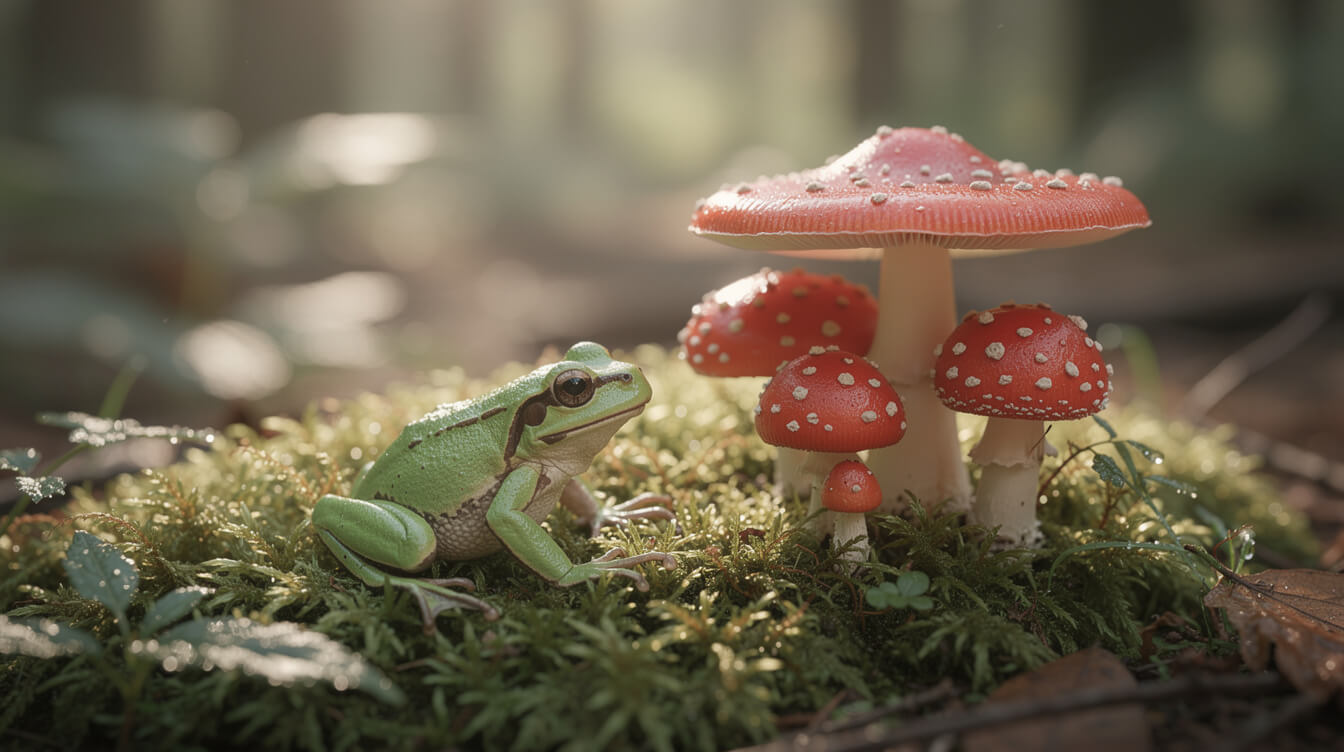
Once you start noticing it you cannot stop. Drawn cute frogs are rarely just frogs. It is holding a tiny umbrella, or cupping a mug of something warm, or wearing a red mushroom cap tipped at a slight angle like a sun hat. Thousands of artists, no coordination, same props.
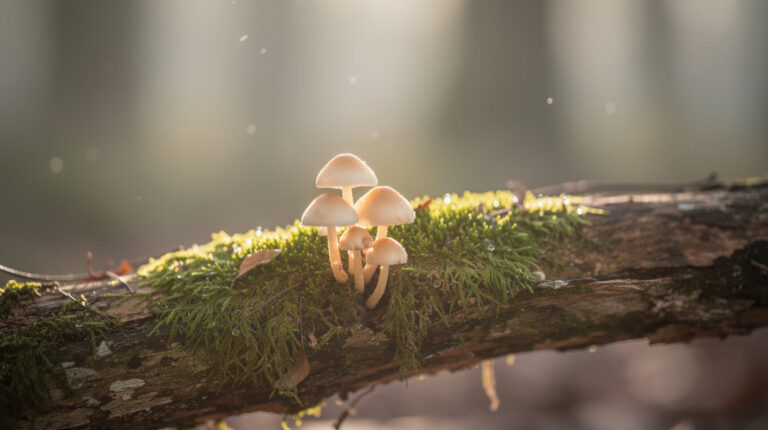
Part of it is simple truth. Frogs and mushrooms really do share an address. Both want the damp, shaded, slightly decaying part of a forest floor, so if you have spent any time in that habitat you have genuinely seen a frog sitting next to a mushroom. The drawing is reporting something real.
But part of it is a design problem being solved. A real frog’s head is wide and flat, which is lovely in a photograph and awkward in an illustration, because flat shapes do not read well at small sizes. A mushroom cap is a dome. Put one on top of that flat wide head and the silhouette suddenly resolves into a nice stack of two round shapes, instantly readable at the size of an app icon or an embroidered patch. The tiny umbrella does the same job. So does the mug, held in front, which gives the frog something to do with its hands and a reason to be sitting down.
And the mushroom carries a whole mood with it. It signals damp woodland, rain on leaves, moss, slow afternoons, which is exactly the feeling a cottagecore drawing is reaching for. That is why the motif shows up far beyond frogs, which we got into when we looked at why the cute mushroom tote bag is having a cottagecore moment.
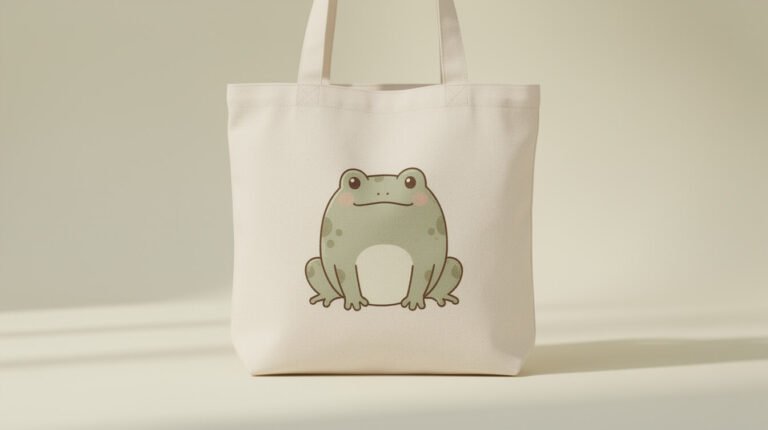
Not every frog design needs the props, though. Our Emotional Support Frog | Cute Frog Lover Shirt goes the other way: one deadpan little frog in a single stroke badge, no hat, no umbrella, printed in plum on soft pink. It turns out the flat wide mouth is plenty on its own when you let it sit still.
The cutemerch letter
A small good thing, once a week
One short, kind email with our coziest posts and new round animals from the shop. No spam. Unsubscribe anytime.
Do cute frogs make good pets? An honest answer

This is the question underneath a lot of frog searching, and it deserves a straight answer rather than a sales pitch. Some frogs can live well with people who have done the reading. Almost none of them can live well with someone who fell for a photo this afternoon.
The central fact is the skin. A frog’s skin is permeable by design, because a frog uses it to breathe and to take on water. That has a consequence people rarely hear in time: frogs do not drink. They absorb moisture directly through a patch of thin skin on the belly and thighs, which is why a frog will press itself down onto a damp surface and simply sit there hydrating. The same openness means anything on your hands goes into the frog. Soap residue, hand lotion, the salt and oils of ordinary skin, all of it crosses straight through. Frogs are look at, not hold. If you have ever wanted to love an animal by not touching it, this is your chance.
The rest is logistics. A frog needs steady humidity, a correct temperature range, dechlorinated water, and in most cases live insects, which means you are also keeping insects. Many species live a decade or longer, and some considerably more, so this is not a short commitment. And two rules that are not negotiable: never take a frog out of the wild, and never release a pet frog outdoors. Captive animals carry diseases that devastate wild populations, which brings us to the next part.
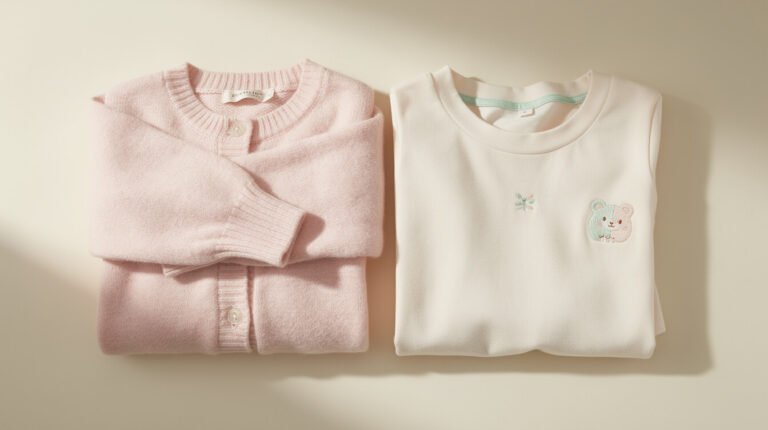
If what you actually want is the feeling of having a small calm frog nearby, the good news is that you do not need a terrarium for that. Sometimes the right amount of frog is one on a shirt, which is roughly the logic behind the whole emotional support animal shirt trend, and it asks nothing of the frog at all.
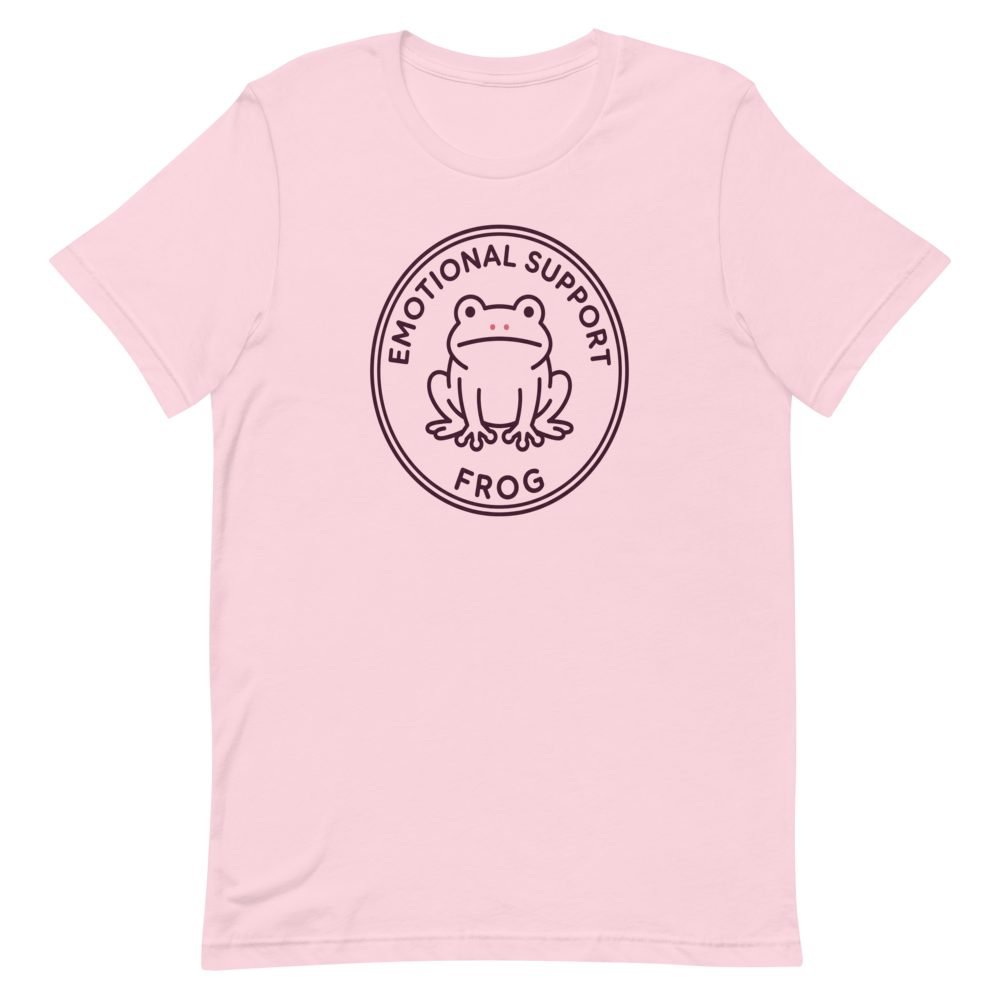
A frog who asks nothing of you
One small, deeply unbothered frog, drawn as a single stroke badge in plum on a soft pink tee. No habitat, no crickets, no humidity to monitor. Just the calm flat face, on a shirt you will keep reaching for.
The part most cute frog lists leave out
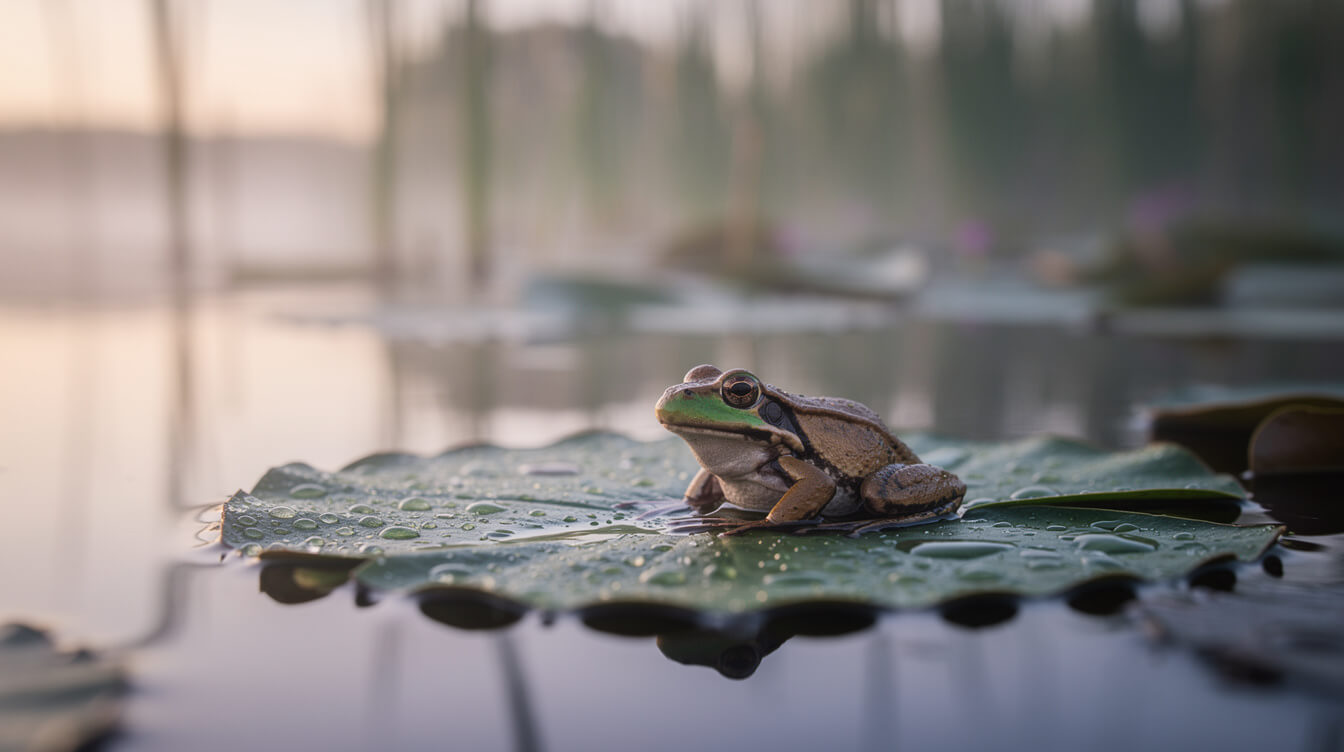
Cute frogs are not a new or delicate arrival. Frogs have been on this planet for something like 250 million years, on every continent except Antarctica, including a few that freeze nearly solid through an Alaskan winter and thaw out in spring as though nothing happened. They are not fragile animals. They are, right now, in a great deal of trouble.
Amphibians are the most threatened group of vertebrates on earth. The most recent global assessment put roughly two in five amphibian species at risk of extinction. The causes stack: habitat loss, drained wetlands, pollution, a warming and drying climate, and a devastating skin fungus called chytrid that has swept through populations on several continents and is very good at killing frogs specifically.
The reason it hits frogs first is the same reason they are so soft to look at. That permeable skin takes in whatever is in the water and the air around it, which makes a frog an unusually honest readout of whether a place is healthy. When the frogs in a pond go quiet, something was wrong in that pond before anybody noticed.
None of which has to land as a lecture, and there are small real things that help. Leave one damp, shady, slightly untidy corner of a yard alone, because leaf litter and a log are frog housing. Skip the pesticides near standing water. A shallow dish at ground level with a sloped edge, so a frog can get out again, is a genuine kindness in a dry month. If a local group runs frog call surveys, they will take all the volunteers they can get, and it mostly involves standing near a pond at dusk listening, which is not a bad way to spend an evening. And if you ever do keep an amphibian, buy captive bred, never wild caught.
Caring about an animal because it is cute is not a lesser reason to care. It is often the first one, and it is how most people arrive. The frog is simply one of those cases where the affection and the animal’s actual needs point in the same direction.
Frequently asked questions about cute frogs
What is the cutest frog?
If you want the popular answer, it is the red-eyed tree frog, and it has earned the poster. If you want ours, it is the desert rain frog, because a round sand colored frog that squeaks indignantly when startled is doing something no other animal is doing. The pumpkin toadlet runs a close third for sheer improbability.
Are frogs amphibians or reptiles?
Amphibians. The simplest tell is the skin: reptiles are sealed in dry scales, while amphibians have moist permeable skin they breathe and drink through. Most frogs also change body form as they grow, going from egg to tadpole to adult, which reptiles do not do.
Why do frogs croak?
Mostly it is males advertising for a mate, and the call is species specific so that a female hears her own kind in a chorus of dozens. Frogs also make territorial calls to warn off rival males, release calls when something has grabbed them by mistake, and in some species a rain call before a storm. The sound is made by pushing air back and forth over the vocal cords, often inflating a throat pouch that works as a loudspeaker.
Why can frogs not drink water?
They can take on water, they just do not do it with their mouths. A frog absorbs moisture straight through a patch of thin skin on its belly and thighs, so instead of drinking it presses itself against something damp and sits. That is why a frog kept too dry becomes dehydrated even with a full water bowl in the tank, and why humidity matters more than the bowl does.
Do frogs actually smile?
No, and that is part of the charm. The curve we read as a smile is just the line where a wide jaw closes, and frogs do not have the facial muscles for expressions the way mammals do. The friendliness is entirely our contribution.
Which cute frogs are kept as pets most often?
White’s tree frogs, African dwarf frogs, and horned frogs come up most, because they tolerate captivity better than most species. All of them still need specific humidity, temperature, water quality, and live food, and none of them should be handled casually. Read for a few weeks before deciding, and buy captive bred rather than wild caught.
Where do frogs live?
Almost everywhere except Antarctica. Rainforest canopies, desert dunes, mountain streams, suburban drainpipes, and a few species well inside the Arctic Circle. The one constant is access to moisture at some point in the life cycle, though frogs like the coquí have found ways around even that by laying eggs on land.
Final thoughts
The internet did not invent cute frogs. It just finally gave a lot of people a place to admit something they had quietly felt since the first time they found one in a garden: that a small round animal sitting very still in a damp place is unreasonably comforting.
What we like best is that the frog holds up under examination. Plenty of things are cute from a distance and disappointing up close. The frog gets better. The smile turns out to be a wide jaw, the stare turns out to be a clever piece of plumbing, the tiny orange one in Brazil turns out to be too small to land a jump properly, and every single one of those facts is more endearing than the photo you started with.
If frogs have properly got hold of you, we keep a cute frog gift guide for exactly that condition, and a longer piece on the sea bunny for when you are ready for the next strange small creature. Either way, the next time you pass something damp and shaded, look down. There is a decent chance somebody round is already sitting there, not smiling at you, and it will be the best part of your walk.
Before you go
Want the next one in your inbox?
We write something soft every day. The best of it lands in one gentle weekly note, for you or for the friend who needs it.

2 Comments