Glass frog: the see-through frog that hides its own blood to sleep
The first time most people see a glass frog, it is upside down. Someone has flipped a tiny green frog onto a pane of glass, and there, through the skin of its belly, is a small heart quietly beating. It is one of those animals that sounds made up and is not. A glass frog is a real, palm-of-your-hand tree frog from the forests of Central and South America, and its see-through belly is only the start of what makes it so lovely to know.
This is a gentle guide to the glass frog: what it is, why you can see inside it, the clever thing it does with its blood while it sleeps, the surprisingly devoted way it looks after its eggs, and what the rest of us can do to keep these small frogs around. No biology degree needed, just a little curiosity.
What is a glass frog?

“Glass frog” is not one species. It is the common name for a whole family of frogs, the Centrolenidae, with roughly 160 known species spread across 12 genera. New ones are still being described, often from a single mountain valley, because many glass frogs live in small, very specific patches of forest and look nearly identical to their neighbors.
They live from southern Mexico down through Central America and along the Andes from Venezuela to Bolivia, with more species in the Amazon, the Guiana Shield, southeastern Brazil, and northern Argentina. The real center of glass frog life is the cloud forest: cool, misty mountain woods where streams run fast and every leaf is wet.
How big is a glass frog?
Small. Most adults are about 20 to 30 millimeters long, which is under an inch and a quarter, or roughly the length of a paperclip. A few larger species reach close to 80 millimeters, about three inches, but the frog most people picture would sit comfortably on a coin with room to spare.
What a glass frog looks like from above
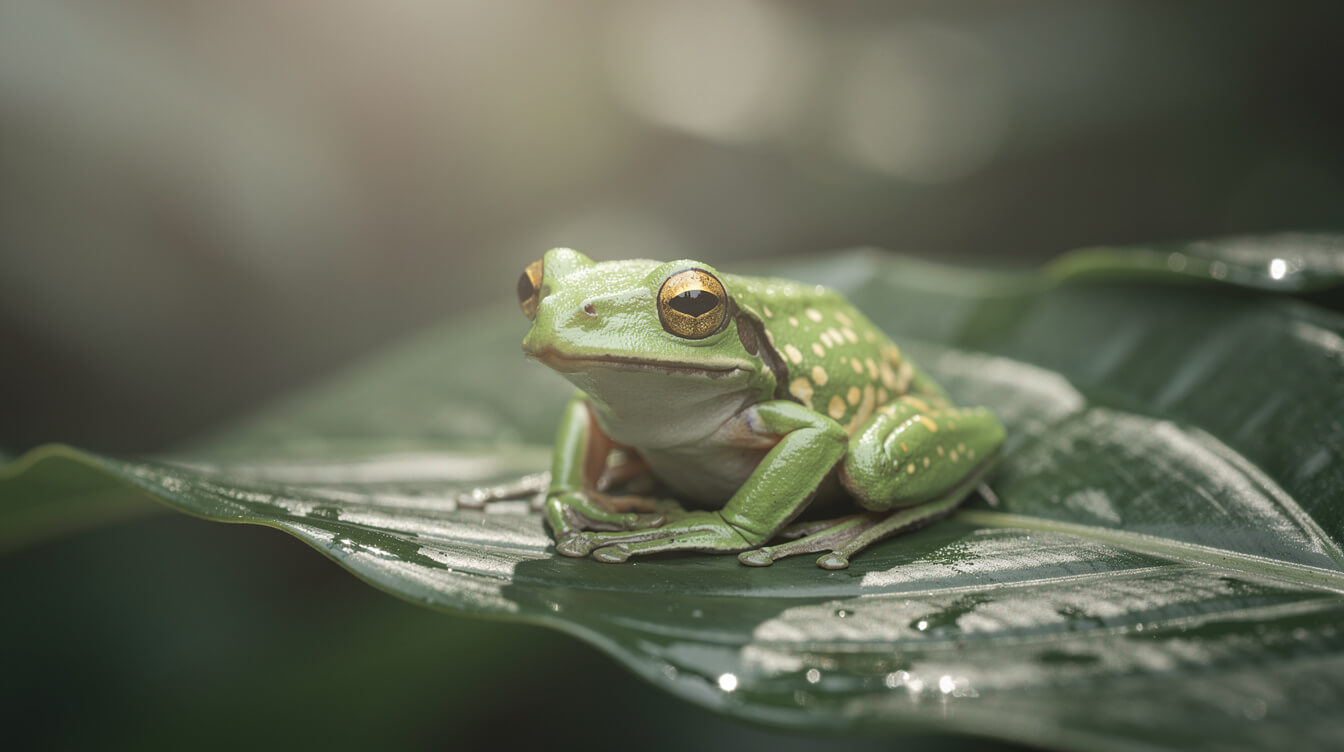
From the top, a glass frog is mostly a soft lime green, sometimes plain and sometimes sprinkled with tiny pale yellow or white dots. Those dots are not random. In some species they resemble the frog’s own eggs, which is a sweet bit of design if you think about it. The toes end in wide, sticky pads for climbing slick leaves.
One detail is a good field tip: a glass frog’s eyes point forward, while most of the tree frogs it gets confused with have eyes that face out to the sides. That forward gaze gives a glass frog a slightly earnest, attentive look, as if it is listening carefully to whatever you are saying.
If you have read our piece on why cute frogs are so hard to stop looking at, you will recognize the glass frog from its short appearance there. This is the longer visit it deserves.
Why you can see a glass frog’s heart
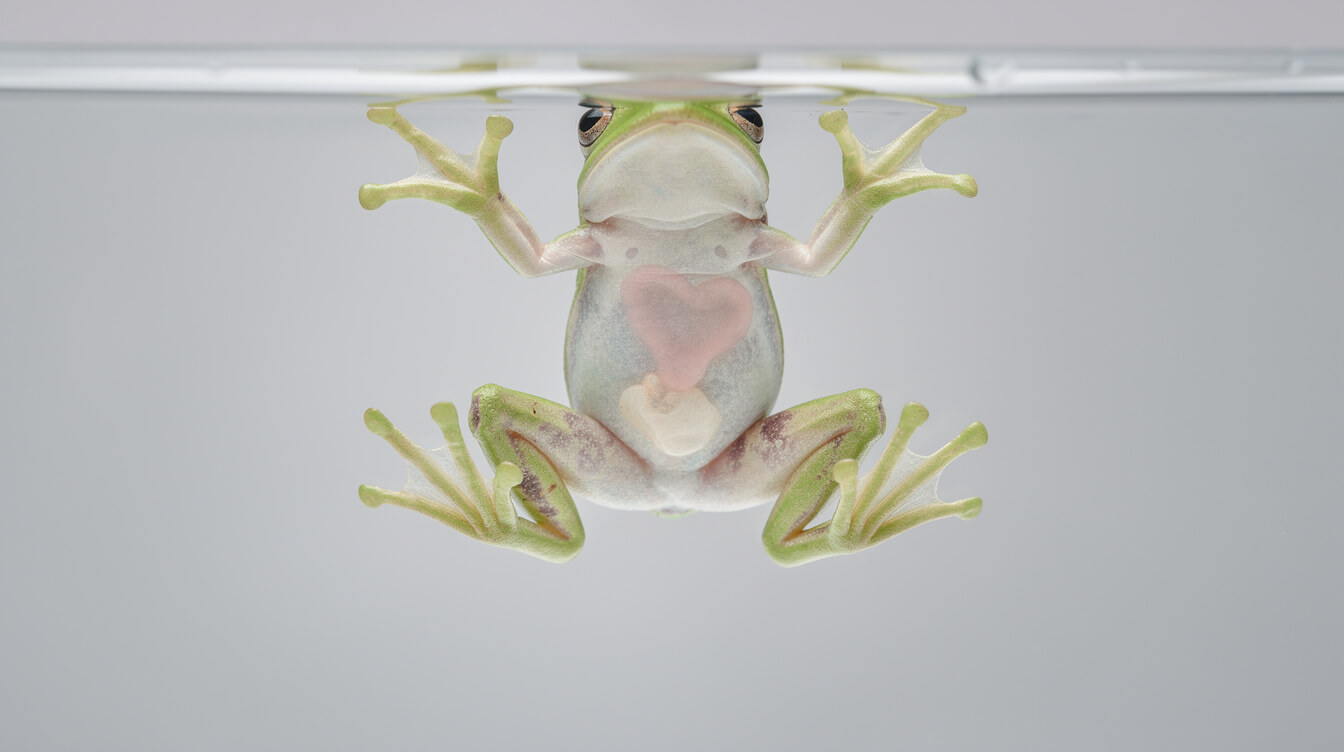
Turn a glass frog over and the skin of its belly is translucent, sometimes almost clear. Depending on the species, you can see the heart pumping, the liver, the gut, and in some cases even the bones. It sounds like it could be unsettling, and in practice it is delicate and strange in the nicest way, a little like looking into a raindrop.
Not every glass frog is equally see-through. In some species the transparency covers the whole underside. In others it is partial, and a white sheet of tissue lined with a reflective pigment called guanine covers some organs while leaving others visible. The northern glass frog, one of the best studied, is a good example: part window, part frosted glass.
The camouflage is about edges, not invisibility
For a long time the transparency was a bit of a puzzle. The frog’s back is green and opaque, so it was not obvious how a clear belly helped. The answer turned out to be quietly clever. A glass frog spends the day pressed flat against a leaf, with its translucent legs folded around its body. Because the legs let light through, they pick up the color and brightness of the leaf underneath. The hard outline of the frog softens into the leaf, and the eye has nothing crisp to catch on.
Researchers call this edge diffusion. In a 2020 study, scientists tested it with frog-shaped models and computer images, and the translucent versions were both harder to spot and attacked by birds less often than opaque ones. The frog is not invisible. It is just blurry in exactly the right places, which is a very gentle way to survive.
Why most land animals cannot do this
Transparency is common in the sea, where jellyfish and many larval fish are nearly clear, because water and living tissue bend light in similar ways. In air, it is much harder. And there is a bigger problem than skin. Blood is red, and red blood cells soak up light. Any animal with a full load of red blood moving through its body is going to show up. Which brings us to the most remarkable thing a glass frog does.
The sleeping trick: how a glass frog hides its blood
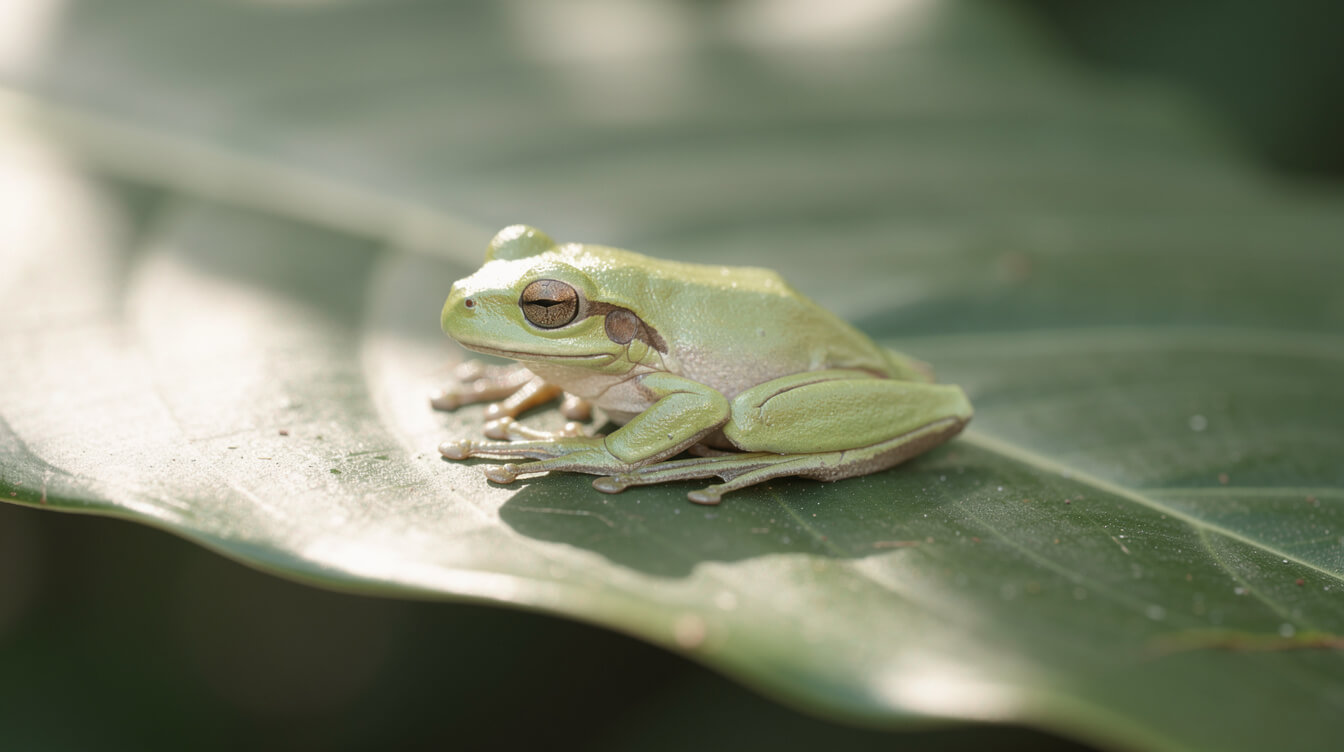
In December 2022, a team of researchers from Duke University and the American Museum of Natural History published a study in the journal Science that explained how the glass frog gets so clear. They watched Fleischmann’s glass frog, the northern glass frog, and noticed that the frogs were far more transparent while asleep than while awake.
The reason was the blood. When a glass frog settles in for its daytime sleep, it pulls nearly all of its red blood cells out of circulation and packs them into its liver. The researchers measured sleeping frogs as 34 to 61 percent more transparent than active ones. Using a technique called photoacoustic imaging, which detects tiny sound waves made when red blood cells absorb light, they found that a sleeping frog could hold about 89 percent of its red blood cells in the liver. Other tree frogs managed around 12 percent.
The liver itself swelled by roughly 40 percent to hold it all. In this species the liver is wrapped in a reflective layer, so the packed red cells are largely tucked out of sight. When the frog wakes, the blood flows back out, and it becomes visibly less transparent again.
Why this matters beyond frogs
In most animals, people included, crowding that many blood cells together in one place would cause dangerous clots. Glass frogs do it every single day and then release the cells again without harm. The study’s authors pointed out that nobody yet knows exactly how, and that solving it could help with understanding blood clotting in humans.
There is also the oxygen question. Red blood cells carry oxygen, and a sleeping glass frog has parked most of them. As one of the researchers put it, the frogs are basically not transporting very much oxygen for around 12 hours a day. How a small frog gets through a whole day on so little is one of the open mysteries scientists are still working on.
We love this part. It means the glass frog is not just born see-through. It actively puts itself away for the day, tidying its own blood into a cupboard, and then curls up on a leaf to rest. That is a very relatable kind of self-care.
Glass frog parents: patient, damp, and devoted

Glass frogs do not lay their eggs in water. During the rainy season, a male calls at night from a leaf hanging over a stream. When a female arrives, the pair mates right there on the leaf, and she lays a small clutch of jelly-coated eggs that stick to the leaf above the water. In the northern glass frog, a clutch is often somewhere around 18 to 30 eggs.
Mothers do a short, important shift
For years, scientists thought parental care in glass frogs was rare, and mostly a job for the fathers. Then two researchers, Jesse Delia and Laura Bravo-Valencia, spent six rainy seasons on night shifts at 22 streamside sites from Mexico to Peru, watching about 40 species. Their 2017 study in the Journal of Evolutionary Biology found that every species they watched cared for its eggs in some way.
In many species, the mother stays with her new eggs for up to about five hours after laying them, sitting on the clutch through the night and leaving around dawn. Her belly skin takes up water from the wet leaf, and she uses it to hydrate the jelly around the eggs, which swells and helps shield the embryos from predators and mold. A short shift, but a meaningful one.
Fathers take the long nights
In some species, the father takes over and stays for days, sometimes guarding several clutches from different females on the same leaf. He keeps the eggs damp in a way that is both practical and a little funny: he soaks up water, then, to put it plainly, pees on the eggs. He also stands guard. So-called frog flies are a real threat, since the flies lay their own eggs on the clutch and their larvae feed on the developing embryos.
The researchers concluded that this long father-only care grew out of the short maternal care, rather than appearing from nothing. Either way, the picture is the same: a very small frog, sitting very still on a wet leaf through long rainy nights, keeping watch. If a small green frog patiently showing up for someone is your kind of comfort, our Emotional Support Frog T-Shirt was drawn with exactly that steady, unbothered energy.
The drop
When the eggs hatch, often somewhere around 10 to 20 days later depending on the species and the weather, the tadpoles wriggle free and fall from the leaf into the stream below. That is the whole reason for the overhanging leaf. Down in the water, the tadpoles burrow into leaf litter and streamside debris, where they can spend months growing before they become froglets and climb back up into the plants.
The cutemerch letter
A small good thing, once a week
One short, kind email with our coziest posts and new round animals from the shop. No spam. Unsubscribe anytime.
Where glass frogs live, and how to see one gently

Almost every glass frog story comes back to running water. These frogs live in the plants along streams and small rivers in humid forests, and they are most diverse in the mountain cloud forests of the Andes and Central America. Some spend the dry months higher in the trees and come down closer to the water when the rains bring the breeding season.
Costa Rica alone has about 13 species, and Fleischmann’s glass frog is the most common one there. Panama, Colombia, and Ecuador are also famous for them. If you ever find yourself in one of these places, a guided night walk along a forest stream is the classic way to meet one.
A few kind habits for a glass frog night walk
- Go with a local guide. They know the streams, the calls, and the rules of the reserve, and your visit supports people who protect the forest.
- Look under and on top of leaves over the water. Glass frogs often sit right on a leaf above the stream, sometimes on the underside.
- Listen first. Calling males give themselves away with short, high chirps or whistles, depending on the species.
- Use a soft or red light, and do not linger in a frog’s face. A bright beam held on a tiny animal for a long time is not kind.
- Do not touch. Frog skin absorbs what it touches, including sunscreen and insect repellent, and the eggs and leaves are easy to disturb.
The good news is that a glass frog is perfectly happy to be admired from a respectful distance. Most of the joy is in the finding.

A small frog that keeps watch
One round frog in a cream badge on a soft black tee, with a single pink dot for a nose. Quiet, steady, and always there, a bit like a glass frog dad on the night shift.
Are glass frogs endangered? And can you keep one?

Many of them are in trouble. Of the glass frog species the IUCN has assessed, roughly half are listed as threatened to some degree, including around a dozen classed as critically endangered. Several others are so poorly known that nobody can say how they are doing.
The reasons are familiar ones for amphibians. Forests are being cleared for farms and roads, and a frog that needs one particular stream in one particular valley has nowhere else to go when that stream changes. Climate change shifts the cool, wet conditions cloud forests depend on. Amphibian disease has hit frogs across the Americas. And there is the pet trade.
The 2022 decision that protects every glass frog
In November 2022, at the CITES meeting held in Panama, countries agreed to list the entire glass frog family on Appendix II of the Convention on International Trade in Endangered Species. That means international commercial trade in glass frogs is now only allowed with permits showing it is legal and sustainable. The proposal was brought by a group of countries including Panama, Costa Rica, Ecuador, Peru, Brazil, Argentina, and the United States.
It was listed as a whole family for a very glass frog reason: the species look so alike that even experts often cannot tell them apart without close study, so protecting just a few would have left the rest wide open. The listing also means trade gets tracked, which matters because nobody had good numbers on how many glass frogs were being moved around the world.
The honest answer about glass frogs as pets
Glass frogs do turn up for sale, and it is easy to see why people want one. But we would gently steer you away. These are tiny, nocturnal frogs adapted to cool, humid streamside air, they do not enjoy handling, and many species have small wild populations that collecting can hurt. Even where trade is legal, it is hard for a buyer to know where a particular frog came from.
We have had the same honest conversation about otters as pets and about round African rain frogs: loving an animal does not always mean bringing it home. With glass frogs, the kindest kind of love is supporting the forests and the people who look after them, and saving your admiration for a night walk or a good photograph.
Glass frog FAQ

Are glass frogs real?
Yes, completely. They are a real family of tree frogs from Central and South America, with around 160 known species. The see-through belly photos you see online are genuine, not edited.
Is a glass frog poisonous?
Glass frogs are not known for the kind of strong skin toxins that poison dart frogs are famous for. That said, any wild frog should be left alone, both for its sake and yours, and you should never handle one with sunscreen or insect repellent on your hands.
Can you really see a glass frog’s heart beating?
In many species, yes. With the frog viewed from below, the heart is visible through the belly skin, along with other organs. How much you can see depends on the species, since some have more of their organs covered by a white reflective layer.
What do glass frogs eat?
Small invertebrates, mostly. Crickets, moths, flies, small spiders, and ants are typical, and some larger glass frogs will occasionally eat smaller frogs. They hunt at night, which is also when they call and breed.
How long do glass frogs live?
Honestly, it is not well documented for most species in the wild. You will see various figures online, but they are rarely traced back to solid studies, so we would rather say we do not know than guess. If you like lifespan questions, our piece on how long an axolotl lives has a much clearer answer.
Why are they called glass frogs?
Because of that window of a belly. When you see one from below, the translucent skin looks a little like frosted glass, with the organs showing through like shapes behind a shower door.
Are glass frogs related to other see-through animals?
No. Transparency evolved separately in many groups, especially in the ocean. Glass frogs are unusual because they manage it on land, and because they actively boost it while asleep by hiding their blood. If you collect animals that seem too odd to be real, you may also enjoy our guides to weird cute animals and the gloriously baggy Lake Titicaca frog.
Final thoughts
There is something quietly moving about the glass frog. It is small enough to sit on a coin, it lives somewhere misty and far away, and it spends its days doing something nobody fully understands: folding its own blood away to rest unseen on a leaf. Then at night it wakes, a little pinker, and gets on with calling, courting, and keeping its eggs damp through the rain.
The glass frog is a good reminder that the softest things are often the most clever. You do not need to own one to love it. Learn its name, tell a friend about the heart you can see beating, and if you ever get the chance to walk a cloud forest stream at night, look under the leaves. Somewhere up there, a very small frog is keeping watch.
Before you go
Want the next one in your inbox?
We write something soft every day. The best of it lands in one gentle weekly note, for you or for the friend who needs it.