

The Cozy Fall Aesthetic, for People Who Do Not Have a Farmhouse
The cozy fall aesthetic is the one everybody recognizes and almost nobody explains. You know it when you feel it: lamp light instead of ceiling light, a knit blanket that has given up its shape, the particular quiet of a gray afternoon when you have nowhere to be. Then you go looking for how to get it, and every guide hands you a porch, a mantel, a hearth, and a shopping list.
Most of us do not have a porch. We have one room, or a corner of one, and a lease that says no holes in the walls. So this guide takes a different route. We are going to look at what the cozy fall aesthetic is actually made of, which turns out to be texture, light, and small rituals rather than square footage, and then build it at the scale most people genuinely live at: one room, one desk, one wardrobe you already own. Very little of it costs anything.
What the cozy fall aesthetic is really made of, and it is not pumpkins

Here is the thing nobody says out loud. A pumpkin on a shelf is a signal, not a feeling. It announces the season without changing how the room acts on your body. You can fill a space with gourds and plaid and still find it slightly unpleasant to sit in, because the overhead light is the color of an office and there is nothing soft within arm’s reach.
What actually produces the feeling is a short list, and it is worth learning because once you know it you can build cozy anywhere, in any room, at any budget.
- Warm, low light. Not more light. Warmer light, placed lower.
- Texture you can reach. Something soft within arm’s reach of wherever you actually sit.
- Enclosure. A sense of being gently contained rather than adrift in open floor.
- Contrast with the outside. Cozy needs weather. The blanket means more when the window is cold.
- A small repeated ritual. The thing you do, not the thing you own.
Notice that four of those five are free, and the fifth costs the price of a lamp bulb. Notice also that none of them is a decoration. This is the quiet reason the big seasonal guides leave people unsatisfied. They sell you the vocabulary of autumn without the grammar of it.
Cozy is not a style you apply to a room. It is a set of conditions you arrange, and then the room does the rest.
If the aesthetic itself is new to you and you want the fuller background on where this sensibility comes from, our guide to what cottagecore actually is covers the roots. Autumn is simply cottagecore’s best season, the point in the year when the whole sensibility stops being aspirational and becomes genuinely practical. It is cold. You do want soup. The aesthetic and the weather finally agree.
The pumpkin spice problem
A quick word of reassurance, because it comes up. If you find the pumpkin and plaid version of fall a little tired, you are not failing at the season. The cliché exists because it is easy to photograph and easy to sell, not because it is the heart of the thing. You can skip every orange object in the world and still have the coziest room on your street. The heart of it is warmth and texture and the small sense of being taken care of, and those come in every color.
The four textures that do most of the work

If you only change one category of thing this autumn, change the textures. They are the engine of the cozy fall aesthetic. They do more per dollar than anything else in the room, and they are the most forgiving: a soft thing in the wrong color still feels good, while a correctly autumnal object that is hard and shiny still does not.
There are four kinds of texture worth understanding, and they are different from each other in a way that matters. Mix all four and a space reads rich and intentional. Use only one and it reads flat, no matter how much of it you buy.
1. Loft: wool and chunky knit
Loft is the air a fiber traps. A chunky wool knit feels warm not because wool is magic but because its structure holds pockets of still air against you, and still air is a genuinely good insulator. That is also why a thick open knit looks warm from across the room. You can see the air in it. One chunky throw over the back of a chair changes a room more than a whole shelf of seasonal objects, and it gets better as it slouches.
2. Nap: flannel, brushed cotton, corduroy
Nap is a raised, brushed surface, and its real job is light. A brushed fabric scatters light softly in every direction instead of bouncing it back at you, so flannel sheets and a corduroy cushion literally lower the glare in a room. This is why a flannel pillowcase feels cozier than a crisp cotton one even at the same temperature. It is softer to the eye before it is ever softer to the face.
3. Irregular weave: linen and raw cotton
This is the one people skip, and skipping it is why some cozy rooms still look a bit like a catalog. Linen has slubs, small thick spots in the yarn, and that irregularity reads to us as handmade and real. It keeps a soft room from going sickly sweet. Think of it as the dry note in the recipe. A washed linen cushion cover or a rumpled linen curtain adds the honesty that keeps all that softness believable.
4. Pile: sheepskin, boucle, fleece
Pile is the one you actually touch. It is deep, dense, and slightly absurd, and you need less of it than you think. One sheepskin on a desk chair or a small boucle cushion is plenty. Pile is the exclamation point of the texture world, which is to say use it once and then stop.
The rule of thumb that holds all of this together: three textures minimum in any space you want to feel cozy, and at least one of them irregular. Two textures read as a hotel room. Four or more with one rough note reads as somewhere a person lives.
Cozy fall in one room, on a renter’s budget
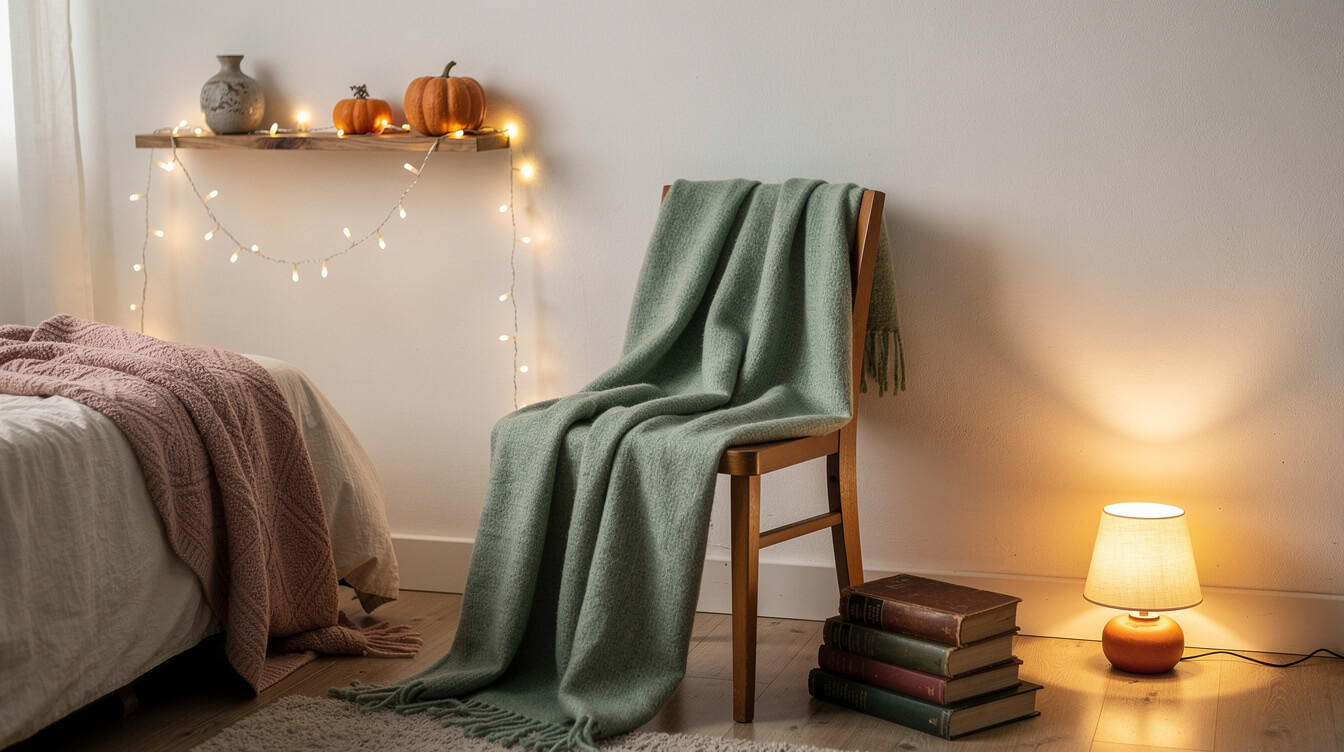
This is where the usual guides lose most of their readers, somewhere around the instruction to style the mantel. Let us assume you have no mantel, no porch, possibly no permission to put a nail in anything, and a budget in the range of nothing to forty dollars. That is a completely workable position. Here is the order of operations, best return first.
Kill the overhead light. This is free, immediate, and it is the single biggest change available to you. One ceiling fixture in the middle of a room casts hard downward shadows and flattens every texture you own. Turn it off. Then light the room from two or three low points instead: a lamp on a side table, a lamp on the floor behind a chair, a candle, a string of warm lights laid along a shelf rather than pinned to the wall. Light below eye level reads as evening and safety. Light above it reads as work.
Change the bulb color before you change anything else. If you buy one thing this season, buy a warm bulb. Look for 2700K or lower on the box, often labeled soft white or warm white. Anything at 4000K and up is daylight, and daylight at eight in the evening in October is the enemy of everything you are trying to do here. A warm bulb in an ugly lamp beats a cold bulb in a beautiful one, every time.
Build one corner, not a whole room. Pick the single place you already sit the most and make that one spot excellent. A chair, a blanket, a lamp within reach, a surface big enough for a mug, and something soft underfoot. A finished corner in an unfinished room feels calm. A room half decorated everywhere feels like a project you are behind on.
Make the window do the work. Autumn hands you a free view, and a window is the cheapest seasonal decoration in existence because the content changes by itself. Clear the sill, put one small living thing or one honest object on it, and leave the curtains open during the day so you can see the weather you are being cozy in contrast to. At night, close them. That shift from open to closed is a ritual in itself.
Then, and only then, add objects. Dried grasses in a jar. A stack of books lying down instead of standing. A bowl of apples you intend to eat. Thrifted anything, because secondhand objects arrive with texture and history already attached and they cost almost nothing in October when everyone is clearing out.
If the layering question is what you are really wrestling with, we went deep on the cute-but-not-cluttered balance in our guide to room decor that feels cozy rather than crowded, and the restraint principles there apply to autumn without modification.
Your desk is the easiest win in the house

If one room still feels like too much, start smaller. Your desk is roughly four square feet, you look at it for hours, and nobody needs to approve what you do to it. For a lot of people it is the highest-leverage surface they own, and it is completely absent from every fall aesthetic guide on the internet, which is strange given how much of autumn most of us now spend sitting at one.
A desk only needs four things to bring the cozy fall aesthetic down to its smallest workable size, and the whole operation takes about ten minutes.
- A warm pool of light. A small lamp at the side, warm bulb, aimed at the surface rather than at your face. Turn off anything overhead. This alone makes a five o’clock in November feel survivable instead of grim.
- One soft thing. A sheepskin or folded throw on the chair. Your back will notice within a day, and it is the difference between a workstation and a place you choose to be.
- A warm drink with a permanent home. A coaster or small tray that means the mug has a spot. Sounds trivial. It converts drinking tea from a thing you do into a small event with a stage.
- One living or once-living thing. A small plant, a sprig of dried leaves in a jar, three conkers you picked up on a walk. It brings the season indoors at a scale that fits.
Everything else is optional, and a desk gets cluttered faster than a room does, so be stingy. If you want the longer version of this with specifics, our piece on desk accessories that actually make a workday softer goes further into what earns its footprint.
The cutemerch letter
A small good thing, once a week
One short, kind email with our coziest posts and new round animals from the shop. No spam. Unsubscribe anytime.
Dressing for it, the autumn cottagecore wardrobe you already own

Here is the gap in every fall aesthetic guide out there. They all treat autumn as something you display and never as something you wear, which is backwards, because you spend the season inside your clothes and only occasionally looking at your shelves. Your wardrobe is the part of the aesthetic that travels with you to work, to the bus, to someone else’s cold apartment.
The good news is that the same four textures that build the cozy fall aesthetic in a room do the same work on a body, and you almost certainly own them already. Autumn dressing in this register is not a shopping problem. It is an assembly problem.
The basic formula is three layers in three different textures, in a palette that stays quiet:
- Next to skin, something soft and plain. A cotton tee, a thin knit, nothing with a message competing for attention.
- Over it, something with loft or nap. An oversized cardigan, a flannel shirt worn open, a brushed overshirt.
- Below, something with visible texture. Corduroy, a heavy cotton, a skirt with real weight to it. Denim counts.
- Then one rough note. Thick oatmeal socks, worn boots, a scarf that has clearly been washed a hundred times.
Keep the colors within about three steps of each other and let the textures provide the interest instead. Cream, oatmeal, rust, moss, soft brown, dusty rose. If two pieces are fighting, it is almost always because they are the same texture in different colors, which is the one combination that never settles.
The soft plain layer underneath is where a good t-shirt earns its keep, and it is worth owning one you actually like, since it is the piece doing the most work and getting the least credit. Our Kawaii Prickly Hedgehog Approach With Care t-shirt is the one we reach for in October, partly because the hedgehog is the correct autumn animal, prickly on the outside and entirely soft about it underneath, and partly because it sits quietly under a cardigan and then turns out to be charming when the cardigan comes off.
For the full wearable version of this, including what to do about the corset question and how to layer through a whole season, we wrote both a beginner’s guide to cottagecore clothing and a softer, more practical take on cottagecore outfits for ordinary days. This section is the autumn-specific layer on top of those.

The soft layer underneath it all
The Kawaii Prickly Hedgehog Approach With Care t-shirt is our autumn pick, prickly on the outside and entirely soft about it underneath. It sits quietly under a cardigan and is quietly charming when the cardigan comes off.
The small rituals that matter more than the decor

Ask people for their coziest autumn memory and almost nobody describes an object. They describe a sequence. Coming in from the cold and putting on dry socks. The ten minutes with a hot drink before anyone else is awake. The specific sound of rain while being indoors and not needing to go out.
Rituals are what turn a nicely arranged room into a season you actually felt. They are also, conveniently, free. A ritual needs only three parts to work: a trigger, a small sensory reward, and enough repetition that your body starts to expect it.
Rituals worth stealing
- The threshold change. Shoes off, warm socks on, immediately, every time you come in. It is a tiny ceremony that tells your nervous system the cold part is over.
- The first warm drink, undisturbed. One mug, no screen, however many minutes you can defend. This is the whole of autumn in one small act, which is why we gave the cozy mug ritual its own guide.
- The lamp round. At dusk, go around and turn the lamps on deliberately instead of flipping one switch. Thirty seconds, and it marks the change from day to evening.
- One walk in bad weather. Not a nice walk. A slightly unpleasant one, on purpose, because cozy is relative and you cannot feel the contrast without the cold.
- Something slow in the oven or on the stove. Soup, bread, apples, anything that fills the place with smell for an hour. Scent is the fastest route to the feeling and the one most people under-use.
- The Sunday reset. Wash the blanket, change the sheets to flannel, clear the one surface that always collects things. Cozy survives on small maintenance.
Pick two. Not six. A ritual you do twice a week beats five you abandoned by the middle of October.
Keeping the cozy fall aesthetic warm after the novelty wears off

Nobody writes this part, and it is the part that actually decides whether you enjoy your autumn. There is a reliable dip. The first cold week is delightful, the leaves do their thing, you light the candle, and then somewhere in the first half of November the novelty burns off. The leaves are down, the sky goes flat gray, it is dark at five, and the same room that felt like a refuge in October starts to feel like a waiting room.
This is not a failure of your decor. It is the predictable shape of the season, and you can plan for it.
Hold something back. Do not deploy everything in the first week of October. Keep one thing in reserve, the heavy blanket, the good candle, the flannel sheets, and introduce it in November when you need it. A season with something still coming feels different from one that peaked early.
Shift from visual to sensory. October cozy is something you look at. November cozy has to be something you smell, taste, and touch, because there is simply less to look at once the color outside is gone. This is the month for the slow stove, the heavier textures, the warmer bulb.
Let the palette drift darker and quieter. Trade rust and gold for deep brown, charcoal, forest, and cream. It sounds like a small thing. It stops the room from looking like it is still trying to be October.
Add one source of light at a time. As the days shorten, keep adding small warm points rather than turning up one big one. By December you might have five little sources going in one room, and it will feel better than any single bright lamp ever could.
Accept the gray. Honestly, this helps more than any object. A flat gray sky is not a defective autumn. It is the backdrop that makes a lit window worth sitting next to. The coziness was never in the leaves.
If you are thinking about this season for someone else as much as for yourself, our guide to cozy gifts for people who love slow, soft days is built on exactly these principles, scaled down to things that fit in a parcel.
Frequently asked questions about the cozy fall aesthetic
What colors make up the cozy fall aesthetic?
Warm neutrals first, with color used sparingly. Cream, oatmeal, and soft brown do the structural work, then one or two accents from the rust, mustard, moss, and dusty rose family. The common mistake is treating bright orange as the base color. It works far better as a small accent, or left out entirely in favor of texture.
Can you really do the cozy fall aesthetic in a small apartment?
Small spaces are easier, not harder. Enclosure is one of the core ingredients, and a small room gives you that for free. What a small space cannot absorb is clutter, so the approach is fewer objects and better light. One well-built corner beats a whole room of seasonal decoration.
How do I get the cozy fall aesthetic without spending money?
Turn off the overhead light, move your lamps lower, bring out the blankets you already own and leave them where you sit, clear one surface, open the curtains by day and close them at night, and cook something slow. That is most of the aesthetic, and the total cost is nothing. A warm bulb is the one purchase genuinely worth making.
Is cozy fall the same thing as cottagecore?
They overlap heavily but they are not identical. Cottagecore is a year-round sensibility about slowness, nature, and handmade things. Cozy fall is autumn’s version of it, with more emphasis on warmth, enclosure, and shelter from weather. If you like one you will almost certainly like the other, and autumn is when cottagecore is at its most believable.
How is this different from Halloween decorating?
Halloween is an event with a theme and an end date, and it works through novelty and a little bit of thrill. Cozy fall is a three-month mood that works through comfort and repetition. They sit happily side by side, but if you build the whole season around Halloween, the first week of November arrives and the room has nothing left to stand on.
How do I keep it from looking cluttered?
Count your textures, not your objects. Three or four different textures in a space will carry it, which means you need surprisingly few things. Before adding anything, ask whether it adds a texture or a function you do not already have. If the answer is no, it is just one more thing to dust in a room that already felt nice.
Final thoughts
The reason the cozy fall aesthetic is so appealing is also the reason it is so easy to get wrong. It looks like a collection of objects, so we go shopping for it, and then we end up with a seasonally correct room that somehow does not feel like anything. The feeling was never in the gourds. It was in warm light placed low, something soft inside arm’s reach, a window with weather behind it, and one small thing you do at the same time every day.
All of which is available to you in a rented room, at a desk, inside a cardigan, this week, for roughly the price of a light bulb. Start with the overhead light. Turn it off tonight and sit in the lamps for an hour, and you will understand the rest of this article better than we could explain it.
Then put the socks on. It is going to be a good season.
Before you go
Want the next one in your inbox?
We write something soft every day. The best of it lands in one gentle weekly note, for you or for the friend who needs it.




One Comment