

The Lake Titicaca frog: why the baggiest frog in the world is built that way
The Lake Titicaca frog looks like a frog that has borrowed a much bigger frog’s coat. Its skin hangs off it in soft, loose folds, draping over its legs and pooling along its sides, and the first reaction most people have is a small, fond laugh. Fair enough. But those folds are not a mistake or a sign of a frog that let itself go. They are the reason it can live where it lives: at the bottom of a cold lake nearly two and a half miles above the sea, breathing almost entirely through its skin.
This is a guide to that frog. What it is, why it is built the way it is, what its quiet life on the lake bed looks like, why it is in trouble, and who is working to help. It is also a small case for loving an animal that will never be called pretty, because some of the best-designed creatures on earth look like a sweater that went through the wash.
What is the Lake Titicaca frog?

The Lake Titicaca frog, also called the Titicaca water frog, is Telmatobius culeus, a fully aquatic frog found only in the Lake Titicaca basin on the border of Peru and Bolivia. That includes the great lake itself, which sits at about 3,800 meters (12,500 feet), plus the rivers that feed it and a few smaller connected lakes, where it has been recorded up to at least 4,250 meters (about 14,000 feet).
“Fully aquatic” is meant literally. It is a frog that has never been observed coming up for air in the wild. It spends its whole life underwater, mostly near the bottom, in water that usually sits between about 8 and 17.5°C (46 to 63°F) all year round. There is no damp-log phase, no sunny lily pad, no hopping across a garden. If a frog could be a homebody, this is the one.
How big does it get?
You will see some dramatic numbers online, so here is the honest version. In the late 1960s, an expedition led by Jacques Cousteau reported Titicaca frogs up to 60 centimeters (2 feet) long with their legs stretched out, and around 1 kilogram (2.2 pounds) in weight. That is where the “20 inches” figure on some fact cards comes from. It is a real report, but it measures a large frog fully extended, legs and all.
The more useful number is snout-to-vent length, which is how frogs are usually measured: from the tip of the nose to the base of the body, legs not included. The largest form of the Lake Titicaca frog typically measures about 7.5 to 17 centimeters (3 to 6.7 inches) that way, with an upper limit around 20 centimeters (8 inches), and usually weighs less than 0.4 kilograms. Frogs from shallower water, rivers, and smaller lakes tend to be smaller still. So it is a big frog, and one of the largest frogs that lives entirely in water, but it is not the biggest frog in the world. That title belongs to the goliath frog of West Africa.
What color is it?
Mostly gray, brown, or olive green on top and paler underneath, often with spots that blend into a marbled pattern. Frogs from the southern shores of the lake can have striped thighs and surprisingly bright orange bellies. Every bay seems to have its own slight variation, which makes sense for an animal that does not travel far.
Why the Lake Titicaca frog is so baggy: breathing through its skin
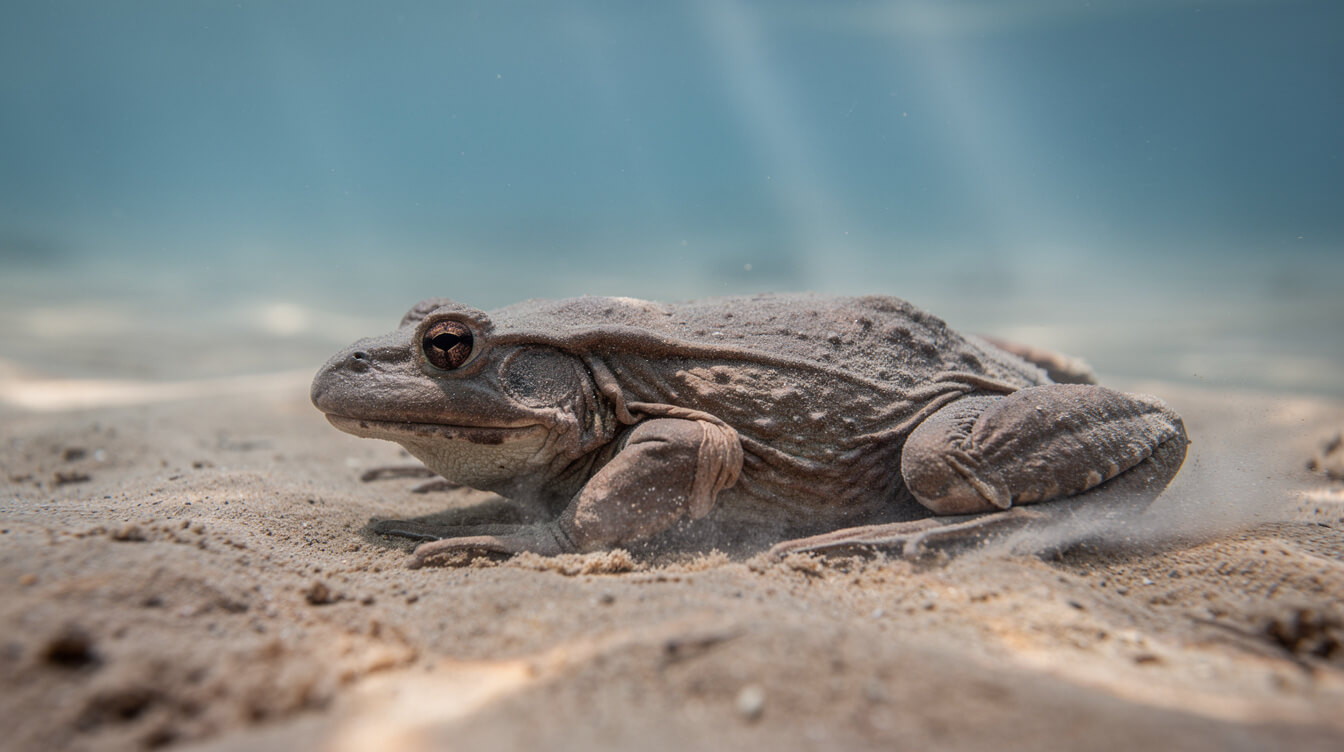
Here is the part that turns the joke into admiration. At the altitude of Lake Titicaca, the air is thin. Cold water holds oxygen well, but with so little air pressing down on the lake, there is simply less oxygen to go around than there would be in a lowland pond. A frog that wants to stay underwater full time at that height needs a very good way to collect what oxygen there is.
The Lake Titicaca frog’s answer is its skin. Frogs can absorb oxygen through their skin in general, but this one leans on it almost completely. Its lungs are tiny, roughly a third of the size you would expect in a frog its size. Instead, it has extra skin, and lots of it. Every fold adds surface area, and more surface touching the water means more oxygen can pass in. The folds work a bit like gills that have been spread out over the whole body.
The details that make it work
- Blood vessels right at the surface. The skin is packed with tiny blood vessels that reach all the way to its outermost layer, so oxygen does not have far to travel once it crosses in.
- Many small red blood cells. Among frogs, it has the lowest relative volume of red blood cells but the highest count. Lots of small cells rather than fewer big ones gives more surface for picking up oxygen, and its blood has a high capacity to carry it.
- A very slow life. Its metabolic rate is lower than that of any other frog that has been measured. It simply needs less oxygen than an active pond frog, so it does not have to work as hard to get it.
- Folds that are full, not empty. In a living frog, the folds are swollen with fluid, which is part of why it looks so soft and padded. If those folds were deflated, the frog underneath would actually be fairly thin.
Put together, it is an animal designed down to its cells for one specific, difficult place. The baggy look is the visible part of a very elegant system. If you have ever loved a frog mostly for its shape, as many of us do (our piece on why cute frogs are so hard to stop looking at gets into the round ones), the Lake Titicaca frog asks you to love one for its engineering instead.
One small, slightly awkward note. Because of all that loose skin, this frog picked up a rather cheeky nickname in some headlines, the “scrotum frog.” Scientists and journalists have used it to get attention for the species, and it has worked. We will leave it there and go back to calling it by its proper name.
The push-up: what a Titicaca frog does when the water runs low on oxygen

Skin breathing has one weakness. The water right against the skin slowly runs out of oxygen, especially if the frog is sitting still on the bottom, which is mostly what it does. A fish solves this by moving water across its gills. The Lake Titicaca frog has a charming solution of its own: it does push-ups.
When it needs more oxygen, the frog bobs its body up and down, sometimes pushing up on its legs, so that fresh water flows past its skin folds. The movement stirs the thin layer of used water away and brings new, oxygen-carrying water in. Researchers who study the frog’s breathing describe the bobbing as a way to ventilate the skin, so it is a real breathing behavior and not a frog doing its morning exercises, however much it looks like one.
In captivity, frogs in poorly oxygenated water have also been seen rising to the surface to gulp air with their small lungs. In the wild, in the clear, cold lake it evolved for, that has never been observed. The frog stays down, does its gentle push-ups, and breathes through its coat.
Why this matters more than it seems
Breathing through your skin is a beautiful adaptation, but it also means everything in the water passes close to your bloodstream. A frog that absorbs oxygen so well also absorbs whatever else is dissolved around it. Keep that in mind. It comes back later in this story, when we get to what has gone wrong in the lake.
A day at the bottom of the lake: food, family, and a very slow pace

Life on the lake bed is calm. Adult Lake Titicaca frogs of the large form usually live deeper than 10 meters (33 feet), and Cousteau’s team filmed frogs and their tracks in the silt at 120 meters (about 400 feet), which is still the deepest record for any frog. Studies near the shore of Isla del Sol found adults most often at 1.5 to 3 meters deep. They like a mixed bottom: mud or sand with a few rocks, or plenty of water plants with some stones to sit on.
They are most active at night. During the day, several frogs are often seen resting quietly side by side on the bottom, which is a lovely image if you think about it for a moment: a little row of baggy frogs having a nap high up in the Andes. They can also adjust their own temperature by moving between warmer and cooler spots, and adults sometimes climb onto underwater rocks to bask in the sunlight that reaches down through the clear water.
What does the Lake Titicaca frog eat?
Mostly amphipods, which are tiny shrimp-like crustaceans, and freshwater snails. It also eats insects and tadpoles, and adults regularly catch small native fish called Orestias, up to about 10 centimeters long. Larger frogs have occasionally been recorded eating smaller ones, which is less cozy, but frogs are frogs.
How it raises its young
Lake Titicaca frogs can breed at any time of year. They move into shallow water near the shore, where a female lays somewhere between about 80 and 500 eggs. Then the male stays and guards the nest site until the eggs hatch, which takes around one to two weeks. The tadpole stage can last from a couple of months to a year, and the young frogs stay in the shallows until they grow up and move to deeper water. They usually mature at about three years old.
There is one more sweet detail. Males call to each other underwater, mostly at night, near the shore. The call is so quiet it can only be picked up with an underwater microphone from close by. Their ears are much reduced, and scientists think they may hear partly through their lungs, as some other frogs do. A secret, nighttime frog song that almost nobody hears seems very fitting for this animal.
If you love the idea of a gentle, stay-at-home frog that mostly wants to be left alone in the quiet, our Emotional Support Frog T-Shirt is made for exactly that feeling: a calm little frog badge for people whose idea of a perfect day looks a lot like the lake bed.

A frog that stays calm at the bottom of things
A quiet, unbothered frog in a clean cream badge on a black tee. It will not do push-ups for you, but it will sit with you through a long week, which is its own kind of support.
The cutemerch letter
A small good thing, once a week
One short, kind email with our coziest posts and new round animals from the shop. No spam. Unsubscribe anytime.
Why the Lake Titicaca frog is endangered

The Lake Titicaca frog was once common. In the late 1960s, Cousteau’s team counted around 200 frogs in a single acre of the lake. Since then the species has declined sharply, by an estimated 80 percent or more in just 15 years, from 1990 to 2004. The IUCN Red List now classifies it as Endangered. You will still see it called Critically Endangered on many zoo pages and older articles, because that was its listing under an earlier assessment, but the current status is Endangered. That is a small improvement on paper, not a sign that the trouble is over.
There is no single cause. It is a few pressures stacking up at once.
Harvest for food and folk medicine
The frog is eaten locally, and it is also blended into a drink sometimes called frog juice, sold as a folk remedy for everything from tiredness to infertility. None of those health claims are supported by evidence. By the 2000s, tens of thousands of frogs were being caught each year for food and traditional medicine. Catching them is now illegal in both Peru and Bolivia, but some trade continues. It is worth describing this plainly rather than with disgust: it is a local tradition and a source of income, and the people working on conservation there are working with communities, not against them.
Pollution in the water it breathes
Remember the skin. Waste from mining, runoff from farming, and untreated sewage have all reached parts of the lake and its rivers. A frog that breathes through its skin absorbs those chemicals easily. Farm runoff can also feed algae blooms that use up the oxygen in the water, which is especially hard on an animal that cannot leave it.
That is the likely cause of the mass die-offs that have made the news. In 2015, thousands of dead frogs were found on the Bolivian shore of the lake. In October 2016, an estimated 10,000 were found along the Coata River, a tributary on the Peruvian side, and scientists believe pollution was responsible. There is one gentle note of hope here: in some affected areas, small frogs have later been seen returning, which suggests a stretch of water can be recolonized if it recovers.
Trout, and a disease that has not struck yet
Rainbow trout were brought to Lake Titicaca in the early 1940s to help local fisheries. They likely eat the frog’s tadpoles, frogs get caught in nets meant for trout, and trout farm pens overlap with the shallow water where frogs breed. The chytrid fungus, which has devastated frogs around the world, is also present in the region. So far it does not seem to have hit the Lake Titicaca frog hard, possibly helped by the cool, slightly alkaline water, but warming water could change that.
If this part of the story feels familiar, it is. The axolotl, another amphibian found in one high lake system and nowhere else, faces a very similar mix of pollution, introduced fish, and a shrinking home. We wrote about that in our gentle introduction to the axolotl, and the two make a good pair to read together.
Can you own a Lake Titicaca frog? Who is helping instead

It is a lovely thought, a big soft frog in a tank at home. The short answer is no, and the reasons are good ones.
- It is protected by law. Peru gave it full protection in 2014. Bolivia followed with protection from hunting between 2016 and 2017. Since 2016 it has been on CITES Appendix I, the highest level of protection under the international wildlife trade treaty, which bans commercial international trade.
- Any frogs on offer are almost certainly a problem. Peruvian authorities have seized thousands of illegally traded frogs. If you ever see one advertised as a pet, it is very likely part of that trade.
- Its needs are very specific. Cold, clean, oxygen-rich water, kept that way all the time, is not something a home tank does easily. The zoos that keep them have dedicated systems for it.
So the way to love this frog is from a distance, and the good news is that a lot of people are already doing that in useful ways.
The people and projects on its side
- Breeding programs. Early attempts to breed the frog in captivity failed for decades. Then, in 2010, Huachipa Zoo in Lima, Peru, succeeded, followed in 2012 by a breeding center in Cochabamba, Bolivia, supported by Berlin Zoo. In 2015, Denver Zoo received frogs from the Peruvian program and in 2017 and 2018 became the first place outside South America to breed them. Their offspring have since gone to other zoos in the US and Europe, building a safety net population. By early 2019 there were around 3,000 frogs at the breeding center in Peru and about 250 in zoos in North America and Europe.
- A frog on the money. In 2019, Peru issued a 1 sol coin featuring the Lake Titicaca frog as part of a series on endangered wildlife. Few frogs get their own coin.
- Former poachers, new work. Education projects around the lake have helped some people who used to catch frogs join a handicraft collective instead, which gives them a small alternative income.
- Looking without taking. A pilot project in 2017 explored snorkeling ecotours at Isla de la Luna, where the frog is still fairly common, so visitors could see frogs in the wild in a wetsuit rather than in a market.
- Cleaner water. In 2016, Peru and Bolivia pledged 500 million US dollars toward cleaning up the lake, including new water treatment facilities.
- Field researchers. Teams from both countries, along with universities and zoos abroad, are monitoring populations, studying the die-offs, and surveying isolated lagoons where frogs may still be hiding.
If you enjoy animals that are wonderful without being conventionally sweet, this frog has a lot of company in our collection of weird cute animals, all of them odd in ways that turn out to be clever.
Lake Titicaca frog FAQ

How many Lake Titicaca frogs are left?
Nobody has a reliable total, and it is better to say that than to guess. What we have are snapshots. A 2017 survey checked 38 locations, using three long strips of lake bottom at each, and found 45 frogs in total, at only 6 of those locations. That is not directly comparable to Cousteau’s count in the 1960s, but it gives a sense of how scarce they have become in many places.
Why is it called the Titicaca water frog?
Because it is one of the few frogs that lives entirely in water. “Lake Titicaca frog” and “Titicaca water frog” are the same animal, Telmatobius culeus. Its close relative, the marbled water frog, also lives in shallow parts of the lake but is semi-aquatic and lacks the dramatic folds.
Is the Lake Titicaca frog the biggest frog in the world?
No. It is one of the largest frogs that lives only in water, but the goliath frog of Cameroon and Equatorial Guinea is bigger. The Lake Titicaca frog’s real distinction is how it breathes, not how big it gets.
Was it really voted the ugliest animal?
It was a contender. In 2013, the Ugly Animal Preservation Society, a group that uses humor to draw attention to threatened species that do not get the cute treatment, ran a public vote. The Lake Titicaca frog was on the shortlist. The blobfish won. We would gently argue that both deserve a recount.
How long does a Lake Titicaca frog live?
In captivity, they have lived for up to 20 years. Nobody knows for certain how long they live in the wild.
Is it poisonous or dangerous?
No. If it is bothered, it can release a sticky whitish fluid from its skin as a defense, but it is not a threat to people. It mostly wants to be left alone on the lake bed.
Are there other frogs this unusual?
Plenty. If round and grumpy is more your style, the African rain frog lives underground and squeaks. And if you are shopping for the frog person in your life, our cute frog gift guide is a good place to start.
Final thoughts
It is easy to love an animal that already looks like a plush toy. The Lake Titicaca frog asks for something a little different. It asks you to look past a coat that is several sizes too big and see what the coat is doing: catching oxygen in thin mountain water, one fold at a time, while the frog does slow push-ups on the bottom of one of the highest lakes in the world.
It is a homebody that guards its eggs, sings songs almost nobody hears, and naps in rows with its neighbors. It is also an animal in real trouble, with real people working hard to help it, from breeding rooms in Lima and Denver to a craft collective on the shore. The Lake Titicaca frog will probably never be called pretty, and that is fine. Pretty was never the point. Being exactly right for where you live is a kind of beauty too, and this frog has it in every fold.
Before you go
Want the next one in your inbox?
We write something soft every day. The best of it lands in one gentle weekly note, for you or for the friend who needs it.




One Comment