What is kawaii? A warm guide to what the word actually means
What is kawaii? The quick answer is that it is the Japanese word for cute. The truer answer is that it is a feeling, a small set of design habits, and roughly a thousand years of people noticing little things and going soft over them. Translate kawaii as “cute” and you get the outline right while missing most of what is inside.
This guide is for anyone who has seen the word on a shirt, a shop tag, or under a photo of a very round bird, and quietly wondered what it covers. We will look at where the word comes from, the handful of visual rules that make something read as kawaii, how it differs from the English word, and why it works just as well on a forty-five-year-old as on a teenager. No famous characters required. By the end, you should be able to spot kawaii in a teacup.
What is kawaii, and why “cute” is not a clean translation
The word started with a blush. Its oldest ancestor is the old Japanese phrase kao hayushi, which means something close to “the face is aglow.” It described the warmth that rises into your cheeks when you are flustered or self-conscious. Over the centuries the phrase softened into kawayushi, then kawayui, and finally the modern kawaii, and its meaning drifted from “embarrassed” toward “lovable.”
The word picked up some revealing relatives along the way. Kawaisō, which grew from the same root, means pitiable, the feeling you have toward something that clearly needs looking after. In some regional dialects, forms of the word can still mean embarrassed, and in others they can mean splendid. That is a lot of emotional range for one little word, and every bit of it is still faintly present when someone says kawaii today.
Day to day, kawaii is usually written in the soft, rounded hiragana script as かわいい. It can also be written 可愛い, using characters chosen mostly for their sound that happen to read as “able to be loved.” It is hard to imagine a better accidental summary.
Where the English word falls short
English “cute” mostly describes how something looks. It can also be said with an eye-roll, as in “well, isn’t that cute,” which is not a compliment at all. Kawaii sits closer to a response than a description. It names the warm, slightly protective pull you feel toward something small, a little vulnerable, and harmless, and it is very rarely sarcastic.
That is why Japanese speakers use kawaii for things an English speaker would never call cute: an elderly man padding around in slippers, a clumsy bit of handwriting, a lopsided rice ball, a grown colleague who gets flustered when complimented. In our overview of cute aesthetics and how to find yours, we gave kawaii a short sketch. This is the long version.
The grammar of kawaii: round, small, soft, and asking nothing of you
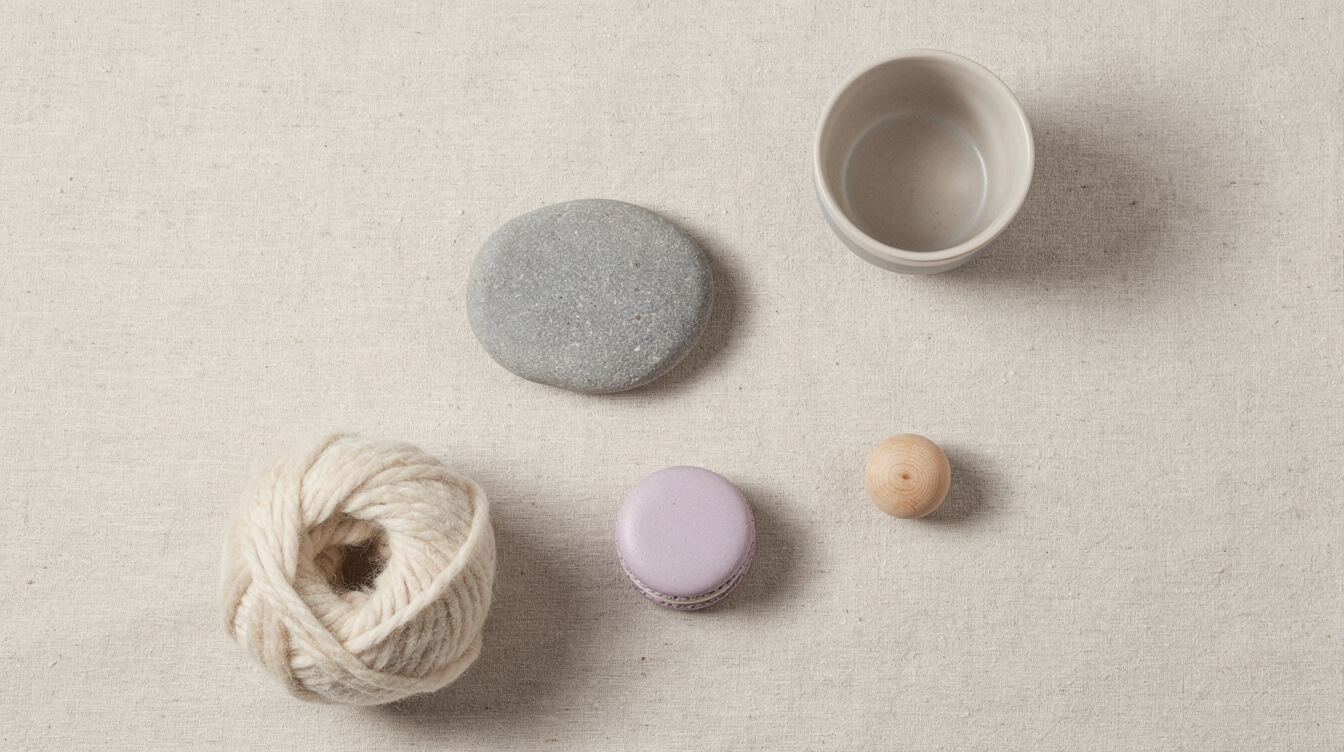
Most explanations of kawaii teach it through a roster of famous characters. That approach gives you a list of names, not a language. Here is the grammar instead: five rules that hold across stationery, food, clothing, signage, and real animals. Learn them and you will start seeing kawaii everywhere, including in things nobody designed on purpose. If you only keep one answer to what is kawaii, keep this one.
1. Round beats angular
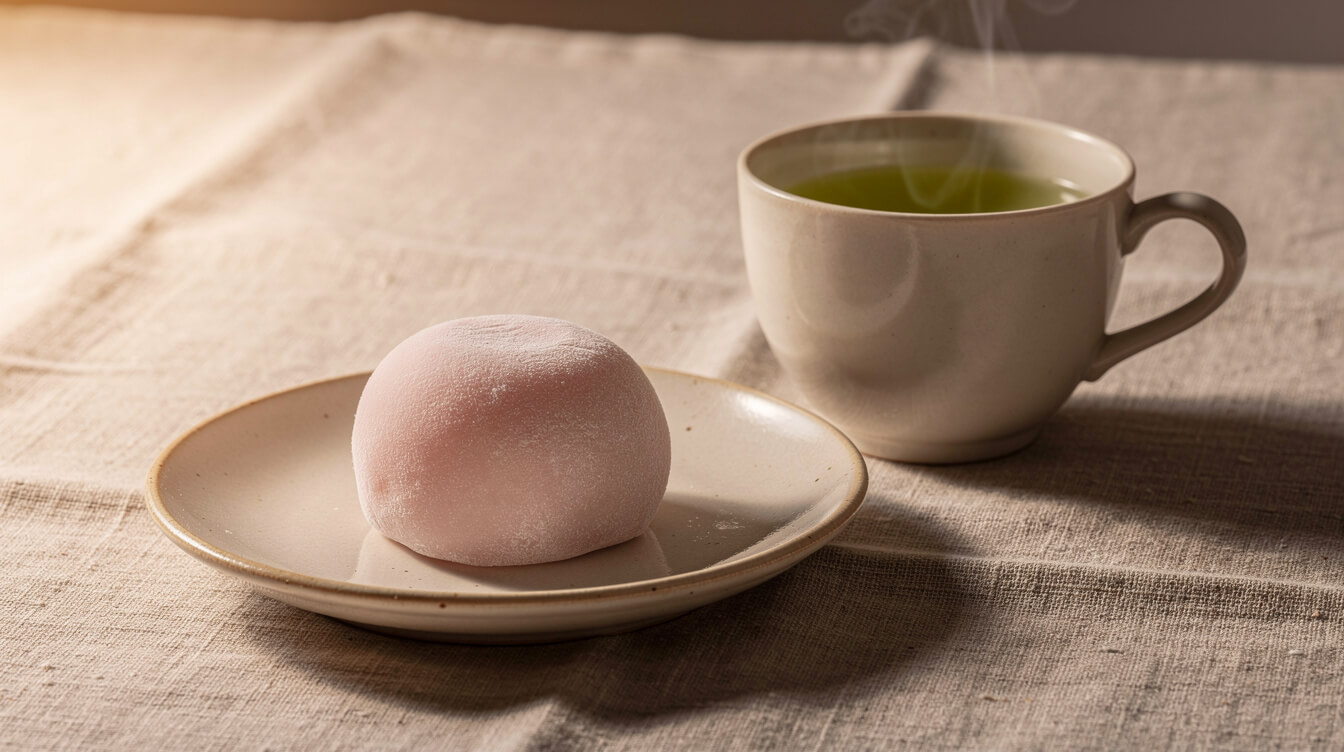
Corners read as hard, and curves read as safe. Given the choice between a corner and a curve, kawaii takes the curve every single time. A rice ball with its edges pressed soft, a bird puffed up against the cold, a sticky note with rounded corners. We wrote more about why roundness does so much work in our guide to the round animal t-shirt trend, but the short version is that round things look like they could not hurt anyone.
2. Small, and a little smaller than it needs to be
Kawaii loves miniatures: the palm-sized notebook, the tiny lunch with every item cut into a shape, the keychain version of an ordinary object. Large things ask for respect. Small things invite care. Shrinking something by even a third changes how we feel about it, and kawaii design uses that shift constantly.
3. Features low, close together, and few
Kawaii faces put the eyes low and wide, and keep the mouth tiny or leave it out entirely. This borrows the proportions of a baby’s face, which the brain is wired to go soft on. We unpacked that science properly in our piece on why weird cute animals win us over, so we will not repeat it here. What kawaii adds is ruthless simplification. Two dots and a tiny curve are often the whole face. Nothing gets drawn that does not need to be there.
4. Soft color, soft texture, soft edges
The palette tends toward pastels or warm, gentle brights, and the line work is smooth and even rather than scratchy. There is often a small flush of pink on the cheeks, which is a lovely echo of where the word began. Textures lean fluffy, squishy, or matte. If you want to go deeper on the color side, our guide to what pastel aesthetic actually means covers why low-saturation color feels calming.
5. It asks nothing of you
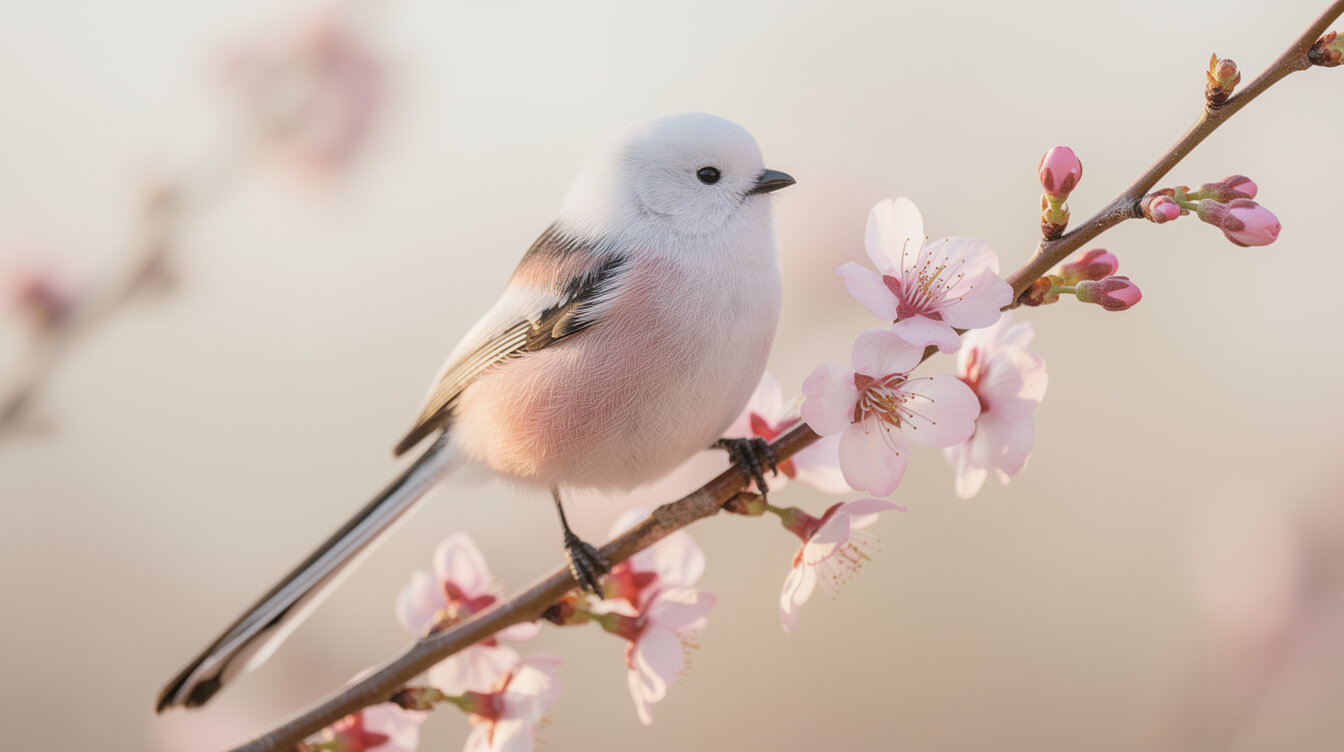
This is the rule most people miss, and it is the one that matters most. A kawaii face is calm, content, maybe a little sleepy. It is not winking, not selling, not demanding your attention. Think of a loud cereal-box mascot shouting at you from the shelf, then think of a small round bird sitting quietly on a branch. One wants something from you. The other is simply there, and lets you feel warmly toward it in your own time. Kawaii lives in that second space.
The teacup test
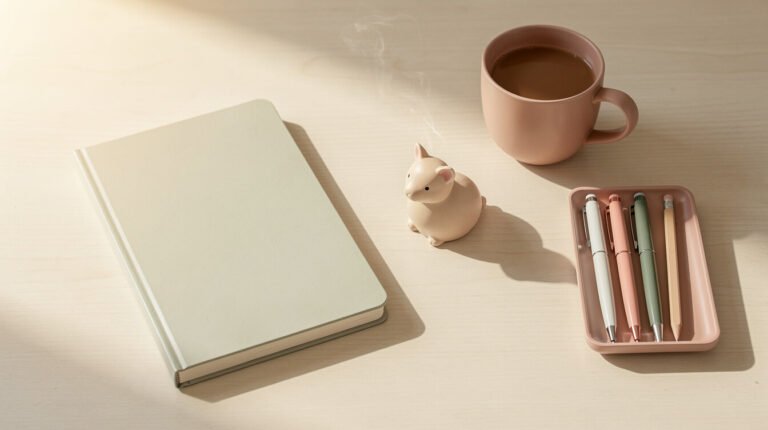
Take an ordinary straight-sided teacup. Give it a round belly. Shrink it slightly. Glaze it a soft peach. Paint two small dots and a tiny curve low on one side, and stop there. You now have a kawaii teacup, and you did not need a single character to get there. Remove any one of those steps and it becomes a little less kawaii. That is how you know it is a grammar and not a costume.
Where kawaii came from, briefly and warmly
Around the year 1000, a lady-in-waiting at the Japanese imperial court named Sei Shōnagon kept a notebook of observations we now know as The Pillow Book. One of its lists is devoted to endearing things. On it: a child’s face drawn on a melon, a baby sparrow that comes hopping over when you make a little squeaking sound, and a toddler who spots a tiny speck of dust while crawling and holds it up in small fingers to show the grown-ups. The vocabulary was different then, but the instinct is word for word the same one we are talking about. People have been writing down small, sweet things for a very long time.
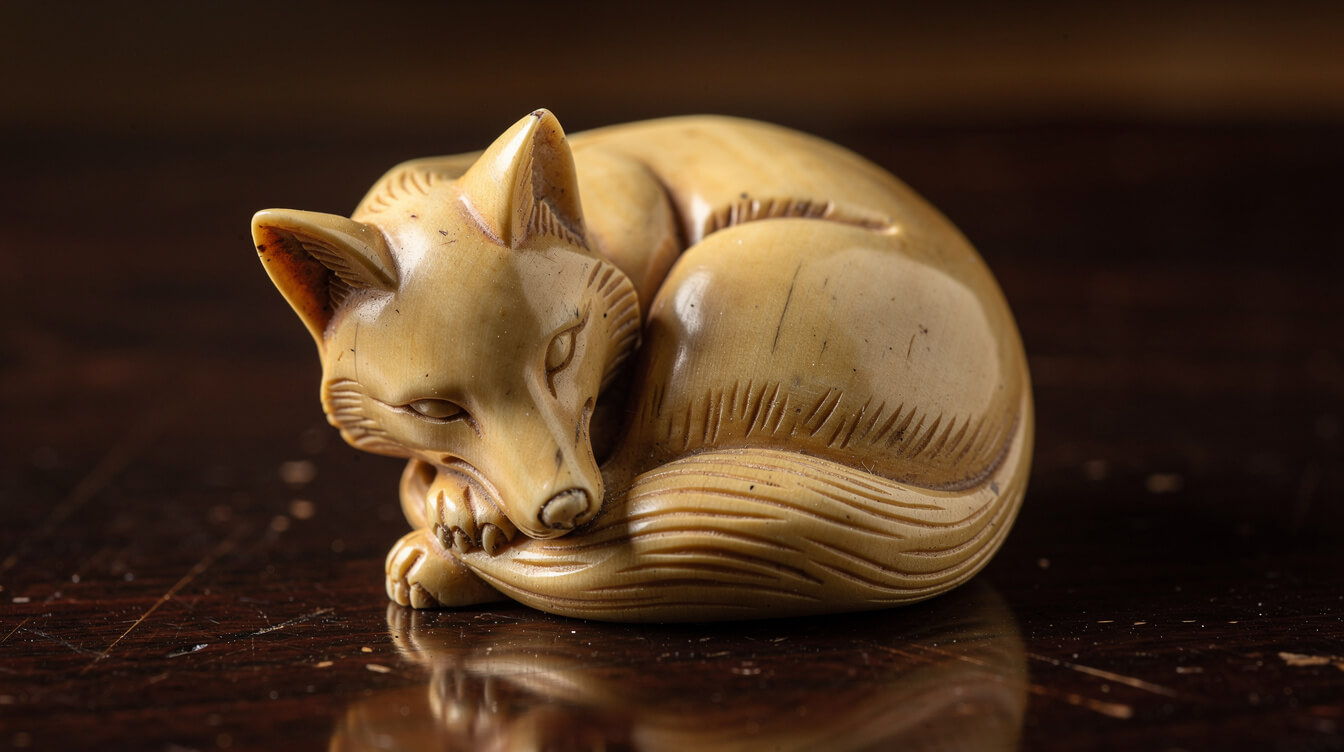
Some historians also point to the Edo period and its netsuke, tiny carved toggles used to fasten pouches to a kimono sash. Many were animals, often curled up asleep, small enough to hold in a closed hand. Round, small, quiet, and asking nothing: the grammar was already there in boxwood and ivory.
A handwriting that teenagers invented
The modern story really belongs to girls. After girls’ secondary schools spread across Japan from 1899, a youth culture grew up around girls’ magazines, with gentle, big-eyed illustrations and a sensibility of its own. Then, in the 1970s, teenage girls did something wonderful. They started writing sideways with fine mechanical pencils in big, round letters, decorated with little hearts and stars. It was called marui ji, “round writing,” and sometimes koneko ji, “kitten writing.”
Many schools banned it for being hard to read. A researcher who studied it in the mid-1980s concluded that the girls had invented it themselves, rather than copying it from comics. We love that detail. Kawaii as a mass style was not handed down by a company. It began as a handwriting teenagers made up and adults tried to stop.
From pencil cases to the whole world
By the 1980s, magazines, stationery makers, and packaging designers had adopted the round, soft look, and it spread onto every kind of small everyday object. In the 1990s and 2000s it moved into street fashion, which we cover in what kawaii clothing actually means. By 2009, Japan’s foreign ministry was appointing young “kawaii ambassadors” to represent the country abroad, and the internet carried the look everywhere else. What survived all of that travel is not any particular face. It is the grammar.
Cute vs kawaii: what is kawaii doing that cute is not

One of the most popular pages on this whole question is a forum thread simply asking what the difference is between cute and kawaii. It exists because most explanations never answer it in plain English, so here is our attempt.
- Cute describes. Kawaii responds. Cute is a quality something has. Kawaii is closer to the feeling it gives you, the soft “aw” that comes with a small urge to look after it.
- Cute can be sarcastic. Kawaii almost never is. You can call a bad idea “cute.” Kawaii carries no sneer.
- Kawaii makes room for imperfection. It covers the clumsy, the scruffy, and the slightly odd, as long as they are also small and harmless.
- Kawaii applies to people and behavior. A grandparent being sweetly fussy, a friend who gets shy, a dog trying very hard. English would reach for “sweet” or “endearing” instead.
- Kawaii is also a style. You can describe a design as kawaii in the same way you would call one minimalist. “Cute” does not really work as a design movement.
Creepy cute and ugly cute
The clearest proof that kawaii is bigger than cute is that Japanese has compound words for its odd corners. Kimo-kawa means creepy cute. Busa-kawa means ugly cute, and is usually said with real fondness about something like a squashed-faced dog. These words exist because kawaii can stretch over things that are a bit alarming, as long as the grammar is present. English mostly has to borrow phrases to say the same thing.
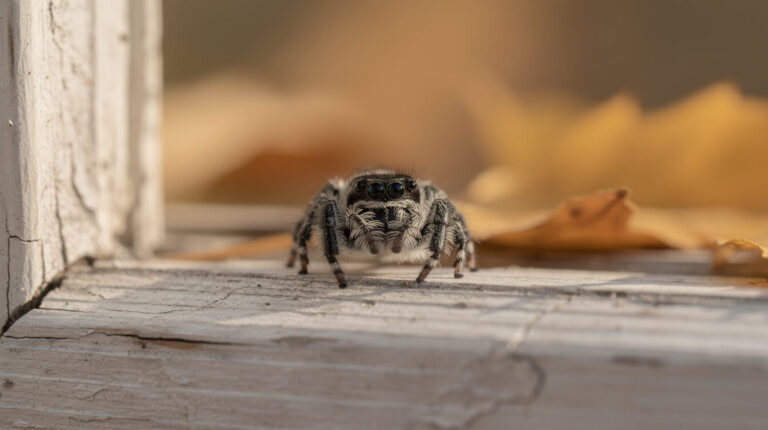
Jumping spiders are our favorite example of kimo-kawa. A real one is fuzzy, round-bodied, about the size of a fingernail, with two enormous front eyes, so the grammar is already half there before any designer gets involved. Our Cute Jumping Spider Kawaii Jump For Joy T-Shirt finishes the job: rounder, pinker, a little blush, and a creature most people flinch at suddenly reads as pure delight. It is a small lesson in kawaii grammar that you can wear.
So, in one line: in English, every kawaii thing is cute. But plenty of things English calls cute are not quite kawaii, such as a smirking cartoon, a sassy slogan, or anything with an edge to it.
The cutemerch letter
A small good thing, once a week
One short, kind email with our coziest posts and new round animals from the shop. No spam. Unsubscribe anytime.
Why kawaii works on grown adults

Underneath a lot of searches for what is kawaii sits a quieter question: is it alright that I like this, at my age? We want to answer that one directly, because nobody else on the first page of results does.
Start with the research. In 2012, a team led by the Japanese psychologist Hiroshi Nittono ran a set of experiments where people looked at photos before doing fiddly tasks, one of which involved picking tiny pieces out of holes with tweezers. People who had just looked at baby animals became noticeably more careful and precise than people who had looked at grown animals. Nittono went on to argue that kawaii is best understood as a social feeling, a warm pull to come closer and be gentle, rather than something only babies set off. That pull does not switch off at eighteen. If anything, adults are the ones who need it most.
Low-stakes tenderness
Grown-up life asks a great deal. Inboxes ask, bills ask, people ask. A small round bird printed on a mug asks for nothing at all. That is rule five doing its work, and it explains why so many adults keep one soft little thing on a desk at the office. It is a tiny pocket of tenderness with no obligations attached. If that sounds like you, our list of kawaii desk accessories that make a workday softer is a gentle place to start.
Kawaii is not age-restricted where it comes from
In Japan, kawaii is not filed under children’s things. It shows up on bank cards, public safety posters, train station signs, and construction barriers shaped like friendly animals. Adults there use it without embarrassment, because a gentle drawing on a notice simply makes the notice kinder to read.
So here is our position, said plainly. Cute is for everybody, at every age. Liking soft, round, gentle things is not a phase you were meant to grow out of. It is a small, sensible way to be kind to yourself in a world that is often louder than it needs to be.
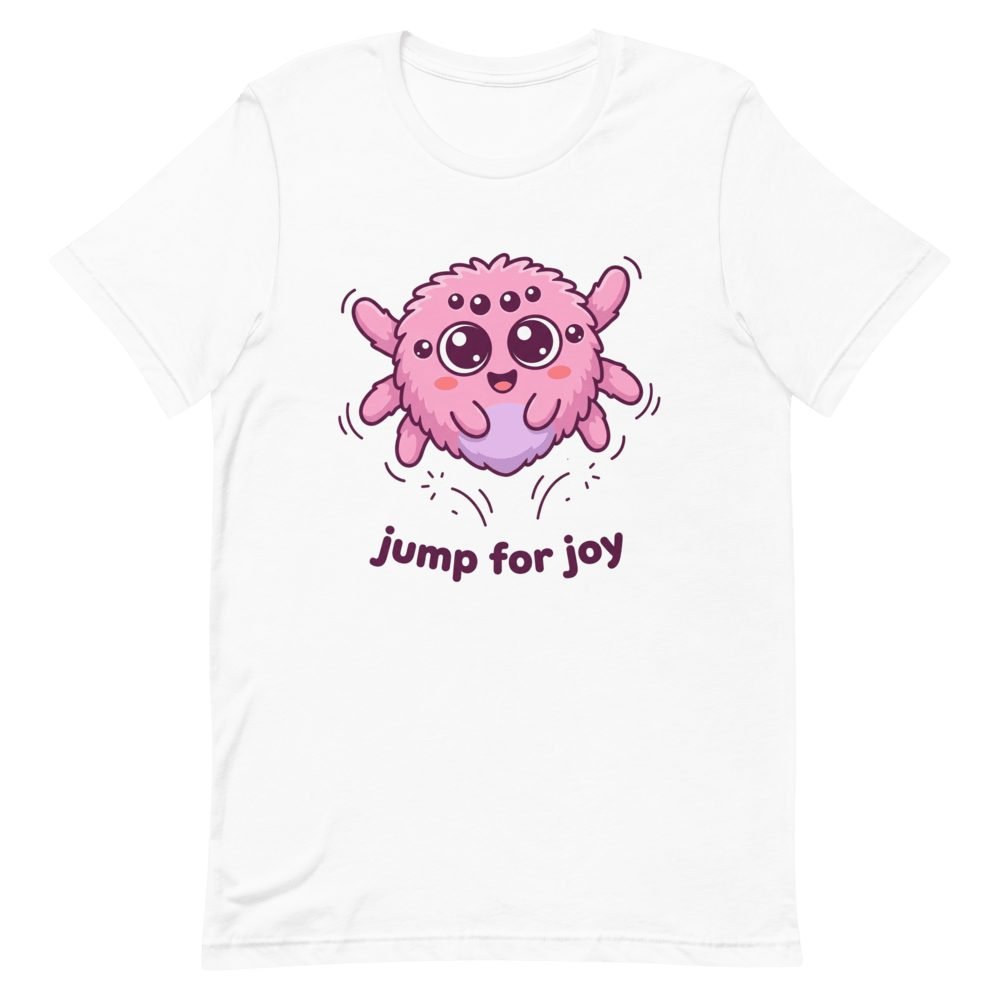
Cute Jumping Spider Kawaii Jump For Joy T-Shirt
A round, pink, very happy jumping spider, drawn in the kawaii grammar from top to bottom. Proof that the right shapes can make almost anything gentle, on a soft tee made to be worn often.
How to tell real kawaii from the cheap version
Once you know what is kawaii and what makes it work, it becomes easy to see why some cute things feel lovely and others feel thin. The cheap version tends to look adorable in a photo and sad in your hands. Here is what separates them.
Restraint
Real kawaii uses few elements and lets each one breathe. The cheap version piles everything on at once: glitter, three slogans, every motif in the catalog. If a design feels crowded, it has usually forgotten rule three.
A calm face
Look at the expression. If it is manic, leering, or trying too hard to be zany, the designer has missed rule five. Good kawaii faces are content, not frantic. Even an excited one, mid-jump, still looks happy rather than hungry for your attention.
Even, confident line work
Good kawaii line work is clean, smooth, and consistent in weight. Blurry edges, wobbly traced outlines, and jagged curves usually mean low-resolution clip-art stretched past its limits. You can often spot it from a meter away once you know to look.
Originality
If a design looks like a famous character with a few details nudged, it is a copy, and copies tend to be careless in other ways too. An original design is a much better sign that someone actually thought about it. The grammar is open to everyone, so there is no reason to borrow anybody else’s face.
Materials that hold up
Kawaii on a shirt that pills after three washes is not really kawaii anymore. It is just a sad shirt. Check the fabric weight and the print quality, and if you want your favorites to stay soft and bright, our guide on how to wash graphic tees so the design lasts covers the simple habits that help.
A last test that never fails: real kawaii is still charming the fiftieth time you see it. Cheap cute tends to wear out its welcome by the third.
Letting a little kawaii into an ordinary day
You do not need a themed room or a new wardrobe to enjoy kawaii. The grammar works best in small doses, one soft thing in each place you spend time.
- On your desk: one small, round object that asks nothing of you. A pastel pen cup, a tiny plant, a palm-sized notebook.
- In your bag: something that makes you smile when you reach for your keys. Our guide to kawaii accessories worth actually carrying around has ideas that hold up to real life.
- In your room: a single soft corner rather than a full makeover. See kawaii room accessories that make a space feel like a hug and kawaii room decor that feels cozy, not cluttered.
- In your wardrobe: one gentle design on a good shirt, worn with everything else you already own.
- For a friend: a small soft thing chosen for their particular kind of cute. Our kawaii gift guide for your best friend sorts the options by personality.
Keep your own list of endearing things
Our favorite way to practice kawaii costs nothing. Borrow Sei Shōnagon’s habit and start a little list of endearing things you notice: a sparrow puffed into a ball on a cold morning, a dumpling that came out lopsided, a dog asleep with one ear inside out. You will be surprised how quickly you start seeing the grammar everywhere, and how much softer an ordinary day gets once you are looking for it.
If you feel like going fully old school, try writing a note to a friend in big, round letters with a small heart in the corner. It is, after all, how the whole thing started.
Frequently asked questions about kawaii
What is kawaii, in one sentence?
Kawaii is the Japanese word for the warm, protective feeling that small, soft, harmless things bring out in us, and for the design style built to bring that feeling out on purpose.
How do you pronounce kawaii?
Roughly “kah-wah-ee,” three soft beats with a long “ee” at the end. It is not “ka-why.”
Is kawaii the same as anime style?
No. They overlap, but kawaii is older and much broader. It shows up in stationery, food, handwriting, public signs, and clothing, and plenty of animation is not kawaii at all.
Does something need a character to be kawaii?
Not at all. That is the whole point of the grammar. A teacup, a font, a rice ball, or a real bird can all be kawaii without a single named character involved.
Is it alright to use the word if I am not Japanese?
Yes. The word is used warmly all over the world now. It is nicest when used with a little knowledge of where it comes from, which, having read this far, you now have.
Is kawaii only for girls?
It grew out of girls’ culture, and that history is worth honoring, but today it belongs to anyone who likes it. For a wider look at how kawaii sits alongside cottagecore, pastel, and the rest, see our guide to what cottagecore is and our overview of the cute aesthetics.
Final thoughts: kawaii is a way of looking
So, what is kawaii? A blush that became a word. A handwriting teenagers invented that turned into a design language. A handful of quiet rules: round, small, soft, few features, and asking nothing in return. And underneath all of it, a very old human habit of noticing small, sweet things and letting them make us a little gentler.
You do not need to buy anything or learn any character names to take part. You only need to notice. Somewhere in your day tomorrow there is a puffed-up bird, a lopsided dumpling, or a tiny round something waiting to be seen. When you spot it and feel that small warm pull, that is kawaii. It was there the whole time.
Before you go
Want the next one in your inbox?
We write something soft every day. The best of it lands in one gentle weekly note, for you or for the friend who needs it.